SpiderBot Prompts Laser Envy

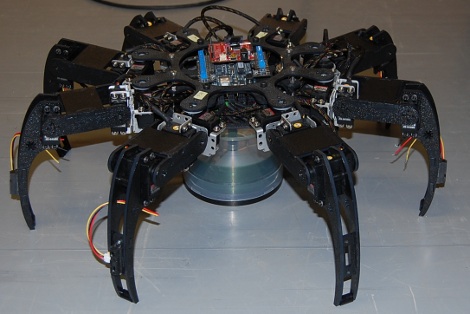
[Daniel’s] horrifying hexapod makes us wish we were sitting next to a laser cutter. The parts are cut from 4.9mm plywood and include laser-sculpted sections to allow the twenty servos to properly seat in their mounting spaces. We would suggest that you build it in secret so as not to ruin the surprise when your house mates come home to find this romping around their room.

Sadly, we couldn’t find video of this in action but go look at this other hexapod if the still shots aren’t good enough. Adding two legs to the party, you behold the video after the break of the 8-legged spider milled from ABS.

Continue reading “SpiderBot Prompts Laser Envy”

Robots In Space

[youtube=http://www.youtube.com/watch?v=nl6lZbyLkzs]

SPHERES (Synchronized Position Hold, Engage, Reorient Experimental Satellites) are experimental robots made at MIT for the purpose of testing robot locomotion in space. As you can see in the video above, they are capable of maneuvering pretty well. They seem to hold formation fairly tightly. They are using compressed CO2, through 12 different thrusters for positioning. They should be capable of autonomously navigating around each other as well as docking to one another.

Polymorph In Practice

[youtube=http://www.youtube.com/watch?v=gxy22VfZq0E&feature=player_embedded]

[Leesam] tipped us off to this cool tutorial for shaping Polymorph. For those who haven’t, it is pretty cool stuff. It is a plastic that comes in little pellets. You can melt it down at relatively low temperatures and mold it to the shape you need. We’ve seen it used on several projects, most notably CrabFu’s swashbot3. Generally, we see it hand shaped, so it is fairly organic and imperfect. It can be used for more precise shapes though. This tutorial walks us through the easiest way to produce sheets of the stuff to be cut and bent into brackets as well as some helpful tips on getting the best results.

The Pololu 3 Servo Hexapod

[youtube=http://www.youtube.com/watch?v=cqI-sDJTyuo&w=470]

Here’s a great tutorial on how to make a tiny hexapod walker. While this was written specifically for a kit that is sold by pololu, we like the simple layout. You could implement your own electronics if you prefer something else.  If you want to follow along with their components, you’ll end up with a fairly small and decently agile hexapod. Sure the legs aren’t articulated at every joint, but  the effect is workable. This is probably the first 3 servo walking hexapod we’ve encountered and we’ve seen a pretty decent amount of hexapods.

[Via HackedGadgets]

Robot Waits For No Man When Recharging

Yikes, that power connector certainly wasn’t designed by Apple. Ugly as it may be, it’s the charging cable for a robot and acts as a sensor that allows the robot to properly align and plug into a power receptacle.

We’re going to go off on a tangent for just a second. We often think of the Rat Things from Snowcrash when considering robot power. They were nuclear powered (or something) and instead of recharging required constant cooling. Those day’s aren’t exactly around the corner but we think they’ve been realized in the lawn mowing robots that have a little nests to recharge in. Base stations work but they require the machine to return to the same place, or to have multiple charging stations.

The point is, this specialized cable makes base stations for robots obsolete. Now a robot can plug into any outlet it can get near, a great thing for robots roving large facilities. After the break you can see a video of this process. The robot arm zeros in by scanning horizontally and vertically and measuring the magnetic field put out by the AC in the wires of the outlet. Take a look, it’s a pretty neat piece of engineering.

Continue reading “Robot Waits For No Man When Recharging”

Animatronics Reference

Anyone who is familiar with animatronics or even most robotics knows that almost every build is a hack if you don’t plan on reproducing it.  This gallery is to show off the work of [John Nolan]. However, instead of just posting the final product, he has posted several galleries that show, in detail, the internal structures. Curious how to rig a jaw or an eyebrow?  Wanna see the internals of an animatronic baby? How about building giant monster hands that are rugged and have full digit control? It’s all in the gallery.

LEGO Robot Lays Dominoes Not Eggs

[Mattias] brings the awesome once more with his LEGO robot that sets up dominoes. You’ll remember his work from the wooden keyboard case and the mechanical binary adder. This time around he’s still exercising those woodworking skills by making his own domino tiles, but it’s the robot that makes this interesting. In the must-see video after the break the device lays perfectly straight, perfectly spaced dominoes just begging to be upset by a spoiled toddler. The robot is nothing more than handful of LEGO parts powered by a tape deck motor. The parts may be meager, but there’s an abundance of ingenuity tied up in the design.

Continue reading “LEGO Robot Lays Dominoes Not Eggs”