Gentle Introduction To White Light Interferometry

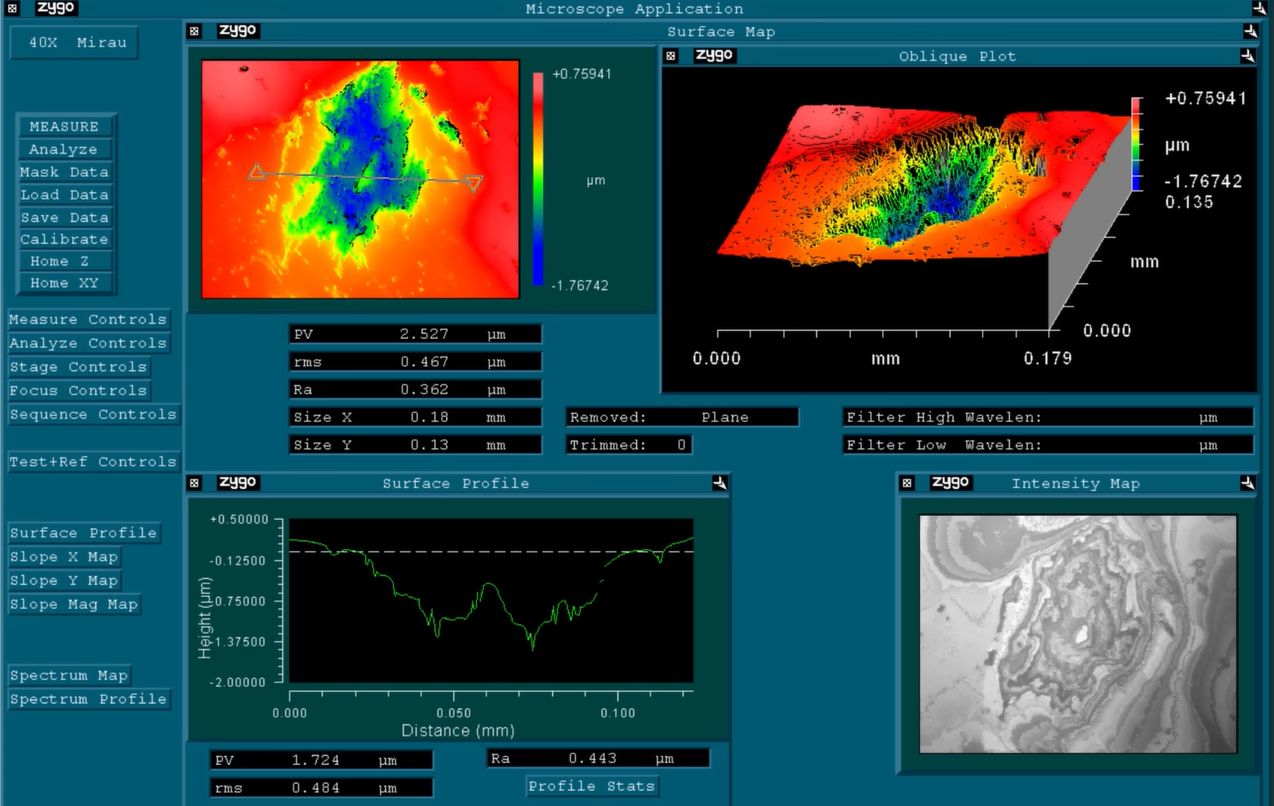
Screenshot of the Zygo white light interferometry microscope software. (Credit: Huygens Optics)

White light interferometry (WLI) is a contact-free optical method for measuring surface height. It uses the phase difference between the light reflected off a reference mirror and the target sample to calculate the height profile of the sample’s surface. As complex as this sounds, it doesn’t take expensive hardware to build a WLI microscope, as [Huygen Optics] explains in a detailed introductory video on the topic. At its core you need a source of white light (e.g. a white LED), with a way to focus the light so as to get a spatially coherent light source, like aluminium foil with a pin hole and a lens.

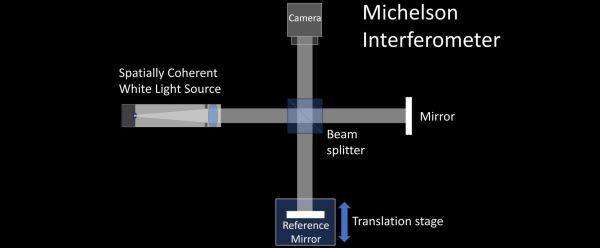
This light source then targets a beam splitter, which splits the light into one beam that targets the sample, and one that targets the reference mirror. When both beams are reflected and return to the beam splitter, part of the reflected light from either side ends up at the camera, which captures the result of the reference and sample beams after their interference (i.e. combination of the amplitudes). This creates a Michelson interferometer, which is simple, but quite low resolution. For the demonstrated Zygo Newview 100 WLI microscope this is the first objective used, followed by a more recent innovation: the Mirau interferometer, which integrates the reference mirror in such a manner that much higher resolutions are possible, down to a few µm.

Continue reading “Gentle Introduction To White Light Interferometry”
An Optical Computer Architecture

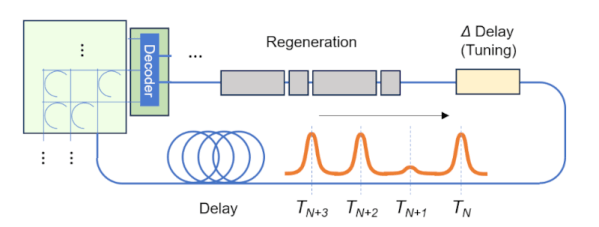
We always hear that future computers will use optical technology. But what will that look like for a general-purpose computer? German researchers explain it in a recent scientific paper. Although the DOC-II used optical processing, it did use some conventional electronics. The question is, how can you construct a general computer that uses only optical technology?

The paper outlines “Miller’s criteria” for practical optical logic gates. In particular, any optical scheme must provide outputs suitable for introduction to another gate’s inputs and also support fan out of one output to multiple inputs. It is also desirable that each stage does not propagate signal degradation and isolate its outputs from its inputs. The final two criteria note that practical systems don’t depend on loss for information representation since this isn’t reliable across paths, and, similarly, the gates should require high-precision adjustment to work correctly.

The paper also identifies many misconceptions about new computing devices. For example, they assert that while general-purpose desktop-class CPUs today contain billions of devices, use a minimum of 32-bits of data path, and contain RAM, this isn’t necessarily true for CPUs that use different technology. If that seems hard to believe, they make their case throughout the paper. We can’t remember the last scientific paper we read that literally posed the question, “Will it run Doom?” But this paper does actually propose this as a canonical question.

Continue reading “An Optical Computer Architecture”

3D Imaging For Natural Science — For Free

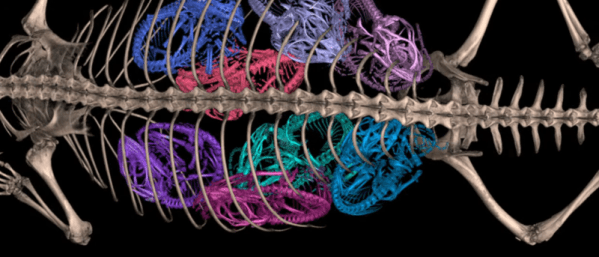
It isn’t that unusual for a home lab to have a microscope, but wouldn’t it be cool to have a CT scanner? Well, you probably won’t anytime soon, but if you are interested in scans of vertebrates — you know, animals with backbones — a group of museums have you covered.

The oVert project is scanning 20,000 specimens and making the results available to everyone. This should be a boon to educators and might even be useful for 3D printing animal forms. Check out the video about the project below.

Continue reading “3D Imaging For Natural Science — For Free”

Measuring Nanometers At Home

If someone asked you to measure a change in distance at about one ten thousandths of the diameter of a proton, you’d probably assume you would need access a high-tech lab. The job is certainly too tight for your cheap Harbor Freight calipers. [Opticsfan], though, has a way to help. You might not be able to get quite that close, but the techniques will allow you to measure a surprisingly small distance.

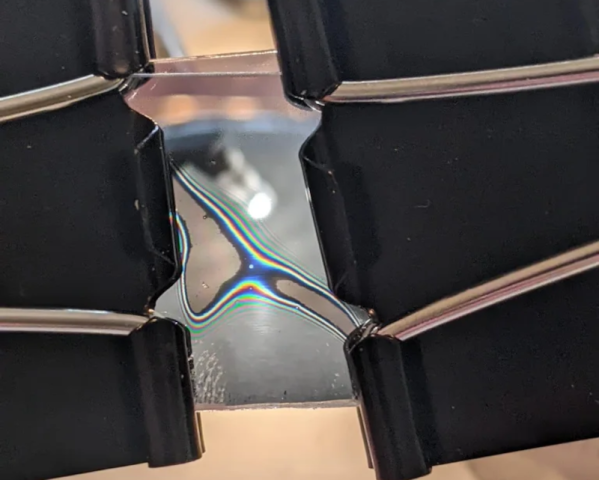
The technique requires a Fabry Perot cavity, an inexpensive spectrometer, and an online calculator to interpret the data. This type of cavity is two parallel mirrors facing each other with a slight gap between them. Light can only pass through the cavity when it is in resonance with the cavity. These have been around since 1899, so they aren’t that exotic. In fact, they are often used in laser communication systems, according to the post.

Continue reading “Measuring Nanometers At Home”

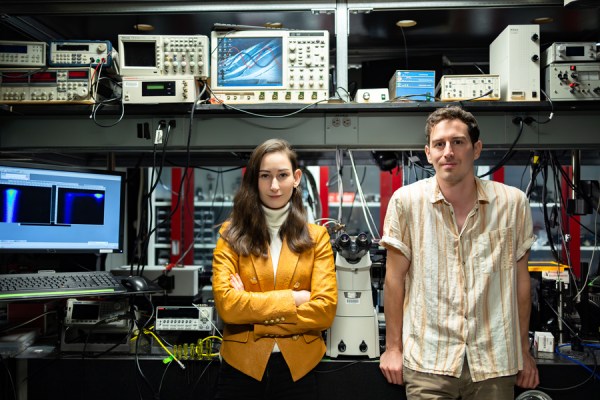
Team members Madeleine Laitz, left, and lead author Dane deQuilettes stand in front of a tidy lab bench equipped with oscilloscopes and computers. Laitz has a snazzy yellow jacket that pops compared to the neutrals and blues of the rest of the picture.

More Progress On Perovskite Solar Cells

Perovskites hold enormous promise for generating solar energy, with the potential to provide lighter and cheaper cells than those made from silicon. Unfortunately, the material breaks down too rapidly to be practical for most applications. But thanks to some recent research, we now have a better understanding of the nanoscale changes that happen during this breakdown, and how to combat it.

The research is focused on the topic of passivation, which seeks to increase the useful lifespan of perovskites by studying the surface interface where they meet other materials. Most of the perovskite material is a perfect latticework of atoms, but this structure is broken at the surface. This atomically “jagged” interface introduces losses which only get worse over time. Currently, the best way to address this issue is to essentially seal the surface with a very thin layer of hexylammonium bromide.

While this technique significantly simplified the passivation process when it was discovered, the effect had yet to be adequately characterized to further advance the field. According to lead author, [Dane deQuilettes], “This is the first paper that demonstrates how to systematically control and engineer surface fields in perovskites.”

Prefer to roll your own cells? How about a DIY dye sensitized cell or this thermionic converter model?

Avi Loeb And The Interstellar Lottery

Except for rare occasions, I don’t play the lottery. Like many of you, I consider state-run lotteries to be a tax paid only by people who can’t do math. That’s kind of arrogant coming from a guy who chose to go into biology rather than engineering specifically because he’s bad at math, but I know enough to know that the odds are never in your favor, and that I’d rather spend my money on just about anything else.

But I’m beginning to get the feeling that, unlike myself and many others, Harvard professor Avi Loeb just might be a fan of playing the lottery. That’s not meant as a dig. Far from it. In fact, I readily concede that a physicist with an endowed chair at Harvard working in astrophysics knows a lot more about math than I do. But given his recent news splashes where he waxes on about the possibility that Earth has been treated to both near misses and direct hits from interstellar visitors, I’m beginning to think that maybe I’m looking at the lottery backward.

Continue reading “Avi Loeb And The Interstellar Lottery”

DIY Geophone Build Performs Well

If you want to know what’s going on with the ground, geologically speaking, a geophone is a great tool to have. It lets you listen in on the rumbles and grumbles beneath your feet, and can give you great insight into matters of seismic importance. [mircemk] has designed a very capable geophone that’s simple enough for you to build at home.

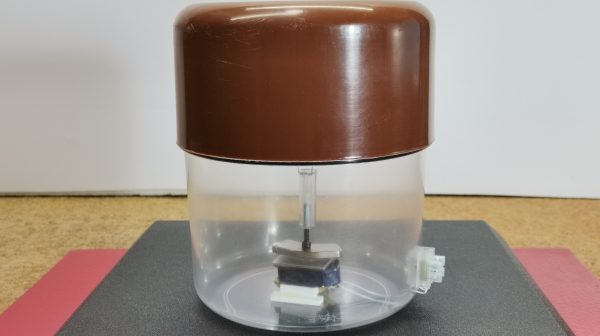
The geophone relies on a mass suspended upon a spring inside a chamber, which as you might imagine, will move when shaken by seismic vibrations. The mass is in fact a plastic rod, fitted with an iron nut and a magnet on the end.

This is mounted above a coil, which is fixed to the base of the chamber. Thus, when the chamber is shaken by seismic activity, the mass moves relative to the coil, with the coil picking up the varying magnetic field as it dances around.

The YouTube video does a great job of explaining the concepts involved and how to practically build the device. [mircemk] has also had some other great projects featured on Hackaday before, too.

Continue reading “DIY Geophone Build Performs Well”