Solar Tracking, Without Overkill

[youtube=http://www.youtube.com/watch?v=ATnnMFO60y8]

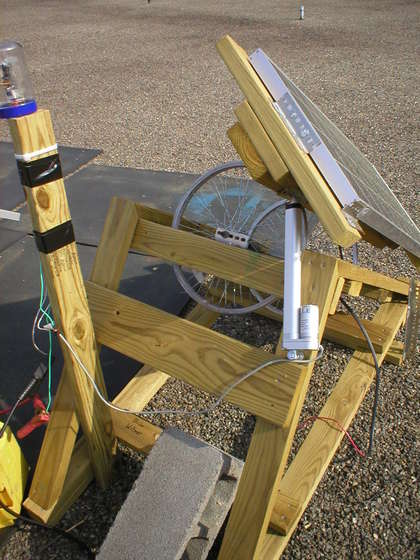
We saw this pretty smooth solar tracker run by an Arduino. There aren’t many details, but we can see that it works well, and is in fact, run by an Arduino. We knew if we posted this that people would be commenting that the Arduino is overkill. We agree.  So this post is to ask, how would you do it? Give us links to the more efficient designs you have come up with. It doesn’t have to be a fully documented project, a schematic will do. We would probably go with something like a phototropic suspended bicore for simplicity and low power consumption.

[via littlebirceo]

12kW Solar Collector

[youtube=http://www.youtube.com/watch?v=jTvAL7ty53M]

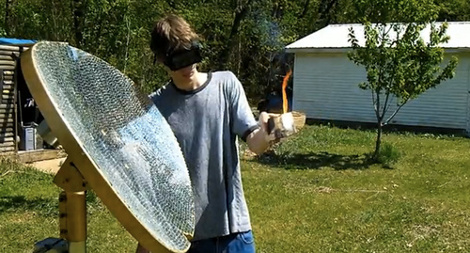
Though not much info is readly available about it on the web, [Joe Carruth] is trying to build publicity (and venture capital) for his home-built solar electric generator. At its essence, it is a Stirling dish system with an adjustable composite mirror surface. This means that instead of having to rotate the entire contraption in order to follow the Sun, [Joe] only has to make  the mirror segments pivot. A Stirling steam engine at the tip converts the energy into the movement used to generate electricity. Solar power plants (or ‘farms’) that are emerging are beginning to consider the advantages of using more efficient Stirling dishes rather than less efficient solar panels. If anyone has an idea as to how [Joe] can automate sun tracking for the mirrors, please post it in the comments. A couple more videos on the topic (in general) are available below: Continue reading “12kW Solar Collector”

DIY Solar Panels

solar

Reader [unangst] pointed out to us an article in the U.K.’s Daily Mail, where a teenager from Nepal had managed to create a 9v, 18W solar panel using human hair rather than the usual semiconductors (usually crystalline-silicon). The complex silicon in solar panels are what keep the prices out of reach of developing nations, and while there are a number of new technologies that are helping  bring down the cost, [Karki] managed to make his solar panel for only £23 (roughly $38). He also claims that when mass produced the price could drop substantially down to under $10 a panel, which would shatter the $1/watt sweet spot.

The melanin in hair acts as an organic-semiconductor, and while the hair does not have the longevity that silicon panels have (months rather than years), these panels can be made cheaply and serviced with little to no complex knowledge. Using melanin as an organic semiconductor seems to be a newer idea, because information seems hard to come by, but we managed to find a research paper from 2007 that explored the energy absorption attributes of melanin, as well as some good background info for the science types.

Research Paper (Warning: PDF)

So, Hack a Day readers, which one of you is going to make your home-brew solar panels first? Let us know when you do.

Thanks [unangst].

[digg=http://digg.com/environment/Teenager_Makes_DIY_Solar_Panels_from_Hair_Hack_a_Day]

Strobit Wireless Widget Project

strobit (Custom)

Strobit looks like it could be a project to keep an eye on. The entire project is open source, including the hardware. The aim is to build a low cost, low power, wireless enable arduino powered widget. This seems like it could really cut down on the development time of many projects we’ve seen here. Development is still ongoing but it looks like they’ve already implemented some mesh networking similar to the zigbee systems.

[via hackaday flickr pool]

Weather Canvas

weather

Another Cornell final project, Weather Canvas aims to make watching the weather a little more pleasant. Data is captured via a thermometer, humidity sensor, anemometer, and a Hotwheels radar gun turned precipitation sensor. Once it’s captured, it’s transmitted to the LED matrix inside which displays pretty patterns to convey the weather conditions. They have set images, like icons, that mean different things.

Radish – Eco Friendly Google Calendar

[youtube=http://www.youtube.com/watch?v=VyHaImmmkGs]

[Aaron] a google employee came up with an idea that would be good for the environment, as well as fun. The Radish is a solar powered display, updated from a google calendar, with extremely low power consumption. They are building this to be an indicator of the conference room schedule. When we first read this, we wondered just how much greener it could possibly be than printing a few sheets of paper. Then we read that they were going through six reams per day. wow. The Radish gets its power through a solar panel, and preserves it through some creative power saving modes and the fact that it has an LCD that only requires power to update. Would this be a good place for some E paper? Data is transferred using IEEE 802.15.4, which is slow, but also more efficient in terms of power than normal WiFi. The system is so efficient, it can run for 3-4 days in low light conditions after a charge . Another cool fact is that [Aaron] got to design and build this on company time. Google allows people to spend 20% of their time on innovative new projects of their choice.

correction: the LCD goes into an extremely low power “sleep mode” when not being updated, and retains the last image loaded.

Solar Cells From Donuts And Tea

[youtube=http://www.youtube.com/watch?v=bVwzJEhMmD8]

It sounds unbelievable, but it is true. You can harvest most of what you need for a simple solar cell from powdered donuts and tea. Powdered donuts have nanoparticles of titanium dioxide which is a “high band gap semi conductor”.  This means that it can be used to make solar cells. The tea is simply used to dye the material so it can pick up the visible spectrum. The process is a bit too involved to be something you would just toss together in the field, but it’s cute nonetheless.