Another Take On The Rear-window LED Marquee

re-window-led-display

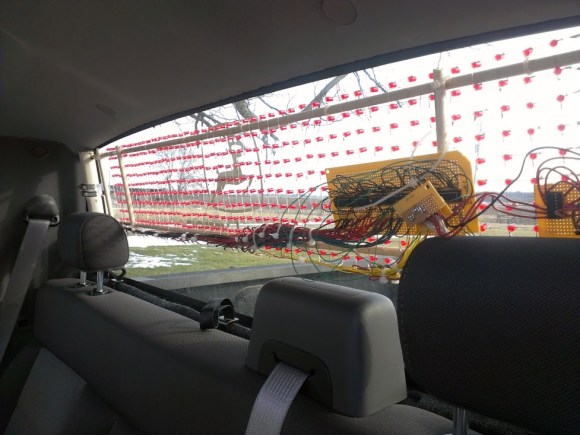
This rear-window LED marquee will help let the driver behind you know when you’re planing to change lanes or make a turn. But it also includes the ability to send a message like “Back Off!”. [Robert Dunn] was inspired to undertake the project after seeing the one we featured back in October. We’d say his has a better chance of being street legal since it uses all red LEDs.

The marquee is a matrix of 480 LEDs, all hand soldered to form the nearly transparent 48×10 grid shown above. This is important to preserve visibility out the back window of his truck. It makes us wonder about the feasibility of using SMD instead of through hole components. That would certainly make it even less visible when not illuminated, but the assembly process would be much more difficult. That’s because the 5mm LED packages fit nicely in the grid of holes he drilled in some plywood which served as the jig during soldering. The presence of leads also made the soldering process manageable.

Power to an Arduino board is provided from the cigarette lighter adapter. A set of six shift registers drive the columns while the rows are controlled by a 4017 decade counter and some transistors. Check out the blinker test video after the break to get a look at what this can do while on the road.

Continue reading “Another Take On The Rear-window LED Marquee”
A Very Dash-ing IPad Mini

iPad-mini-dash-install

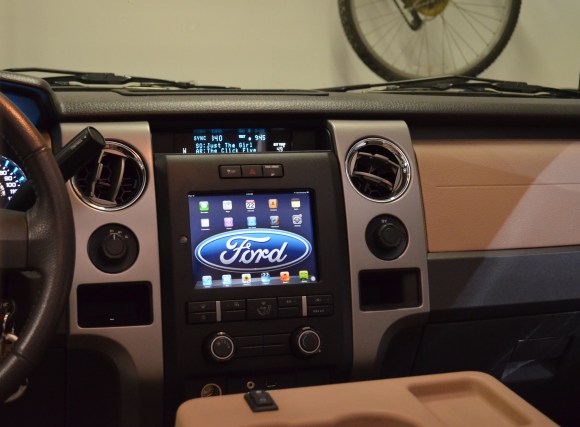
The work which [Mark] did to mount this iPad mini in the dashboard of his Ford truck is commendable. It looks like it came from the factory this way, and the functionality matches that illusion.

He actually started the project before he had the iPad mini on hand. A PDF that mapped out the exact dimensions was used as a template for the layout and alteration. He took the stereo controls out of the original faceplate. That opening was made to fit the screen by cutting, adding putty, then sanding and finishing.

Since the bezel won’t let [Mark] get at any of the buttons on the iPad itself he picked up an external home button on eBay and mounted it just to the left of the screen. Inside the dashboard a docking connector is responsible for powering the tablet and connecting it to the sound system. There’s even a WiFi connection thanks to the MiFi system he mounted in the overhead console.

Self-balancing Unicycle Using Arduino And Sparkfun IMU

Raptor-Bike-self-balancing-unicycle

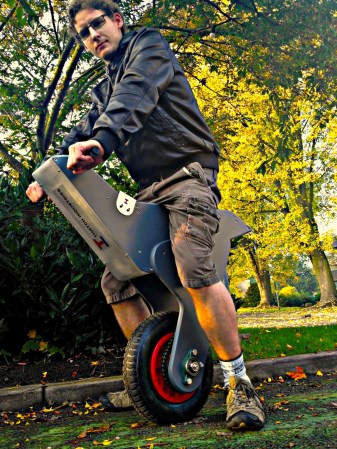
Here’s proof that you can build cool stuff with simple tools. This self-balancing unicycle uses an Arduino and a five degree of freedom IMU from Sparkfun to keep the rider upright. Well, it’ll keep you upright as long as you have good side-to-side balance. But that’s true of any unicycle, right?

The Raptor was built by [Nick Thatcker] who is no stranger to self-balancing transportation. A few years back he built a Segway clone and the same type of geared motor used in that project also went into this one. I connects to the wheel with a chain, allowing him to keep the motor hidden in the saddle. He gets between 90 and 120 minutes of used on one charge with a top speed of 10 MPH. The motor could move you along faster but he has limited this in firmware to ensure it has enough power to ‘catch up’ if you lean too far forward.

Don’t miss the demo after the break. If you like this unicycle there are several others worth looking at.

Continue reading “Self-balancing Unicycle Using Arduino And Sparkfun IMU”

Homemade Tank Joins The Battle In Syria

syrian-home-made-tank

What does a hacker do when going into battle for the freedom of their country? He builds a tank from scratch, of course. It’s a little bit of a stretch calling it a tank as it lacks treads. But it’s got a high-caliber gun mounted on top and has been heavily armored.

There is room enough inside for two people. What may look low tech in this picture is a different story from the cockpit. A pair of LCD monitors display images from five different cameras. You can see the shrouds that protect three of them on the front of the vehicle with a fourth acting as the rear view. A fifth camera mounted on the gun gives the passenger a look at where he’s aiming. A PS1 controller can rotate it and we assume has a fire feature as well. Check out the demonstration video embedded after the break.

Continue reading “Homemade Tank Joins The Battle In Syria”

Self Balancing Unicycle Built From Old Scooter

[Glenn] had an old electric scooter/motorcycle in his garage that had long ago given up the ghost. Without a working battery and motor controller this scooter wasn’t beyond repair, but [Glenn] thought he could use it to build something much, much cooler. What he came up with is a self-balancing unicycle that borrows inspiration from a Segway and other self-balancing robots.

After cutting the drive chain off his scooter, [Glenn] began work on installing a new motor controller and battery. To make this unicycle balance itself, he would need a few gyroscopes and accelerometers provided via an Arduino and Sparkfun IMU shield.

After tuning his PID loop, [Glenn] hopped on his new ride and took it for a spin with the help of a pair of ski poles. It’s much easier to ride than a traditional unicycle and [Glenn] says he’s getting better at riding it.

Porsche 911 Made Electric

[Kurt] wanted an electric car, and always wanted to drive a Porsche. Killing two birds with one stone, he decided to combine these wishes and convert a 2002 Porsche 911 into an electric vehicle.

After removing the engine, fuel tank, exhaust, radiator, and all the other things that make an internal combustion engine work, [Kurt] installed a high power motor, controller and 72 lithium phosphate batteries weighing in at over 500 pounds. He’s put over 300 miles on the car in the last few months while working out the kinks, but now he’s finally gotten the bugs out of the system allowing him to take it up to some relatively high speeds.

Already [Kurt] has taken his new ride to 100 mph and done a little bit of range testing that told him he should expect around 40 miles per charge in his new ride. It’s not exactly what he hoped, but more than enough for a few trips around town while riding in style.

After the break is a video [Kurt]’s first test drive of his electric Porsche.

Continue reading “Porsche 911 Made Electric”

Wristband RFID Unlocks Car Door And Starts Engine

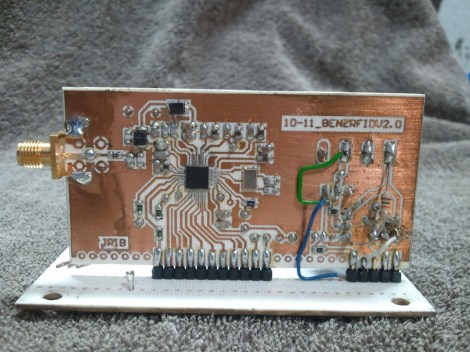
[João Ribeiro] is an electronics engineer by day, but in his free time he likes to ply his trade on everyday items. Recently he’s been integrating his own microcontroller network to unlock and start his car via RFID. In addition to the joy of pulling apart the car’s interior, he spent time designing his own uC breakout board and developing an RFID reader from a single chip.

He’s working with a 1988 Mercedes that has very little in the way of electronics. It sounds like the stock vehicle didn’t even include a CAN bus so the prelude to the RFID hack had him installing a CAN bus network made up of two microcontrollers. One reads the velocity and RPM while the other displays it on the tachometer. When he began the tag-based entry system he used an RFID reader module for prototyping, but eventually built his own reader around the TRF7960 chip. This included etching his own receiver coil which was mounted in the side-view mirror bracket. To unlock the doors he holds the bracelet up to the mirror and the vehicle lets him in. The video after the break starts with a demonstration of the completed project and moves on to some build videos.

We certainly like the idea of using a bracelet rather than implanting the tag in the meaty part of your hand.

Continue reading “Wristband RFID Unlocks Car Door And Starts Engine”