Using An Oscilloscope As A Composite Video Adapter

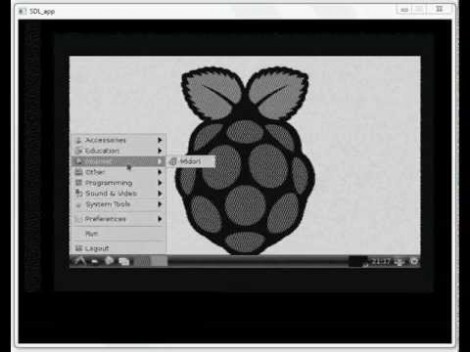
Confronted with a monitor that would display neither HDMI signal, nor composite video, [Joonas Pihlajamaa] took on a rather unorthodox task of getting his oscilloscope to work as a composite video adapter. He’s using a PicoScope 2204 but any hardware that connects to a computer and has a C API should work. The trick is in how his code uses the API to interpret the signal.

The first thing to do is make sure the voltage levels used in the composite signal are within the tolerances of your scope. [Joonas] used his multimeter to measure the center pole of the RCA connector and found that the Raspberry Pi board puts out from 200 mV to 2V, well within the PicoScope’s specs. Next he started to analyze the signal. The horizontal sync is easy to find, and he ignored the color information — opting for a monochrome output to ease the coding process. The next big piece of the puzzle is to ascertain the vertical sync so that he knows where each frame starts. He got it working and made one last improvement to handle interlacing.

The proof of concept video after the break shows off the he did. It’s a bit fuzzy but that’s how composite video looks normally.

Continue reading “Using An Oscilloscope As A Composite Video Adapter”
Moving An FPGA Project From VGA To DVI-D

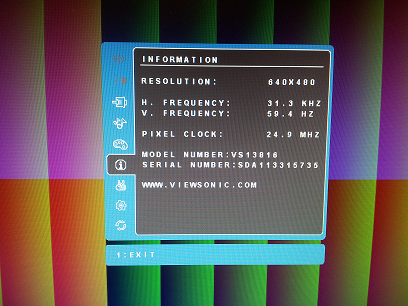
It’s fairly easy to create VGA with an FPGA using a simple R/2R DAC. As [Mike] points out, this requires a lot of IO pins, and many development boards only support 8 bit VGA. Analog VGA is being replaced with DVI-D and HDMI on many devices nowadays, so it would be nice to port projects from VGA to DVI-D.

To address this, he’s come up with a simple DVI-D implementation in VHDL. The result converts RGB and sync data for VGA into DIV-D. Since DVI-D and HDMI both use the same signals for video, this can be connected to either input on a monitor or TV.

This implementation is shown displaying a test pattern on the Pipistrello development board, which features a Spartan 6 LX45 FPGA, but the project was written to be portable to other vendor’s FPGAs. With the right connector and a fast enough clock speed, this project should help move a project from 8 bit VGA to glorious 32 bit color.

Digital Zoetrope Uses 18 LCD Displays

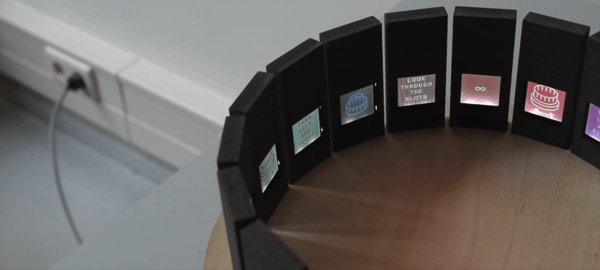
[Jasper] sent in a project he, [Quinten], and [Mr. Stock] have been working on for a while. It’s called the Pristitrope and brings the classic 19th centrury paper-based animation device into the 21st century with 18 LCD displays.

The lazy suzan portion of the build was fabricated out of plywood cut on a CNC router and fastened together with the help of a slip ring to transfer power between the stationary and spinning portions of the device. For the electronic part of the build, eighteen LCD displays were connected together on a data bus with each display independently addressable by a microcontroller.

One really interesting feature of the Pristitrope is its ability to detect if it is currently rotating clockwise or counterclockwise. While [Quinten]’s video doesn’t show off the full possibilities of this feature, the spin sensor makes it possible to always have an animation played in the right direction regardless of how the Pristitrope is spun.

Continue reading “Digital Zoetrope Uses 18 LCD Displays”

Viewing CCTV On Every Street Corner

2.4 GHz video transmitters are everywhere these days, in many, many products ranging from baby monitors to CCTV setups. Surprisingly, most owners of these video devices don’t realize they’re transmitting an unencrypted video signal, a belief [Benjamin] hopes to rectify.

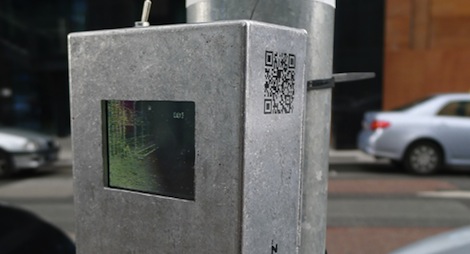
[Ben]’s project started with him driving around cities recording unencrypted 2.4GHz video feeds. His idea has since expanded to include building metal boxes with an LCD display and attaching them to light poles. Think of it as an education via technology; most people don’t know these devices are receivable by everybody, and showing them it is possible is the first step in learning.

If you’re looking for something a little more creepy than a metal box attached to a lamp-post, [Ben] is also the brainchild behind the Surveillance Video Entertainment Network, an installation (also in van form) that exposes unencrypted 2.4 GHz video transmissions in cities around the world.

You can check out a few intercepted surveillance videos after the break.

Continue reading “Viewing CCTV On Every Street Corner”

Flip-dot Display Is An Advertising Experience We Can Get Behind

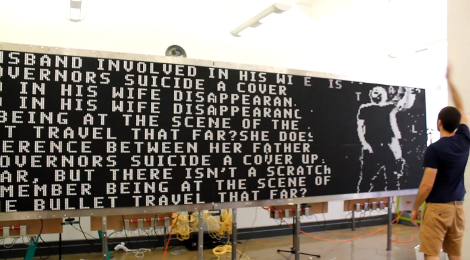
This huge and mesmerizing interactive display is just a big piece of advertising. It is a flip-dot display. Each pixel is a mechanical disk, white on one side and black on the other. The team over at BreakfastNY hacked the display modules and wrote their own software so that it can be refreshed with lighting quickness. To the left you can see the high contrast text, but on the right it’s showing the camera-based interactivity. A few seconds later this gentleman sweeps his arm to the side and all the pixels scatter as if blown away by a forceful wind. You might as well just skip down to the video after the break right now.

The display is an advertisement for a new show on the TNT network called Perception. We’ve got to say, if you’re going to advertise this is the way to do it. Make something cool, then share the details. We get to enjoy the clickity-clack of all those dots flipping into place and they got us to at least recognize the network and say the name of the show. Everyone wins.

Continue reading “Flip-dot Display Is An Advertising Experience We Can Get Behind”

Joystick Operated Security Cam Will Overlook The Moat

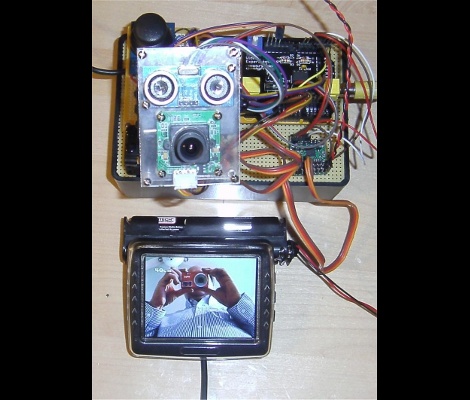
What good is a moat if nobody is guarding it? We suppose that depends on what beasties lurk beneath the surface of the water, but that’s neither here nor there. The members of LVL1 continue their quest to outdo each other in augmenting the building’s automated features. The latest offering is this security camera which is operated with an analog thumb stick.

These are the people who are building a moat (which the city things is a reflecting pool) in front of their main entrance. Now they will be able to see and sense if anyone is trying to get across the watery hazard. The hack marries an ultrasonic rangefinder and camera module with a pair of servo motors. The brackets for the motors allow a full range of motion, and the signal is translated by an Arduino and Video Experimenter shield to put out a composite video signal. That’s not going to make streaming all that easy, but we’re sure that is just one more hack away.

Television Built From A Tin Can

A tin can and string telephone just doesn’t impress the kids anymore. Luckily, now you can  turn that tin can telephone into a television, as [aussie_bloke] over on the Narrow-Bandwidth Television forum showed us.

[aussie_bloke]’s tin can TV is a mechanical television, a TV where the scanning lines of a CRT is replaced with a spinning disk with very small holes.(if you have a better analogy in this day of LCDs, tell us). Instead of the usual Nipkow disk, [aussie_bloke] used a small tin can.

The image displayed on this TV isn’t very large; there are only 30 scan lines and the pattern of the holes results in a display 10.5mm in width by 7.85mm high. Basically, this display is microscopic but it’s still very impressive.

Sure, you may not be able to sit your kids down in front of this can-powered TV and let them watch Yo Gabba Gabba for hours on end, but it’s more than enough to impress those technically minded kids.

You can check out a video of [aussie_bloke]’s can TV after the break. Thanks [gary] for sending this in.

Continue reading “Television Built From A Tin Can”