Shooting Fireballs From Your Wrists – Hadouken!

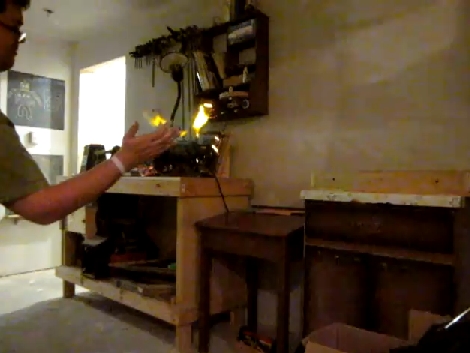
[Glass Giant’s] wrist-mounted fireball launcher adds a little stage magic to his life. This method of fire production is several orders of magnitude less dangerous than other arm-attached flamethrowers or instrument-mounted torches. The module, which is strapped to the underside of his wrist, stores and lights a combination of flash cotton and flash paper. The two flammables are housed in a small aluminum tube touching a glow plug. A slider switch acts as a safety, completing the circuit from the battery, to the glow plug, terminating in a mercury switch which heats things up when held at the proper level. He’s still working out the best way to load the flash materials but as you can see in the video after the break, this is definitely worthy of the Street Fighter reference.

Continue reading “Shooting Fireballs From Your Wrists – Hadouken!”

EEG The Locomotion

The use of brainwaves as control parameters for electronic systems is becoming quite widespread. The types of signals that we have access to are still quite primitive compared to what we might aspire to in our cyberpunk fantasies, but they’re a step in the right direction.

A very tempting aspect of accessing brain signals is that it can be used to circumvent physical limitations. [Jerkey] demonstrates this with his DIY brain-controlled electric wheelchair that can move people who wouldn’t otherwise have the capacity to operate joystick controls. The approach is direct, using a laptop to marshall EEG data which is passed to an arduino that simulates joystick operations for the control board of the wheelchair. From experience we know that it can be difficult to control EEGs off-the-bat, and [Jerky]’s warnings at the beginning of the instructable about having a spotter with their finger on the “off” switch should well be followed. Maybe some automated collision avoidance would be useful to include.

We’ve covered voice-operated wheelchairs before, and we’d like to know how the two types of control would stack up against one another. EEGs are more immediate than speech, but we imagine that they’re harder to control.

It would be interesting albeit somewhat trivial to see an extension of [Jerkey]’s technique as a way to control an ROV like Oberon, although depending on the faculties of the operator the speech control could be difficult (would that make it more convincing as an alien robot diplomat?).

How To Work With EL Wire

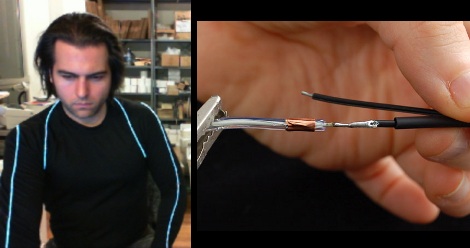
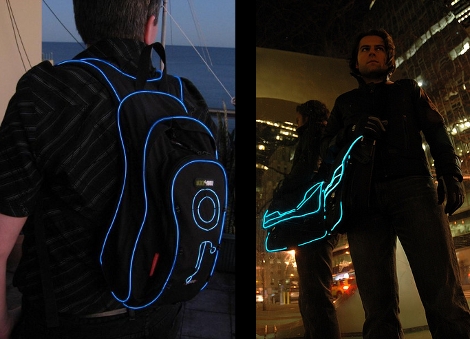
As you can see, [Phillip Torrone] has a nice start on his Tron costume for the movie premiere. Electroluminescent wire is what makes these costumes glow and if you’ve never worked with the stuff before you’re in for a treat. Adafruit posted a tutorial explaining how to work with EL wire. The process isn’t hard, but they’ve got a few nice tips, like using copper tape as a platform for soldering the corona wires. There is also a discussion of the math involved with properly powering your setup.

In this case, Adafruit is using ready-made power inverter units. If you’ve interested in hacking together your own inverter take a look at the background information from [Jeri Ellsworth].

Breathing Motion Powered USB Charger

When your batteries run low you can use your body to recharge them. This contraption generates power from chest expansion while breathing. [Jmengel] used some gears from old optical drives to boost the RPM generated by a belt around your torso that he calls a thorax expansion coupler. When you breath in, that belt pulls on a plate that spins the gears, ultimately rotating a small motor. The AC current generated by that motor is run through a rectifier and a boost converter, then fed to a charging circuit.

Does it work? Not really, as this only outputs around 50 mW. But we like the twinge of Dune nostalgia we get looking at it. Wouldn’t this be a perfect addition to a stillsuit?

Power All Over Your Body

We know that you can transform the mechanical motions of your body into electrical energy, like when you turn the crank or shake a mechanically-powered flashlight. These types of mechanical motions are quite large compared to many of the day-to-day (and minute-to-minute) actions you perform–for example walking, breathing, and thumb wrestling.

What if we could harvest energy from these tiny movements? Researchers at the Korea Advanced Institute of Science and Technology are seeking the answer to this question with piezoelectric barium titanate. The electrical output of their devices is very small (in the nanoAmps) but over a long period and over many repetitions it would be possible to run a small electric device–even a biologically-embedded one. An alternative to blood power?

There is clearly a lot of potential in this technology, and we’ll be interested to see if and when we can start messing around with this stuff. Heck, it’s already been used to power a small LED and you all know just how much everyone would jump at the chance to cover themselves in self-powered LEDs…

Developing An Animatronics Platform

This Predator costume has an animatronic element in the shoulder cannon. It tracks the movement of the mask, aiming wherever the Predator gazes. [Jerome Kelty] was asked by a friend to help develop the costume and he ended up with an animatronics platform which can be adapted for many different uses.

Starting with an Arduino Pro Mini [Jerome] designed a host board which would breakout the pins of the Arduino and make it easy to connect and drive multiple servo motors. The board is powered by a 3.3v Lithium Polymer battery with charging handled by a MAX1555 that was included in the design. Check out the video after the break which shows off the Predator suit. Looks like [Jerome] got it right, and he’s also put the platform to use with an Ironman suit that has an arm-mounted missle feature.

Need some inspiration for you next costume build? Take a look at this animatronic collection to get you started.

Continue reading “Developing An Animatronics Platform”

Well-balanced Flight Simulator

Here’s a flight simulator which uses concepts simple enough for anyone to build. As you pilot your virtual craft, the cockpit you’re sitting in moves as well. But unlike some of the more extreme simulator builds we’ve seen, this uses basic materials and simple concepts to provide that motion. Its center of gravity is balanced on a base frame. The joystick slides as you move the nose of the craft up and down, shifting the center of gravity causing the cockpit to tilt as well. The pilot sees the simulated flight through a wearable display. There is a stationary reference in front of him which allows the system to measure head movements, panning and tilting the virtual display to match. Check out the overview video after the break, or click through to the page linked above and watch all 22 episodes of the video build log.

Continue reading “Well-balanced Flight Simulator”