The New Apple TV

You’ve probably already heard about the Apple TV 2. It retails for $99 and packs a punch with HD video, optical audio, and WiFi in that tiny package. But as always, we like it for its hackability. Even though it’s just starting to ship, the hacks are already rolling in. The firmware is available from Apple’s servers and has already been unlocked with the yet-to-be-release SHAtter exploit. [Das_coach] even sent us a link to a video of the new Frontrow ported for the iPod touch (embedded after the break).

But the holy grail has to be XBMC. We’ve seen it on the first generation Apple TV and it was good. The second generation switches to the A4 processor which is an ARM Cortex-A8. Not quite as easy to port for as the Intel chip on the first generation was. But there is hope, one of the 2010 Google Summer of Code projects worked to port XBMC to another ARM device, it’s just a matter of inspiring some developers to take on the quest to make it happen. We can’t wait for the day that we can just velcro one of these to the back of our TV and be done with it, that first generation Xbox isn’t going to last forever.
Continue reading “The New Apple TV”

As Promised: More Industrial Robot Goodness

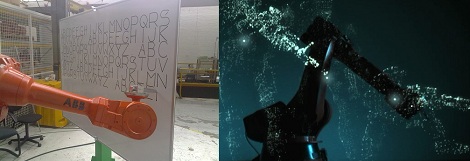
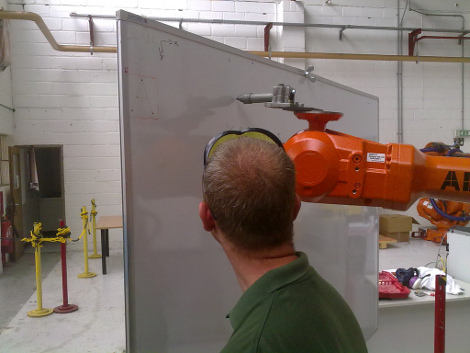
Remember [Mattythorne]? He took a BMW industrial arm and re-purposed it to write twitter messages on a white board. You can read a small excerpt here.

Well [Matt] is back, and as promised includes an entire write up for how he got @scribblebot scribbling twitter messages.  It’s a little light on details and we wish there was some more in-depth how-to magic, but then we remembered with most of the population not having an industrial arm in the first place the extra time spent incorporating the extra info would be far from worth it. Regardless, it doesn’t surprise that the previous commentators were not far off the mark in how difficult programing one of these machines would be. While such arms do have a few built in libraries it looks like a very exhausting process to override the default axis of motion, incorporate a UI, build a pen holder, and more. And in the end, is it worth it? [Matt] tells us the arm is going to be going back to monotonous car building work soon, giving weeks of prep only a day in the limelight.

Building Linux Images For ARM Architectures

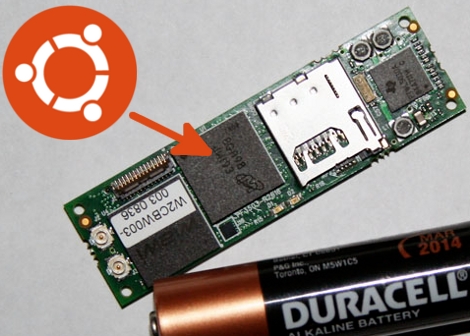
Want to try your hand at building a Linux package for an embedded device? [SnowBot] decided to give it a try and set out to build Ubuntu for a GumStix. The single-board computer will cost you about $150 to get started, plus a way to connect to the device’s serial port. But once you’ve got your hands on it there is a lot of power in a tiny package.

He’s using the RootStock package to assist in the build. This is a suite of tools that generates the root file system that can be loaded onto an SD card for use with the Gumstix. It’s not quite building from the ground up, but there’s already enough hoops to jump through that this package is a welcomed shortcut.

Already rolling your own Linux packages for embedded hardware? We want to hear about it.

Re-purpose Industrial Robotic Arms

We must find out where you can acquire these industrial robots pictured above. Sure, you expect car companies like BMW to have a few lying around, which they used to make into a Twitter message writing robot. But Bungie, a video game company, to have one as part of an advertisement for Reach?

The former is just a scratch on the surface, with some pictures, but a much more decent writeup will be provided after September 12th. The latter has a few videos, and you can watch it recreate a monument with light ‘live’. And while both are impressive uses of old tech, neither answered our first question, we gotta get us one of these.

[Thanks Matt and FurryFriend]

BeagleBoard Cluster

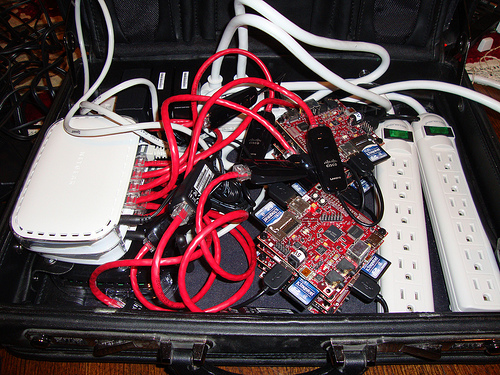
What do you do after you make a BeagleBoard graphing calculator? [Matt] over at Liquidware Antipasto made a BeagleBoard Elastic R Cluster that fits in a briefcase. Ten BeagleBoards, are connected to each other though USB to ethernet adapters and a pair of ethernet switches connected to a wireless router. The cost for this cluster comes in around $2000 and while consuming less than 40 watts of power, out-paces a $4500 laptop. How might you use this cluster? What improvements would you make? Continue reading “BeagleBoard Cluster”

Firmware Hacking On Behringer Midi Devices

A new project called the Unofficial Behringer Control Development Kit lets you tweak or completely replace the firmware on the popular devices. The proof of concept demo shows a custom message scrolling on the 4-character 7-segment display but you can do with the device is only limited by how well you can code for the ARM processor inside. Development takes place using the GNU ARM toolchain but don’t worry, you don’t have to crack the case open to program the chip. The BCR2000 and BCF2000 models supported by the project both run bootloaders that allow firmware updates via midi commands. There’s even a recovery mode if you screw something up. Just make sure you have a direct midi connection for recovery, the USB port won’t work for that purpose. If you need a shove to get you started there’s a nice little example file in the repository.

[Thanks Bjonnh]

Flipping Pancakes

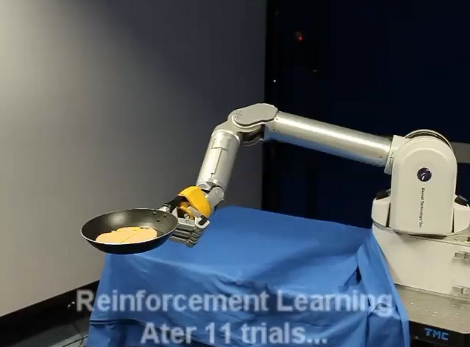
[Petar and Sylvain] are teaching this robot to flip pancakes. It starts with some kinesthetic learning; a human operator moves the robot arm to flip a pancake while the robot records the motion. Next, motion tracking is used so that the robot can improve during its learning process. It eventually gets the hang of it, as you can see after the break, but we wonder how this will work with real batter. This is a simulated pancake so the weight and amount at of force necessary to unstick it from the pan is always the same. Still, we loved the robotic pizza maker and if they get this to work it’ll earn a special place in our hearts.

Continue reading “Flipping Pancakes”