Business Card Draws [ch00f]’s Logo

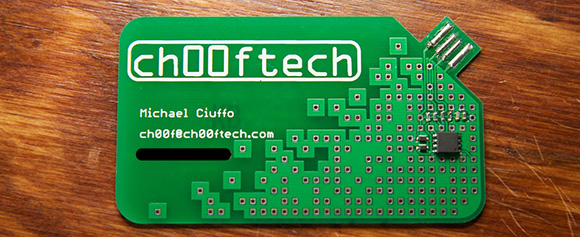
[ch00f] is at it again, expanding the horizons of the art of PCB business cards. This one draws his logo on any computer over a USB port.

The physical design of the card is heavily inspired by [Frank Zhao]’s card; both use an ATtiny85 and the V-USB package to handle the USB protocol and communications. Instead of typing words into a text editor like [Frank]’s, [ch00f]’s card draws the ch00ftech logo in MS Paint or other image editor.

There was a problem with simply emulating the mouse to draw a logo on the screen, though; because different computers have different mouse settings for acceleration, the ch00ftech logo was nearly always distorted. [ch00f] fixed that by emulating an absolute input device, basically turning his business card into a single-function pen tablet.

The logo was traced by hand and put into a few arrays in the firmware. Surprisingly, the logo didn’t take up much space – only 4k of the tiny85’s flash is used. There’s a lot more space for a more complicated drawing, but for now the simple ch00ftech logo (video after the break) will do.

Continue reading “Business Card Draws [ch00f]’s Logo”

Sonic Screwdriver Meets TV-B-Gone

sonic

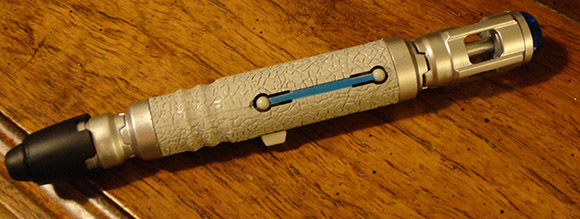
[furrysalamander] has a friend that is a really big Doctor Who fan. It happens that this friend has a birthday coming up, and [furrysalamander] wanted to get her something amazing. A Sonic Screwdriver is always a great gift, but [furrysalamander] wanted to put his personal touch on it. He ended up adding a TV-B-Gone to [10]’s screwdriver, turning a fictional deus ex machina into a functional device.

The body of the Sonic comes from this replica of [10]’s screwdriver from Think Geek. Inside, the screwdriver has space for a battery a circuit board to control the lights and sound normally expected of a sonic screwdriver. [furrysalamander] added a freeform circuit composed of an ATtiny85, a transistor, LED, and a few resistors to add the ability to turn just about any TV off.

Of course [furrysalamander] needed to program the ATtiny with the TV-B-Gone firmware, and lacking any AVR development tools he used a Raspberry Pi’s GPIO pins to write the firmware to the microcontroller. That’s something we’ve seen before, but [furrysalamander] is a champ for including the process in his Instructable.

The end result is a Sonic Screwdriver that doesn’t work on wood and can’t break a deadlock seal. It turns off TVs just fine, though, and looks great to boot. You can check out a demo of [furrysalamander]’s sonic in action after the break.

Continue reading “Sonic Screwdriver Meets TV-B-Gone”

A Pair Of Automatic Fish Feeders

a-pair-of-automatic-fish-feeders

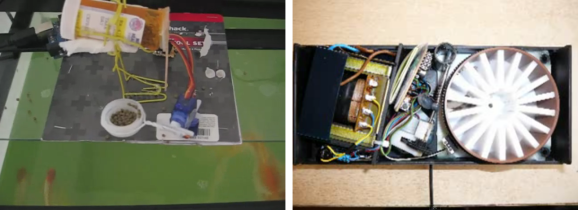
Sometime the hacking topics come in waves. For instance, we were tipped off about this pair of automatic fish feeders just an hour apart from each other. Maybe it’s that time of year when people are about to go on Holiday and want to make sure their marine pets don’t go hungry?

The feeder on the left is a true hack. It’s built from a pair of servos and a pill bottle. An ATtiny85 drives the motors. One is mounted to the other, allowing the cap which catches and distributes the food to move along two axes. When it rotates into place under the pill bottle it bumps against a stick to open a flapper releasing more food.

On the right is a feeder that precisely doses the food. That’s because it includes a separate chamber for each feed. A worm gear drives the hopper, with screw heads pressing against a leaf switch for position feedback. This one is well designed and built to last.

An Attempt To Replace Multiple RFID Cards With A Single Hacked-together Tag

It’s kind of a convoluted title, but [Hudson’s] attempt to replace multiple HID Prox cards with one AVR chip didn’t fully pan out. The project started when he wanted to reduce the number of RFID access cards he carries for work down to just one. The cards use the HID Proximity protocol which is just a bit different from the protocols used in most of the hobby RFID projects we see. He ended up taking an AVR assembly file that worked with a different protocol and edited it for his needs.

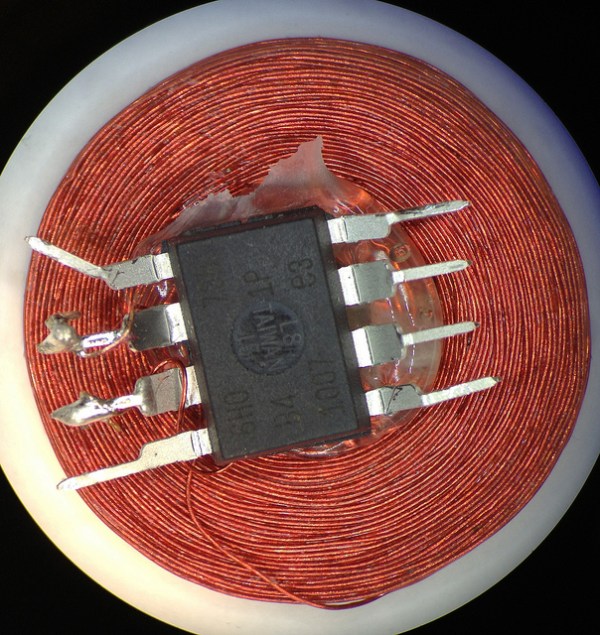
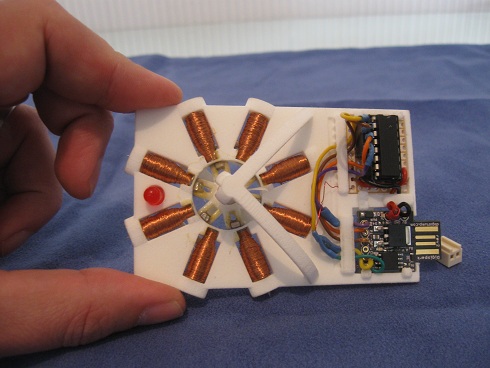
The device above is the complete replacement tag [Hudson] used. It’s just an AVR ATtiny85 and a coil made of enameled wire. The coil pics up current from the card reader’s magnetic field, and powers the chip through the leakage on the input pins (we’ve seen this trick a few times before). The idea he had was to store multiple codes on the device and send them all in a row. He was able to get the tag to work for just one code, but the particulars of the HID Prox reader make it difficult if not impossible to send multiple codes. The card must send the same code twice in a row, then be removed from the magnetic field before the reader will poll for another combination.

Extending The Features Of An IP Camera

adding-external-control-via-IP-camera

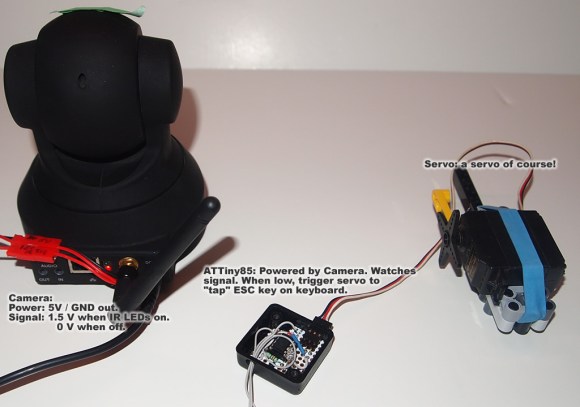
[Dave Astolfo] wanted to be able to let his CNC mill run by itself with the ability to monitor it remotely. The only problem with that idea is that if he checked in and saw something bad happening he needed a remote kill switch as well. He ended up killing two birds with one stone by adding extra features to an IP camera.

These Internet Protocol cameras are pretty nifty. Just plug their power cord in and they’ll connect to WiFi and start streaming video. Many of them offer features like pan and tilt, and this model even features IR LEDs for night viewing that can be switched on and off through the web interface. That’s the point at which [Dave] started his hack. He patched into the leads on the IR LEDs. They’re monitored by an ATtiny85. When he turns on the LEDs via the webpage the ATtiny85 senses it and drives a servo motor to push the ESC key on the keyboard. As you can see in the clip after the break, this will stop the milling in its tracks. We especially liked the use of LEGO Technique pieces to make the servo mount removable.

Continue reading “Extending The Features Of An IP Camera”

Halloween Props: Spooky Eyes Light Up The Bushes

This is just one example of several pairs of spooky eyes which light up [Vato Supreme’s] bushes this Halloween. The quick and inexpensive build process make it a perfect diy decoration.

Each eye is made up of a ping-pong ball and an LED. But that alone won’t be very spook as the entire ball will glow rather brightly. So he spiced things up a bit by masking off the shape of a pupil and spraying the balls black. The vertical slit seen in white above will glow red like a demon in the night.

The LEDs are driven by an ATtiny85 running the Arduino bootloader. [Vato] found there was plenty of space two write code which fades the eyes in and out using PWM. This happens at random intervals for each of the four pairs he is driving.

We’ve seen a similar project that used oversized LEDs as the eyes. But we really like the idea of using a diffuser like this one. See it in action after the break.

Continue reading “Halloween Props: Spooky Eyes Light Up The Bushes”

Edge-lit Musical Birthday Card

[Monirul Pathan] decided to make the card as unique as this gift when getting ready for a birthday. He designed and built his own musical card with LED edge-lit acrylic to display the message.

The electronic design seeks to keep things as flat as possible. The card-shaped acrylic panel has a void to fit the PCB exactly, and the components are relatively flat. One thing we found quite interesting is that the ATtiny85 which drives the device is surface mounted, but it is not a surface mount component. The layout includes though-hole pads, but instead of drilling holes [Monirul] clipped off the excess of the DIP legs and soldered the remainder directly to the copper. We suppose this isn’t going to get a lot of use so it just needs to hold together for one day.

As you can see in the video after the break, the speaker plays ‘Happy Birthday’ followed by ‘Under the Sea’. At the same time, four blue LEDs pulse to the music, lighting up the words that are engraved in the plastic.

Continue reading “Edge-lit Musical Birthday Card”