Bootloader Brings USB, Firmware Updating To The ATtiny85

[Jenna] sent in a very cool bootloader she thought people might like. It’s called Micronucleus and it turns the lowly ATtiny 85 into a chip with a USB interface capable of being upgraded via a ‘viral’ uploader program. Micronucleus weighs in at just over 2 kB, making it one of the smallest USB-compatible bootloaders currently available.

The USB support comes from V-USB, a project that puts a virtual USB port on a suite of AVR microcontrollers. With V-USB, it’s easy to turn a Tiny85 into a keyboard, custom joystick, data logger, or computer-attached LED display.

One very interesting feature of Micronucleus is the ‘viral updater’ feature. This feature takes a new piece of firmware, and writes it to a Tiny85, disabling the current bootloader. If you’re designing a project that should have a means of updating the firmware via USB instead of the usual AVR programmer, this might be the bootloader for you.

Not bad for a bootloader that emphasizes small code size. At just over 2 kB, it’s possible to use this bootloader on the similar, smaller, and somewhat cheaper ATtiny45.

ATtiny Controlled Magic Eye Tube

In the early days of broadcast radio, the most expensive radio sets were extremely impressive pieces of furniture. With beautifully crafted wooden cases polished to a high shine, these wireless receivers were the focal point of any family room. Some of the most expensive radio sets even included a visual indicator signaling the strength of the reception, something [Marcus] decided to re-engineer using an ATtiny85.

The display tube in question is an EM800 magic eye tube, used in radio sets, stereos, and electronic test equipment as a rudimentary display indicator. By applying a control voltage (from 0 to -10V), the illuminated display can be controlled like a bar graph display.

[Marcus]’ tube display is built around an ATtiny85 microcontroller, using a homemade PCB. It’s a fairly simple build, once the issue of supplying 250 Volts to the EM800’s anode is taken care of.

In the video after the break, you can see the bar display of [Marcus]’s magic eye tube slowly growing and receding, perfect for either displaying the current CPU load on your computer or anything else a dynamic bar graph display would be used.

Continue reading “ATtiny Controlled Magic Eye Tube”

Teensy Tiny Arduino Board With An ATtiny85

Planning another Arduino build? If you’re just doing something simple like switching a relay or powering a LED, you might want to think about the Digispark. It’s a very small ATtiny-based Arduino compatible board developed and Kickstarted by [Erik].

The Digispark is based on the very popular Atmel ATtiny85, an 8 pin microcontroller that provides a quarter of the Flash storage and RAM as the ‘official Arduino’ ATMega328p. The lower storage space and RAM doesn’t mean the ’85 is a slouch, though; it can run Arduino code without a hitch, providing six pins for whatever small project you have in mind.

Right now, [Erik]’s Kickstarter is offering three Digisparks for the price of a single Arduino. At that price, it’s cheap enough to leave in a project and not be repurposed after the build is over. [Erik] is also working on a few shields for the Digispark – only RGB LED shield for now, but hopefully he’ll get some more finished by the time the Kickstarter ends.

Proximity Switch For Your Mains Devices

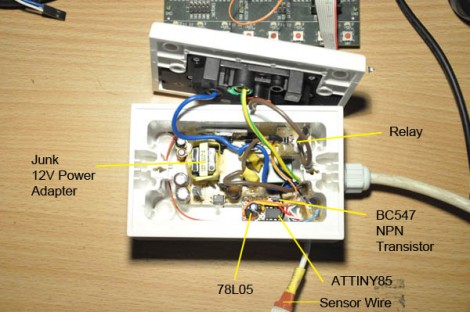
[Ivan’s] friend built a proximity sensor to switch his LED bench lighting off every time he walked away. The idea is pretty neat, so [Ivan] decided to implement it for mains devices by making this proximity switched outlet box.

A Sharp GP2D12 infrared distance sensor is the key to the system. It has an emitter and receiver that combine to give distance feedback base on how much of the light is reflected back to the detector. This is presented as a voltage curve which is monitored by an ATtiny85 (running the Arduino bootloader). It is small enough to fit inside the outlet box along with a tiny transformer and linear regulator to power to logic circuitry. The mains are switched with a relay using an NPN transistor to protect the chip’s I/O pins.

Check out the video after the break to see this in action. It should be a snap to add a count-down timer that gives you a bit more freedom to move around the workshop. With that in place this is a fantastic alternative to some other auto-shutoff techniques for your bench outlets.

Continue reading “Proximity Switch For Your Mains Devices”

[RobB’s] House Has No Light Switches

So [RobB] wanted to take out all the light switches in his house. His plan was to replace them with a system that could be operated from his smart phone. But his wife insisted that there still must be some way to control the lighting directly — we have to agree with her on that one. The solution was to develop a system that switches the lights via a touch sensor or by Bluetooth.

The touch part of the project is pretty easy. He coated the back of a blank outlet plate with tin foil and hooked it to a microcontroller with a couple of resistors. He’s using an ATtiny85, which can be programmed using Arduino sketches, so the software side is made easy by the CapSense Library. The chip also uses the software serial library to communicate with a Bluetooth module. You can see the result of both in the demo video after the break.

Of course you need to throw a relay in there to switch mains, and find a way to power the uC and Bluetooth module. [RobB] went with a tiny plug-in USB power converter and managed to fit everything in a single-gang switch.

Continue reading “[RobB’s] House Has No Light Switches”

Bench Power Supply Resetting Thingy

As is common among some hackers, [Henry] re-purposed an ATX power supply unit to function as a bench power supply for testing circuits on a breadboard (much like this fancy example).

However, safety mechanisms on some modern PC PSUs do not automatically reset after over-current protection has kicked in, which soon became annoying for [Henry]. In order to make his power supply more hacker-friendly, he wired up and programmed an ATtiny85V, using some Arduino libraries, to do that for him. This simple project is a great example of using a hack to improve a pre-existing hack.

Hackaday Links: June 3, 2012

When pigs fly…. close enough.

There are too many jokes to be made about this one. It’s a quadcopter made out of a dead cat. [Bert Jansen], the artist behind this, calls him Orville. He died from natural causes, and what better way to remember a feline friend that liked chasing birds?

Refurbishing an Apple ][

That thirty year old computer in your parent’s attic isn’t going to clean itself, is it? [Todd] put up a series of videos tearing down a 1982 Apple ][ plus, cleaning everything along the way, and doing a very nice demo of AppleSoft BASIC. This is where the revolution started, people.

Ohm sweet Ωhm

Cross stitch isn’t for grandmothers anymore. Adafruit put up a cross stitch tutorial to go along with their resistor color code cross stitch kit. Now down to Hobby Lobby to find black cross stitch cloth and make the ‘ol skull ‘n wrenches.

Welcome! To the world of yesterday!

Boing Boing found an amazing cyberpunk photo spread that appeared in the Mondo 2000 ‘zine back around 1992 or 1993. Even when keeping in mind that this is a self-parody, it’s still incredible. Hackers have laser pointers? And pagers?

Making Arduino projects smaller

[Scott] caught wind of a way to shrinkify Arduino projects, so he turned an Arduino protoboard into an ATtiny85 programmer. As a neat bonus, [Scott] can use the attached breadboard to build circuits around the ’85.