Welding With Over A Hundred A123 Lithium Cells

a123-cell-powered-welder

[Doctor Bass] needed to do some welding on his electric bicycle. The problem is that he’s never welded before and doesn’t have any tools for it. As you can see, that didn’t stop him. He used a bicycle battery made from reclaimed DeWalt A123 cells to power his diy welding rig.

He has a huge adjustable resistor which is responsible for limiting the current. 80 Amps seems to work the best with the welding rods he’s chosen. It is worth noting that when he shows off each part of the welder (see the clip after the break) the color of the wire used for positive and negative leads is opposite of convention. His positive wiring is black while his ground connection is red.

To get the welding under way he connects a jumper-cable-like clamp to his work piece which serves as the positive electrode. To hold the welding rod he drilled a hole in a pair of vice grip pliers and bolted on the negative lead. This way the end of the welding rod can be clamped in the vice grips while his other hand guides the tip. So far he’s still practicing, but it looks like he’s nearly ready to take on the job at hand.

Continue reading “Welding With Over A Hundred A123 Lithium Cells”

LiPo Internal Resistance Measurement Tool

lipo-internal-resistance-meter

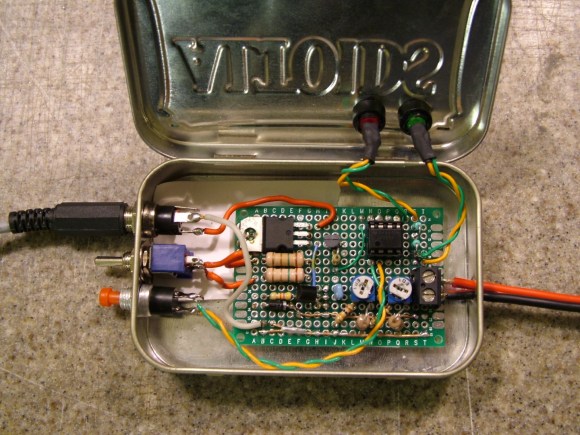
This is a scratch-build meter for measuring the internal resistance of Lithium Polymer cells. [Bleuer Csaba] uses the LiPo cells for RC vehicles and thet take quite a beating from the motors  they’re supplying. This means that he only gets about 100-200 cycles out of each cell. To figure out where one is in its life cycle you can measure the internal resistance where a rising resistance indicates greater age. [Bleuer] mentions that you can buy a meter to do this for you, but what fun is that?

Since he’s rolling his own tool he defined his own parameters for the readings. After experimenting with different loads driven for different test periods he was able to extrapolate an equation that estimates the resistance measurement. As you can see in the clip after the break, this happens very fast. All he has to do is connect the cell and press one button. The measurements are made and various data points are displayed on the quartet of 7-segment displays.

Continue reading “LiPo Internal Resistance Measurement Tool”

Standalone Air Quality Monitor Based Around Raspberry Pi

rpi-air-quality-monitor

You can have a lot of fun tinkering with the Raspberry Pi. But in addition to the low-cost hobby potential it is actually a great choice for serious data harvesting. This air quality monitor is a great example of that. The standalone package can be taped, screwed, bolted, or bungeed at the target location with a minimum of effort and will immediately start generating sample data.

The enclosure is a weather proof electrical box. The RPi board is easy to spot mounted to the base of the case. On the lid there is an 8 Ah battery meant to top off an iPhone. It works perfectly as it provides a USB port and enough current to operate the Pi. On top of that battery is a 3G modem used to access the data remotely — although it can log to the SD card for collection at a later time if you’d rather not mess with a cell network.

Look closely at the GPIO header and you’ll notice that an ADC add-on board has been plugged in. This is used to take the readings from the gas sensor which is monitoring for air pollutants in Paris.

Open Source Capactive Charger Resurrects An Electric Skateboard

mikey-sklar-on-electric-skateboard

Here’s [Mikey Sklar] posing on his new electric skateboard. Well, it’s new to him at any rate. He bought it used on eBay for $250. That may not sound like much of a deal, but these will run more like $800 retail. The savings comes because the thing would no longer charge. But it took him just an hour and a half with his capacitive charger to resurrect the flat lithium cells.

The first thing he did in trouble shooting the situation was to measure the voltage of the battery pack. It registered 5V, which is a far cry from the 36V it should supply. The built-in charger does nothing, as it’s circuitry isn’t designed to work in a situation like this one. But [Mikey] has a tool perfect for this purpose. Da Pimp is a capacitive charger which we’ve seen before. It succeeds where the other failed because it is able to adapt itself to the internal resistance of the battery, no matter what voltage level it starts at.

[Mikey] shows off the use of his charger in the clip after the break. His first test run was more than two miles without issue.

Continue reading “Open Source Capactive Charger Resurrects An Electric Skateboard”

IPad External Battery Case Forced To Work With A Non-iPad Tablet

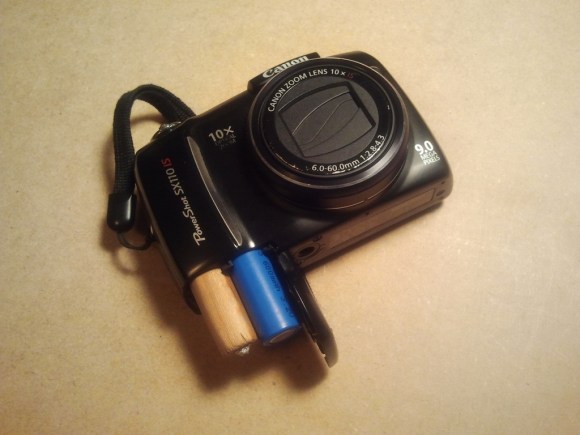
[Carnivore] uses a Pipo Max M1 tablet. It’s an Android device that is very responsive thanks t the 1.6 GHz dual-core processor and it runs Jellybean (latest version of Android OS). The one thing he wasn’t so happy with is battery life. Under heavy load it lasts about three hours. When reading an eBook that use can be stretched to 10 hours. His solution was to add an external battery. It turns out the 9.7″ screen makes the body of the device almost exactly the same size as an iPad, so he made an iPad external battery case work with the Android tablet.

[Carnivore] started the hack by disassembling an iP6000 case which houses a 6000 mAh battery. He removed the dock connector and fitted in a 2.5mm power jack. Luckily the buttons on the Android tablet are in nearly the exact same place as those on an iPad, with the power button hole needing just a bit of enlargement. The case charges itself and the tablet’s internal battery using a microUSB port which means he no longer needs to carry around a special power cord. The new hardware increased the battery life by about 75%.

Laser Power System Keeps UAVs Flying Indefinitely

Drone technology is driving the aerospace industry as companies trip over each other trying to develop the next big thing. Here’s a good example of what we’re talking about. Lasers can no be used to keep a UAV in the air indefinitely. The trick is to add an array of photovoltaic cells specifically tuned to an IR laser’s wavelength. A ground system then directs a high-intensity laser beam onto the aircraft’s cell array to transfer energy while in flight.

After the break you can catch a video from a trade show where a Lockheed Martin employee describes the successful testing of such a system. But there’s a lot more information available in the white paper (PDF) which Laser Motive has released. They’re the folks behind the technology who have teamed up with LM to implement the system. The laser unit on the ground can track a UAV visually, but there is also a method of using GPS coordinates to do so in the case of overcast skies.

Continue reading “Laser Power System Keeps UAVs Flying Indefinitely”

Testing 30 Brands Of Batteries

Batteries come packaged in bright blister packs emblazoned with vague guarantees such as “45% more pictures” and “five times longer lasting.” During his internship at BitBox this summer, [Thomas] decided to put those statements to the test. He tested thirty brands of batteries on a homebrew rig to find the batteries with the most power and the most bang for your buck.

The hardware [Thomas] used an STM32 microcontroller to perform two different tests: a high drain and a low drain condition. For the high drain, 1000 mA were sucked out of the batteries until the voltage reached 0.8 V. For the low drain, 200 mA were used. Data including milliwatt-hours, milliamp-hours, joules, voltage, current, power, and effective load resistance were all logged for both conditions for all 30 batteries.

Generalizing the results for both low and high drain conditions, lithium batteries were better than alkaline, which were both better than zinc AA cells. Perhaps unsurprisingly, batteries marketed as ‘long life’ and ‘extended power’ were the worst batteries for the money, but a brand-name battery – the Kodak Xtralife cells – were actually the best value for the money.