Hackaday Links: November 24, 2013

hackaday-links-chain

We love home theater hacks and this one especially since it is also part of a larger home automation project. [Falldeaf] use Z-Wave wireless home automation and includes mains switching for his television. The only problem being that when power is switch back on the TV remains in the standby state. His solution was to use an ATtiny85 to detect power, then push the IR code to turn the TV on after a short delay.

[Pjkim] wanted to prototype using the Tiva Launchpad on his Mac. He managed to get a toolchain up and running that includes the TivaWare libraries. He put together a guide that shows how to set up Eclipse and Energia for the Tiva family. If you haven’t heard of Energia check out the Github Readme.

Most folks have a smartphone and you can bet that the handsets are Bluetooth enabled. But we think there is still a low percentage who are connecting their smartphone audio to wireless speakers. [Anton Veretenenko] shows how you can use some cheap KRC-86B modules from Ali Express to make your own wireless speakers. He’s even powering his hack with a single 18650 Li-Ion cell.

Taking a turn away from electronics we got a chuckle out of [CADFood’s] plan to make pearls with his bicycle. He used DesignSpark Mechanical to model what amounts to a bicycle powered ball mill. It attaches to his spokes and after taking a hammer to some oyster shells he loads them up and goes for a ride. Well actually he needs to go for a bunch of rides. The idea is that about six months of bicycling will yield a cache of pearls. [Thanks Holger]

We enjoyed this article on how designing powered scooters is changing engineering education. We’re happy to see that hacking is starting to be widely accepted as a functional and effective way to gain and pass on knowledge.

If you have access to a 3D printer you can own some of the relics from the Smithsonian. They’ve been 3D scanning some pieces in their collection and you can download the models.

And finally, [GravityRoad] is working on building a delta-bot arm to use as part of a performance art project. Check out one of the most recent development videos and if that gets you interested there’s much more on the website. [Thanks Charles]


Bluetooth Audio Adapter Hacked To Switch Off Amplified Speakers

bluetooth-audio-amp-auto-switch

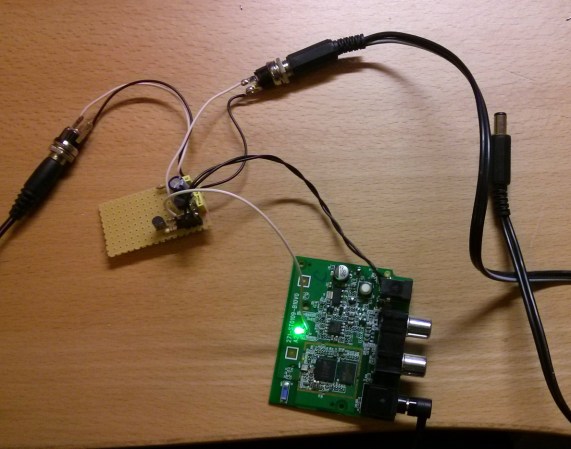
This Bluetooth Audio Adapter is meant to connect a Bluetooth audio source (like a smartphone or tablet) to a speaker system with a plain old line-in connection. It has the ability to automatically connection when the Bluetooth device comes into range. Sounds convenient until [Andreas Pösch] points out that he still has to switch the speakers on and off manually. This hack automates the entire thing using a bit of additional hardware.

If you look closely you’ll see that the black cables have barrel jacks. This is a power pass-through rig that he whipped up. The protoboard includes a 7805 linear regulator which feeds power to the green circuit board in lieu of it’s original power adapter. A MOSFET switches outbound power headed for the speakers. All of it fits inside of the original enclosure, and he only had to add one port for the AC adapter.

This would be absolutely perfect for an antique radio retrofit. One of these adapters can be had for just over thirty bucks!

A Cortex M4 Based Platform With ETH, USB, BT And Many On-board Peripherals

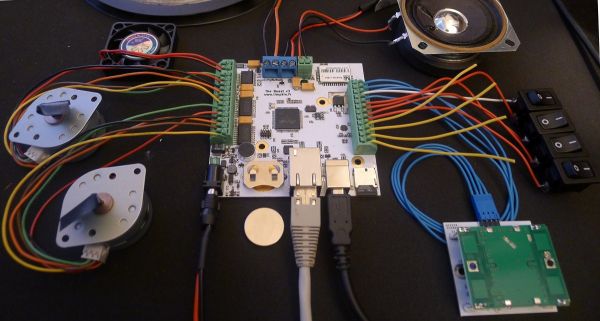
Here is a very time consuming project that I worked on during last summer: an ARM Cortex M4 based platform with plenty of communication interfaces and on-board peripherals. The particular project for which this board has been developed is not really HaD material (one of my father’s funny ideas) so I’ll only describe the platform itself. The microcontroller used in the project is the ATSAM4E16C from Atmel, which has 1Mbyte of flash and 128Kbytes of SRAM. It integrates an Ethernet MAC, a USB 2.0 Full-speed controller, a sophisticated Analog to Digital Converter and a Digital to Analog Converter (among others).

Here is a list of the different components present on the board so you can get a better idea of what the platform can do: a microphone with its amplifier, a capacitive touch sensor, two unipolar stepper motors controllers, two mosfets, a microSD card connector, a Bluetooth to serial bridge, a linear motor controller and finally a battery retainer for backup power. You can have a look at a simple demonstration video I made, embedded after the break. The firmware was made in C and uses the Atmel Software Framework. The project is obviously open hardware (Kicad) and open software.

Continue reading “A Cortex M4 Based Platform With ETH, USB, BT And Many On-board Peripherals”

1Sheeld Uses Your SmartPhone As An Arduino Accessory

1sheeld

The Arduino can be a bit of a gateway board. You start with an Uno, then a shield, then another. Before you know it, you have an entire collection of shields. This is the problem 1Sheeld wants to solve. 1Sheeld allows a you to use your cell phone as a sensor and I/O suite for your Arduino, replacing many existing shields. We think this will be a great idea, especially with all the older phones coming off contract these days. The sensor capabilities of the average smartphone, as well as the LCD and touchscreen I/O capabilities could make for an interesting pairing.

Currently the 1Sheeld page is just a sign up for an upcoming kickstarter, which leaves many details to the imagination. It appears that the 1Sheeld will be a bluetooth based board. A few questions do remain to be answered though – will the 1Sheeld use the Android ADK? The software is what we’re waiting to see. The software running in the 1Sheeld module bluetooth chip will be important, but the software running phone side will be the real make or break of this module. We would love to see more smartphones being used for hardware hacking rather than collecting dust once they’ve been replaced.

[Via TechCrunch]

LED Costumes And Clothing

3ledCostume

Our tips line recently received an influx of wearable LED projects, both for casual and professional wear. [Elizabeth] and [Luis] have created the Lüme wearable collection, aimed at accessorizing by adding adjustable accent colors to jackets, t-shirts and dresses. The electronics are custom-made, built around an ATMega32u4, and each is Bluetooth enabled to interact with a user’s cell phone. From the phone, you can change colors, sequences, set up events, and even take advantage of an “inkdropper-style” feature that matches the color of the LEDs to any object you point your camera at.

[Michal’s] project is an entire suit for a dance and laser show entitled “Tron Dance”, which uses several RGB LED strips placed on key points of the wearer’s costume. It looks like [Michal] has intentionally avoided the joint areas to prevent any problems with breaks or bends, but still manages to place enough to cover the entire body. We aren’t sure what controls everything, but you can watch it go through various sequences and survive an onstage performance after the break.

Finally, in yet another kind of performance, magician [Kiki Tay] has built a jacket that’s overflowing with RGB LEDs. [Kiki] wanted wearable LED control that could be used in various situations without having to re-invent the wheel each time, so he developed his own board — the LED Magician: an Arduino-compatible solution. The board has 12 outputs channels, drives 50+ LEDs per channel and features 12 on-board LEDs that display a preview of the output. To make interactions user-friendly, [Kiki] has provided 32 built-in sequences and adjustable speeds that the user can program via 4 buttons on the board. If that isn’t enough control, there are some options for external control as well. The jacket itself runs off a hobby LiPo battery and is blindingly bright: stick around after the break for a video.

Continue reading “LED Costumes And Clothing”

Passive Bluetooth Keyless Entry System

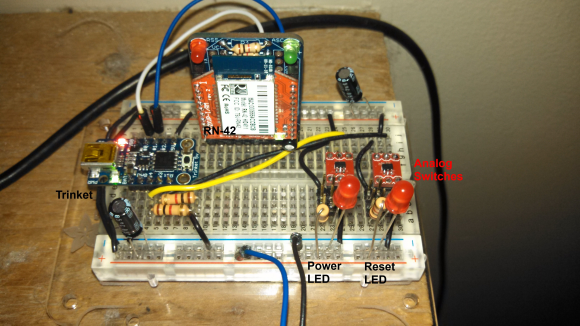
Modern smart keys allow you to keep the key fob in your pocket or purse while you simply grab the handle and tug the door open. [Phil] decided he would rather ditch the fob altogether and instead implemented a passive Bluetooth keyless entry system with his Android phone. It’s probably unlikely for car manufacturers to embrace phone-based keys anytime soon, and [Phil] acknowledges that his prototype poses a landslide of challenges. What he’s built, however, looks rather enticing. If the car and phone are paired via Bluetooth, the doors unlock. Walk out of range and the car automatically locks when the connection drops.

His build uses an Arduino Mega with a BlueSMiRF Silver Bluetooth board that actively searches for his phone and initiates a connection if in range.  Doors are unlocked directly through a 2-channel relay module, and an LED indicator inside the vehicle tells the status of the system. A pulsing light indicates it’s searching for the phone, while a solid ring means that a connection is established.

We hope [Phil] will implement additional features so we can make our pockets a bit lighter. Watch a video demonstration of his prototype after the break, then check out the flood of car-related hacks we’ve featured around here recently: the OpenXC interface that adds a smart brake light, or the Motobrain, which gives you Bluetooth control over auxiliary electrical systems.

Continue reading “Passive Bluetooth Keyless Entry System”

Headphone Hack Makes Wireless An Option

headphone-wireless-option

If you have a favorite pair of over-the-ear headphones you may want to consider upgrading them with a wireless option. The key word here is “option” because these still retain their functionality as a wired headphone. This is nice if you only want to deal with battery life when you’re actually roaming around.

Of course the thing that makes this type of hack work is the extra room inside the body of the earpieces. [Tony] cracked them open and decided there was just enough room to fit the internals of a Bluetooth audio adapter. It has it’s own Li-ion battery (boasting 12 hours of use) which is why there is an added charging port. To fit the board he had to remove some of the aluminum body from the enclosed part of the headphones. He also wired up a tactile switch to act as the power button for the Bluetooth module.

Details are scarce on how the speakers are wired between the module and the jack. But we think he simply wired them in parallel rather than using a switched jack. You can see a quick demo after the break but it really doesn’t augment the build details at all.

Continue reading “Headphone Hack Makes Wireless An Option”