Parts: 133MHz-16.2kHz Programmable Oscillator (DS1077)

cover

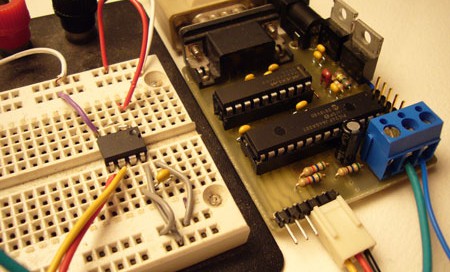
The DS1077 is a 5volt, 133MHz to 16kHz programmable clock source. The internal frequency divider is configured over a simple I2C interface, and the chip requires no external parts. Not bad for under $2. We used the Bus Pirate to test this chip before using it in a project. Grab the datasheet (PDF) and follow along. Continue reading “Parts: 133MHz-16.2kHz Programmable Oscillator (DS1077)”

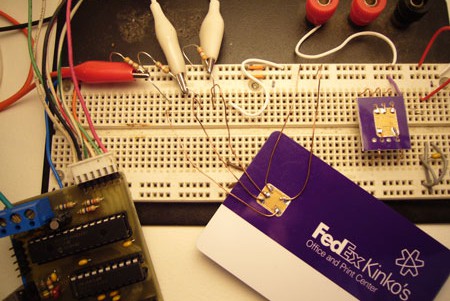
How-to: Read A FedEx Kinko’s Smart Card (SLE4442)

Our wallets are filling up with SIM and RFID cards that contain hidden information. Using our latest project, the Bus Pirate universal serial interface, we can dump the memory from many common smart cards. In today’s How-to, we show you how to interface common smart cards, and walk you through the data stored on a FedEx Kinko’s prepaid value card.

Continue reading “How-to: Read A FedEx Kinko’s Smart Card (SLE4442)”

How-to: The Bus Pirate, Universal Serial Interface

UPDATE: New firmware with JTAG and more

We’re always excited to get a new chip or SIM card to interface, but our enthusiasm is often dampened by the prototyping process. Interfacing any chip usually means breadboarding a circuit, writing code, and hauling out the programmer; maybe even a prototyping PCB.

A few years ago we built the first ‘Bus Pirate’, a universal bus interface that talks to most chips from a PC serial terminal. Several standard serial protocols are supported at 3.3-5volts, including I2C, SPI, and asynchronous serial. Additional ‘raw’ 2- and 3- wire libraries can interface almost any proprietary serial protocols. Since this has been such a useful tool for us, we cleaned up the code, documented the design, and released it here with specs, schematic, and source code.

Continue reading “How-to: The Bus Pirate, Universal Serial Interface”