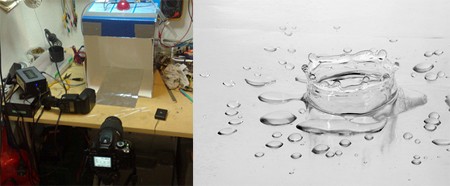
Droplet photography (link translated from French) often produces simple and beautiful images, but timing the exposure can be tricky. Snapping the photo too early or too late can cause you to miss the action, which only lasts a fraction of a second. EquinoxeFR (the people behind the Asus WL500GP audio hack) came up with a solution to this problem using a circuit with an ATmega168 running an Arduino environment. The circuit controls a syringe that contains a liquid and is triggered remotely to release a drop into a darkened chamber. A camera with the shutter open is attached to the chamber, and before the droplet hits, it crosses an IR sensor that triggers the flash to go off a few milliseconds later, capturing the unique crown shape of the impact. No schematic is available as yet, but comments at the bottom of the post suggest one will be coming soon.
camera600 Articles
Rear View Jacket

Is your popped collar so epic it emulates horse blinders? Are punk teens always skitching your coattails? Are you constantly moonwalking into power poles, trash cans, and the elderly? [Paul Coudamy]’s Hard-Wear Jacket solves all of these problems. It has a micro-camera embedded in the back of the neck and streams live video to a sleeve mounted monitor. The goal is to expand the perception of the wearer and how they interact with the environment. We know this is just a small step and doubt many people will be scrambling to never turn their neck again. It’s something interesting to contemplate though: how will people behave when brain taps allow their peripheral vision to have the same clarity as normal vision?
[via Gizmodo]
Waterproof USB For Underwater Cameras
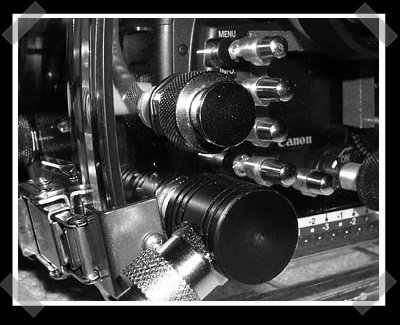
Underwater camera housings work great – but they are prone to humidity, dirt and dust problems if you open them more often than needed. In order to download the images off of his digital camera between dives, [Matt] decided to add a waterproof external USB port to his housing. He had an extra 5 pin strobe bulkhead installed by Ikelite (makers of excellent housings). Then he spliced on a mini-usb cable for the camera and spliced a standard USB end onto a strobe cable. During dives, the port is closed with an o-ring sealed cap.
TI-83 Intervalometer
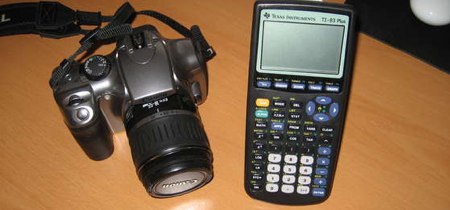
The headline How to Make Time Lapse Video With Your DSLR didn’t really grab us. Honestly, you pay that much for a camera and it can’t do time lapse out of the box? Well, we nearly missed the real story: [Chris Martino] was using a TI-83 to act as the intervalometer for the camera. The calculator has a 2.5mm audio jack for it’s data port and the camera has an identical port for the shutter trigger. The TI-83 runs a program with a FOR loop to act as the timer. When the loop completes it sends data to the port, and the voltage triggers the shutter. The rate isn’t very exact and varies depending on the charge left in the batteries. [Chris] estimated 10000 program iterations ends up being about 26 seconds between pictures. This technique has been tested on 84, 86, and 89 series calculators too. There are a couple example time lapse videos embedded after the break.
Porting CHDK To New Cameras
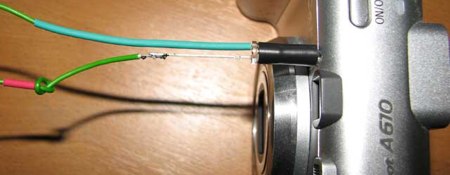
While researching the CHDK How-To, we came across the team’s instructions for porting the firmware to entirely new cameras. In theory, CHDK should work on any Canon running the DIGIC II or III processor since most of them are running the same VxWorks OS. A dump of the camera’s firmware is required before porting work can begin. On some cameras, the firmware was retrieved using software, but others required a hardware route. Pictured above is a Canon A610 that’s slowly flashing out every bit of its firmware using the built in LED. The photodiode is hooked up to a soundcard where the entire bitstream is recorded. It takes 1-7 hours to read the entire firmware. Once the sound file has been captured, it’s reverted to the original bytes and can then be decompiled with something like IDApro.
How-To: Expand Your Camera With CHDK
As anyone who has lusted over the technical specifications for Canon’s new Digital Rebel XSi knows, the capabilities of the average point and shoot camera are severely limited. Using the CHDK firmware hack, the features of Canon point and shoot cameras can be significantly expanded, allowing for ultra-high speed photography, very long exposures, time lapse photography, and RAW capture. This How-To provides a guide to our experiences using the CHDK firmware, and shows just how easy it is to get more out of a point and shoot than ever thought possible.
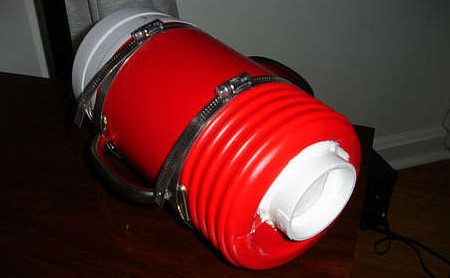
Underwater Camera Housings
Underwater cameras can produce some amazing photography, but who wants to pay for housing if you can make something yourself?
This underwater camera housing on Instructables doesn’t require a specific container, allowing you to choose anything you have around the house that’s watertight and large enough to fit your camera. A finger from a glove is added so you can still operated the controls. A similar project uses an insulated water jug, accommodating any camera that fits inside. Neither of these involve any camera mods.