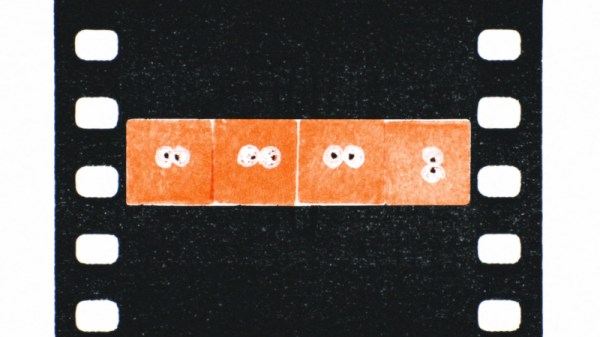
180 Shots On A Roll With The Little Stupid Camera

If you want to play with the coolest kids on the block when it comes to photography, you have to shoot film. Or so say the people who shoot film, anyway. It is very true though that the chemical medium has its own quirks and needs a bit of effort in a way digital cameras don’t, so it can be a lot of fun to play with.

It’s expensive though — film ain’t cheap, and if you don’t develop yourself there’s an extra load of cash. What if you could get more photos on a roll? It’s something [Japhy Riddle] took to extremes, creating a fifth-frame 35mm camera in which each shot is a fifth the size of the full frame.
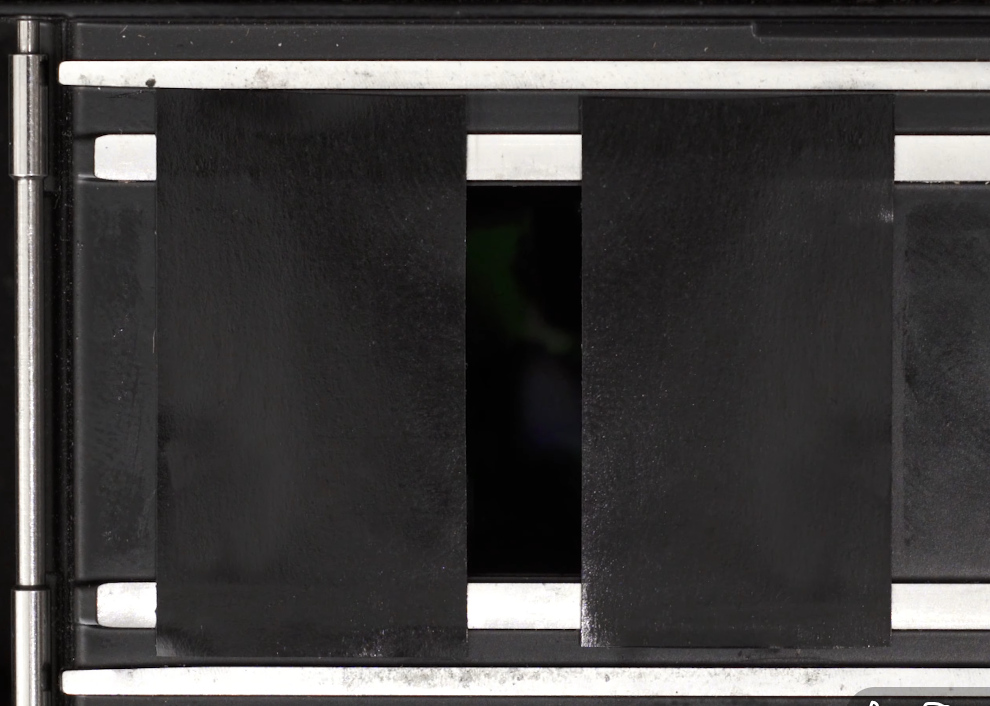
The focal plane of a 35mm camera with tape masking most of the frame
We’re slightly worried about that much sticky tape next to the shutter, but hey.

Standard 35mm still film has a 24x36mm frame, in modern terms not far off the size of a full-size SD card. A standard roll of film gives you 36 exposures. There are half-frame cameras that split that frame vertically to give 72 exposures, but what he’s done is make a quarter-frame camera.

It’s a simple enough hack, electrical tape masking the frame except for a vertical strip in the middle, but perhaps the most interesting part is how he winds the film along by a quarter frame. 35mm cameras have a take-up reel, you wind the film out of the cartridge bit by bit into it with each shot, and then rewind the whole lot back into the cartridge at the end. He’s wound the film into the take-up reel and it winding it back a quarter frame at a time using the rewind handle, for which we are guessing he also needs a means to cock the shutter that doesn’t involve the frame advance lever.

We like the hack, though we would be worried about adhesive tape anywhere near the shutter blind on an SLR camera. It delivers glorious widescreen at the cost of a bit of resolution, but as an experimental camera it’s in the best tradition. This is one to hack into an unloved 1970s snapshot camera for the Shitty Camera Challenge!

Continue reading “180 Shots On A Roll With The Little Stupid Camera”
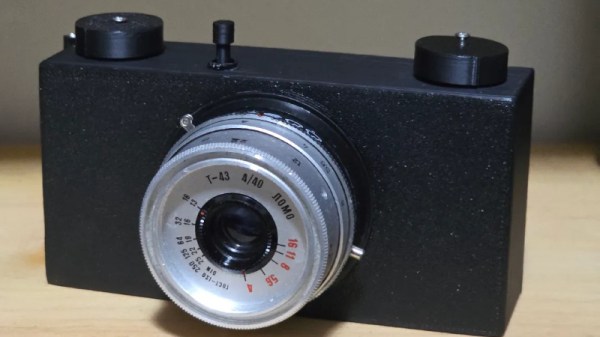
It’s Not A Lomo Smena 8M, But It’s Not Far Off

The joy of camera hacking lies for many at the low end of the market. Not working with many-thousand-dollar Leicas, but in cheap snapshot cameras that can be had for next to nothing at a thrift store. [Marek Sokal] has a perfect example, in a 3D printed 35mm camera body using the lens and shutter assembly from a vintage Soviet Lomo Smena 8M.

The build is a work in progress, a printed assembly that holds the 35mm film cartridge, provides the focal plane for the film, and houses the take-up reel. It fits together with M2 screws, as per the Lomo lens.

We like this build, because we can see beyond the Lomo. In a box above the desk where this is being written there is a pile of old plastic snapshot cameras from the 1960s through 1980s, none of which is worth anything much, but all of which have a similar shutter and lens assembly. In many cases it’s not a huge task to do with them what [Marek] has with the Lomo and mount them to a back like this. The LEGO film camera may not have gained approval, but this prove that making cameras of your own is still pretty easy.

Using Four Rolls Of Film To Make One Big Photo

Typically, if you’re shooting 35 mm film, you’re using it in an old point-and-shoot or maybe a nice SLR. You might even make some sizeable prints if you take a particularly good shot. But you can get altogether weirder with 35 mm if you like, as [Socialmocracy] demonstrates with his “extreme sprocket hole photography” project (via Petapixel).

The concept is simple enough. [Socialmocracy] wanted to expose four entire rolls of 35 mm film all at the same time in one single shot. To be absolutely clear, we’re not talking about exposing a frame on each of four rolls at once. We’re talking about a single exposure covering the entire length of all four films, stacked one on top of the other.

To achieve this, an old-school Cirkut No.6 Outfit camera was pressed into service. It’s a large format camera, originally intended for shooting panoramas. As the camera rotated around under the drive of a clockwork motor, it would spool out more film to capture an image.

[Socialmocracy] outfitted the 100-year-old camera with a custom 3D-printed spool that could handle four rolls of film at once, rather than its usual wide single sheet of large format film. This let the camera shoot its characteristic panoramas, albeit spread out over multiple rolls of film, covering the sprocket holes and all. Hence the name—”extreme sprocket hole photography.”

It’s a neat build, and one that lets [Socialmocracy] use more readily available film to shoot fun panoramas with this old rig. We’ve featured some other great film camera hacks over the years, too, like this self-pack Polaroid-style film. Video after the break.

Continue reading “Using Four Rolls Of Film To Make One Big Photo”

Disc Film,When Kodak Pushed Convenience Too Far

Having a penchant for cheap second-hand cameras can lead to all manner of interesting equipment. You never know what the next second-hand store will provide, and thus everything from good quality rangefinders an SLRs to handheld snapshot cameras can be yours for what is often a very acceptable price. Most old cameras can use modern film in some way, wither directly or through some manner of adapter, but there is one format that has no modern equivalent and for which refilling a cartridge might be difficult. I’m talking about Kodak’s Disc, the super-compact and convenient snapshot cameras which were their Next Big Thing in the early 1980s. In finding out its history and ultimate fate, I’m surprised to find that it introduced some photographic technologies we all still use today.

Easy Photography For The 1980s

Since their inception, Kodak specialised in easy-to-use consumer cameras and films. While almost all the film formats you can think of were created by the company, their quest was always for a super-convenient product which didn’t require any fiddling about to take photographs. By the 1960s this had given us all-in-one cartridge films and cameras such as the Instamatic series, but their enclosed rolls of conventional film made them bulkier than required. The new camera and film system for the 1980s would replace roll film entirely, replacing it with a disc of film that would be rotated between shots to line up the lens on an new unexposed part of its surface. Thus the film cartridge would be compact and thinner than any other, and the cameras could be smaller, thinner, and lighter too. The Disc format was launched in 1982, and the glossy TV adverts extolled both the svelteness of the cameras and the advanced technology they contained. Continue reading “Disc Film,When Kodak Pushed Convenience Too Far”

Use Your Old SLR As A Digital Camera?

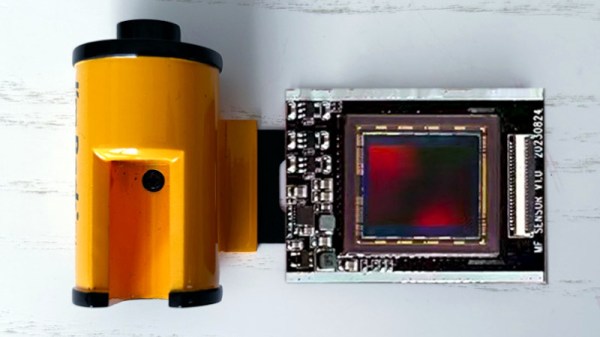
Back in the late 1990s as the digital revolution overtook photography there were abortive attempts to develop a digital upgrade for 35mm film cameras. Imagine a film cartridge with attached sensor, the idea went, which you could just drop into your trusty SLR and continue shooting digital. As it happened they never materialised and most film SLRs were consigned to the shelf. So here in 2023 it’s a surprise to find an outfit called I’m Back Film promising something very like a 35mm cartridge with an attached sensor.

The engineering challenges are non-trivial, not least that there’s no standard for distance between reel and exposure window, and there’s next-to-no space at the focal plane in a camera designed for film. They’ve solved it with a 20 megapixel Micro Four Thirds sensor which gives a somewhat cropped image, and what appears to be a ribbon cable that slips between the camera back and the body to a box which screws to the bottom of the camera. It’s not entirely clear how they solve the reel-to-window distance problem, but we’re guessing the sensor can slide from side to side somehow.

It’s an impressive project and those of us who shot film back in the day can’t resist a bit of nostalgia for our old rigs, but we hope it hasn’t arrived too late. Digital SLRs are ubiquitous enough that anyone who wants one can have one, and meanwhile the revival in film use has given many photographers a fresh excuse to use their old camera the way it was originally intended. We’ll soon see whether it catches on though — the crowdsourcing campaign for the project will be starting in a few days.

Oddly this isn’t the first such project we’ve seen, though it is the first with a usable-size sensor.

Wooden Wide-Angle Wonder Wows World

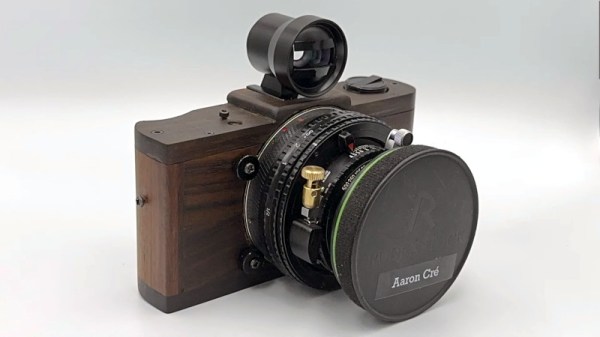
An old-fashioned film camera can be an extremely simple device to make, in that as little as a cardboard box with a pin hole in it will suffice. But that simplicity at heart leaves endless scope for further work, and a home-made camera can be every bit as much a highly-engineered object of beauty as its commercial stablemate. A great example comes from [Aaron Cré], whose desire for something close to a Hasselblad XPan panoramic camera led him to build his own equivalent out of wood.

The video below the break shows in detail how the wooden case is crafted, and how a lens mount ring sawn from a lens adapter is mounted on the front of it. He’s skipped making all the tiresome parts of the camera associated with winding and film transport and instead taken them from a cheap plastic snapshot camera. The original aspect ratio is stretched by cutting the guts of the snapshot camera apart, and extended to make a 75 mm long negative which also exposes over the sprocket holes.

The final camera is carefully finished to the point at which it really looks the part as well as taking those striking wide-angle photographs. We’re not photography buffs enough to identify the lens and shutter combination he’s using, but we can’t help envying him the results. Fancy making your own 35 mm camera too? Here’s another, in case you need inspiration.

Continue reading “Wooden Wide-Angle Wonder Wows World”

This Camera Does Not Exist

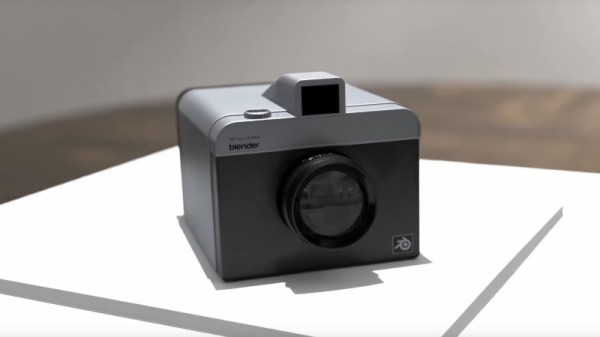
Blender is a professional-grade 3D-rendering platform and much more, but it suffers sometimes from the just-too-perfect images that rendering produces. You can tell, somehow. So just how do you make a perfectly rendered scene look a little more realistic? If you’re [sirrandalot], you take a photograph. But not by taking a picture of your monitor with a camera. Instead, he’s simulating a colour film camera in extraordinary levels of detail within Blender itself.

The point of a rendering package is that it simulates light, so it shouldn’t be such a far-fetched idea that it could simulate the behaviour of light in a camera. Starting with a simple pinhole camera he moves on to a meniscus lens, and then creates a compound lens to correct for its imperfections. The development of the camera mirrors that of the progress of real cameras over the 20th century, simulating the film with its three colour-sensitive layers and even the antihalation layer, right down to their differing placements in the focal plane. It’s an absurd level of detail but it serves as both a quick run-down of how a film camera and its film work, and how Blender simulates the behaviour of light.

Finally we see the camera itself, modeled to look like a chunky medium format Instamatic, and some of its virtual photos. We can’t say all of them remove the feel of a rendered image, but they certainly do an extremely effective job of simulating a film photograph. We love this video, take a look at it below the break.

Continue reading “This Camera Does Not Exist”