Motion Tracking Prop From Alien

[Erv Plecter] likes to recreate movie props that actually work. This time around he’s making the motion detector device from the original Alien movie. You’ll immediately remember this prop after seeing and hearing it in the video after the break.

For our money, the most brilliant part of that movie was the use of rhythmic sounds to boost the intensity of the tension in the viewer. [Erv]’s build captures that feeling, with the steady beat of sonar and the rising pitch of a ping as an object moves towards you. The device can easily track your own movement, as it contains both a GPS module and an electronic compass. He mentions that there is a motion sensor as well, but is a bit vague about how that part of the build works. Still, it’s a nice little piece which looks great despite not being quite finished yet.
Continue reading “Motion Tracking Prop From Alien“ →

Location Recorder And Mapper

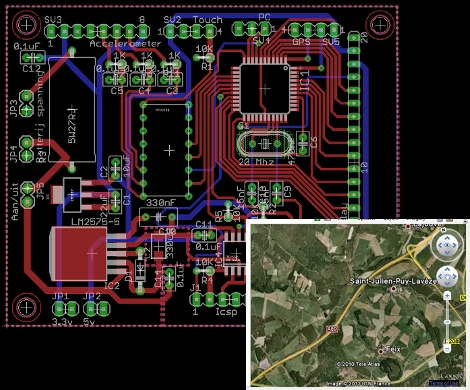
[Jeroen’s] student project is a module that uses GPS tracking to create travel data on Google maps. It’s not really a spy device as the data isn’t transmitted, but would be a lot of fun to use on cycling and hiking adventures. A PIC 18F2550 reads location and altitude data from a GPS receiver as well as data from an accelerometer. This information can be displayed on an attached touchscreen display and it is also saved to a pair of EEPROMs. When you get back from your trip, the data pulled from the device via a serial connection is processed by [Jeroen’s] C# application and used to overlay the route on a google map. He’s got a source code package available for download but we’ve saved you the trouble if the schematic is all you’re after. It’s attached after the break.

Continue reading “Location Recorder And Mapper” →

Reverse Geocache Features UI And Is Reprogrammable

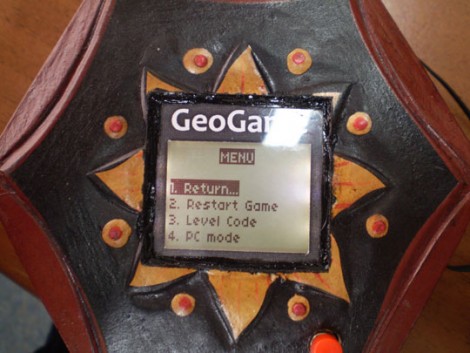
Here is yet another offering in the Reverse Geocache puzzle arena. We’ve been getting a lot of tips about these projects but this one in particular stuck out from the others. [Mure] packed in a bunch of features, starting with the LCD screen seen above. You can just make out the single red button near the bottom of the image which is used to traverse the menu. The octagonal box has an octagonal PCB inside that includes a USB connector. As you can see in the video after the break, this can be used for charging the batteries, and communicating with the internals. An accompanying program is used to generate puzzle data, which can then be programmed via that USB connection to set a new puzzle location. This functionality certainly protects against accidental lock-outs which were a problem with the last puzzle we looked in on.

A Ride Into Space, But Nothing Fancy

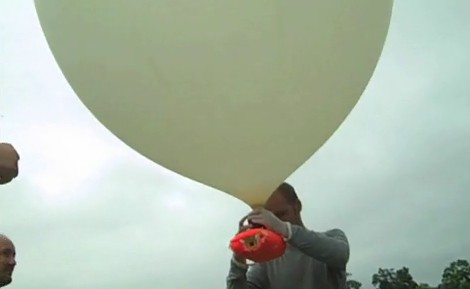
[Luke Geissbuhler] wanted to send something into space, a fun project his kids could get in on too. Instead of sending up a suite of electronic components they went with consumer electronics. The key element, an HD camera to record the event, is protected by a styrofoam shell and soft foam padding. To help ensure that the device was recovered an iPhone also made the trip, running a GPS tracking program that continuously updated the package’s location. To combat the ill-effects of severe cold some chemical hand warming packs also joined the flight.

As you can see after the break, it was a success. The camera documented an incredible ride, with a balloon rupture at 19 miles above the earth (that must be a calculated height as there’s no altimeter in the package). The pod came down gently thanks to a parachute and was recovered just 30 miles from where it launched.

Continue reading “A Ride Into Space, But Nothing Fancy” →

Unmanned Ocean Crossing

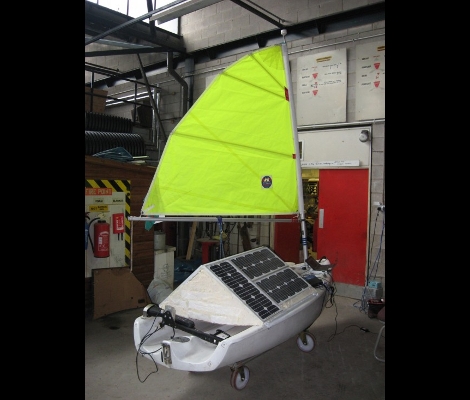
This is the Pinta, an autonomous sailboat built to attempt an ocean crossing from Ireland to Martinique (in the Caribbean). A group of researchers at Aberystwyth University built her as part of the Microtransat Challenge.

To keep tabs on the vessel her creators included an Iridium short burst data modem with a backup system made from a SPOT satellite tracker using a PIC microcontroller to trigger a transmission every six hours. The sailing systems are a conglomeration of a Gumstix board, GPS, a windshield wiper motor to control the sail, and a tiller pilot for steering. A set of solar panels helps to top off the lead-acid batteries that power the system.

Unfortunately the old gal has encountered problems. You can see from the tracking data that, although it sailed 500 km in the last twelve days, she is still just off the coast of Ireland. The primary tracking system has failed, which could signal a system-wide computer failure. We hope the team will eventually recover the vessel as we’re interested in finding out what caused this unfortunate turn of events.

Location Tracking With Twitter And Google Maps


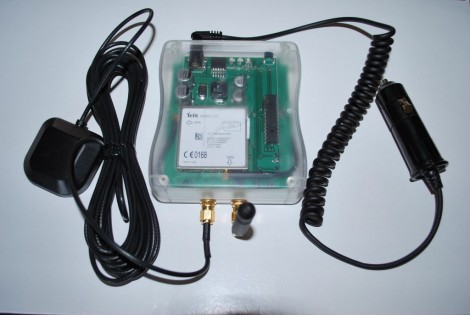
[Ryan O’Hara] built a location tracker he could use on motorcycle trips. Ostensibly this is to give his wife piece of mind be we think that was an excuse to play with GPS and SMS. To stand up to the trials of the road [Ryan] took his breadboarded prototype to the next level, using a manufactured board and a SparkFun enclosure. Tucked safely away is a PIC 18F25K20 gathering longitude and latitude from a GM862, formatting the info into a Google Maps link, and sending it to the Twitter feed via an SMS message. If you’re not familiar with the GM862, in addition to being a GPS module it can send and receive cellular data on a GSM network.

This is a nice solid hardware platform from which we can envision a couple of other hacks. The feed could be parsed to make a nice map graphic like the webpage for that Twittering Road Bike. It also might be nice to have a d-pad and character LCD to post your own tweets to the feed at the end of the day.

Reverse GeoCache Puzzle Gets Downsized

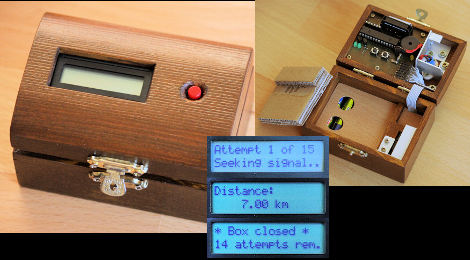
[Markus] built his own reverse geocache puzzle box but on a smaller scale than the original. His is based around a PIC 18F2520 and powered by two AAA batteries. The user interface includes one button, a 16×2 character LCD, and a piezo speaker. The box unlocks itself when the GPS module inside detects the proper location on the globe. There is also a secret code that can be tapped on the button to unlock the box prematurely, and another to show the locations in which the user attempted to open the box. This build doesn’t leave much room for a payload, but [Markus] did a great job designing the board and making the components fit as efficiently as possible.