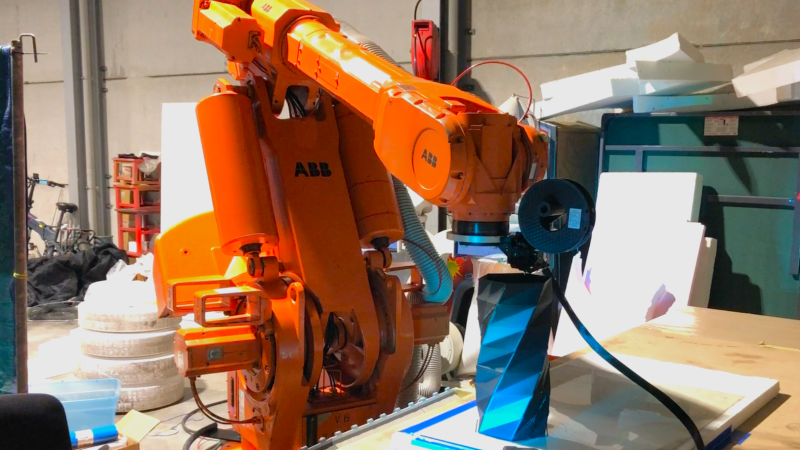
ABB arm printing a vase

Surplus Industrial Robot Becomes Two-ton 3D Printer

As the saying goes — when life gives you lemons, you make lemonade. When life gives you a two-ton surplus industrial robot arm, if you’re [Brian Brocken], you apparently make a massive 3D printer.

The arm in question is an ABB IRB6400, a serious machine that can sling 100 to 200 kilograms depending on configuration. Compared to that, the beefiest 3D printhead is effectively weightless, and the Creality Sprite unit he’s using isn’t all that beefy. Getting the new hardware attached uses (ironically) a 3D printed mount, which is an easy enough hack. The hard work, as you might imagine, is in software.

As it turns out, there’s no profile in Klipper for this bad boy. It’s 26-year-old controller doesn’t even speak G-code, requiring [Brian] to feed the arm controller the “ABB RAPID” dialect it expects line-by-line, while simultaneously feeding G-code to the RAMPS board controlling the extruder. If you happen to have the same arm, he’s selling the software that does this. Getting that synchronized reliably was the biggest challenge [Brian] faced. Unfortunately that means things are slowed down compared to what the arm would otherwise be able to do, with a lot of stop-and-start on complex models, which compromises print quality. Check the build page above for more pictures, or the video embedded below.

[Brian] hopes to fix that by making better use of the ABB arm’s controller, since it does have enough memory for a small buffer, if not a full print. Still, even if it’s rough right now, it does print, which is not something the engineers at ABB probably ever planned for back before Y2K. [Brian]’s last use of the arm, carving a DeLorean out of styrofoam, might be closer to the original design brief.

Usually we see people using 3D printers to build robot arms, so this is a nice inversion, though not the first.

Continue reading “Surplus Industrial Robot Becomes Two-ton 3D Printer”
Industrial Robots, Hacking And Sabotage

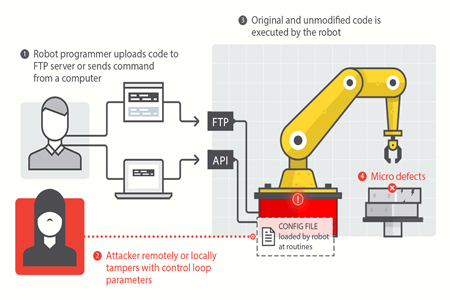
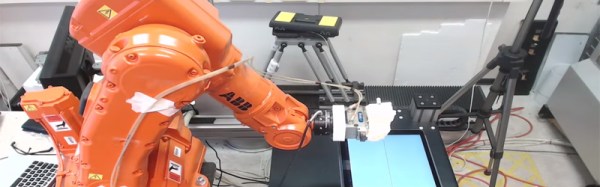
Everything is online these days creating the perfect storm for cyber shenanigans. Sadly, even industrial robotic equipment is easily compromised because of our ever increasingly connected world. A new report by Trend Micro shows a set of attacks on robot arms and other industrial automation hardware.

This may not seem like a big deal but image a scenario where an attacker intentionally builds invisible defects into thousands of cars without the manufacturer even knowing. Just about everything in a car these days is built using robotic arms. The Chassis could be built too weak, the engine could be built with weaknesses that will fail far before the expected lifespan. Even your brake disks could have manufacturing defects introduced by a computer hacker causing them to shatter under heavy braking. The Forward-looking Threat Research (FTR) team decided to check the feasibility of such attacks and what they found was shocking. Tests were performed in a laboratory with a real in work robot. They managed to come up with five different attack methods.


Attack 1: Altering the Controller’s Parameters
The attacker alters the control system so the robot moves unexpectedly or inaccurately, at the attacker’s will.

  • Concrete Effects: Defective or modified products
  • Requirements Violated: Safety, Integrity, Accuracy

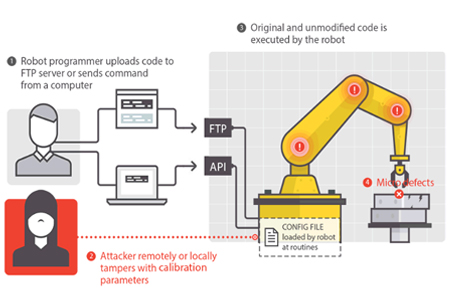
Attack 2: Tampering with Calibration Parameters
The attacker changes the calibration to make the robot move unexpectedly or inaccurately, at the attacker’s will.

  • Concrete Effects: Damage to the robot
  • Requirements Violated: Safety, Integrity, Accuracy

Why are these robots even connected? As automated factories become more complex it becomes a much larger task to maintain all of the systems. The industry is moving toward more connectivity to monitor the performance of all machines on the factory floor, tracking their service lifetime and alerting when preventive maintenance is necessary. This sounds great for its intended use, but as with all connected devices there are vulnerabilities introduced because of this connectivity. This becomes especially concerning when you consider the reality that often equipment that goes into service simply doesn’t get crucial security updates for any number of reasons (ignorance, constant use, etc.).

For the rest of the attack vectors and more detailed info you should refer to the report (PDF) which is quite an interesting read. The video below also shows insight into how these type of attacks might affect the manufacturing process.

Continue reading “Industrial Robots, Hacking And Sabotage”

Sewbo Robot Sews Up Automated Garment Manufacturing

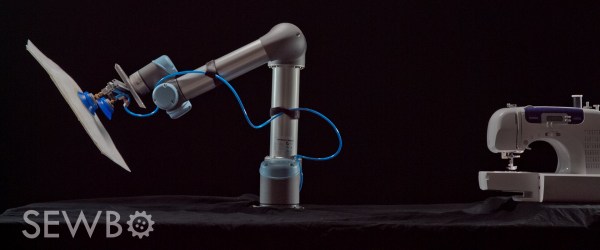
While robots enter other industries in herds, the assembly of garments has long been a tedious, human privilege. Now, for the first time, a robot has sewn an entire, wearable piece of garment. Sewbo, an industrial robot programmed to tackle the tricky task, assembles clothes and makes it look easy.

Continue reading “Sewbo Robot Sews Up Automated Garment Manufacturing”

Tattoos By Robotic Arm With Pinpoint Accuracy

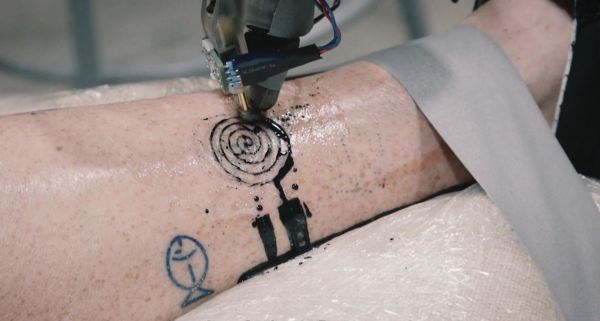
Tattoos are an ancient art, and as with most art, is usually the domain of human expertise. The delicate touch required takes years to master, but with the capacity for perfect accuracy and precision movements, enlisting a robotic arm and some clever software to tattoo a willing canvas is one step closer thanks to the efforts of [Pierre Emm] and [Johan da Silveira].

They began by using a 3D printer modified to ‘print’ with a tattoo needle. Catching the interest of the Applied Research Lab at Autodesk, the next logical step was to use an industrial robot arm get a human under the tattooing machine — dubbed Tatoué — after scanning the limb in question and loading it into Dynamo, their parametric design environment to map the design onto the virtual limb.

Continue reading “Tattoos By Robotic Arm With Pinpoint Accuracy”