
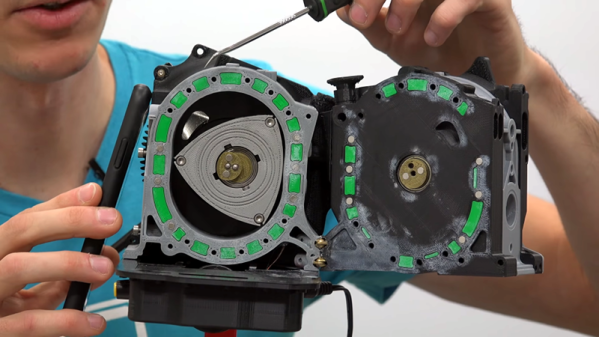
Although there was briefly a company called Rotary Rocket, the term is much better known as a nickname for the Mazda RX-7 — one of the few cars that used a Wankel, or rotary, engine. If you ever wondered how these worked, why not print a model? That’s what [Engineering Explained] did. They printed a 1/3 scale model and made a video explaining and demonstrating its operation. The model itself was from Thingiverse, created by [EricThePoolBoy].
One thing we really liked about the model was the use of lights to show the different stages of combustion. Cool air intake is a blue light, hot air is red, and so on. It really helps visualize what’s happening. You can watch the video below.
If you haven’t seen a Wankel before, it is a clever design. It has very few moving parts and offers very smooth power transfer and high power to weight ratio. The downside, though, is that the engine deliberately burns oil to lubricate and seal, so it is difficult to meet emission standards and requires a lot of oil. The fuel efficiency of current designs is not very good either, especially since manufacturers will often trade fuel efficiency for better emissions.
If you’d like to read more about the Wankel, check out our earlier post (and the 165 comments attached). We also looked at — or rather through — another Wankel earlier this year.
Continue reading “3D-Printing Wankel Engine From Mazda’s Beloved “Rotary Rocket””
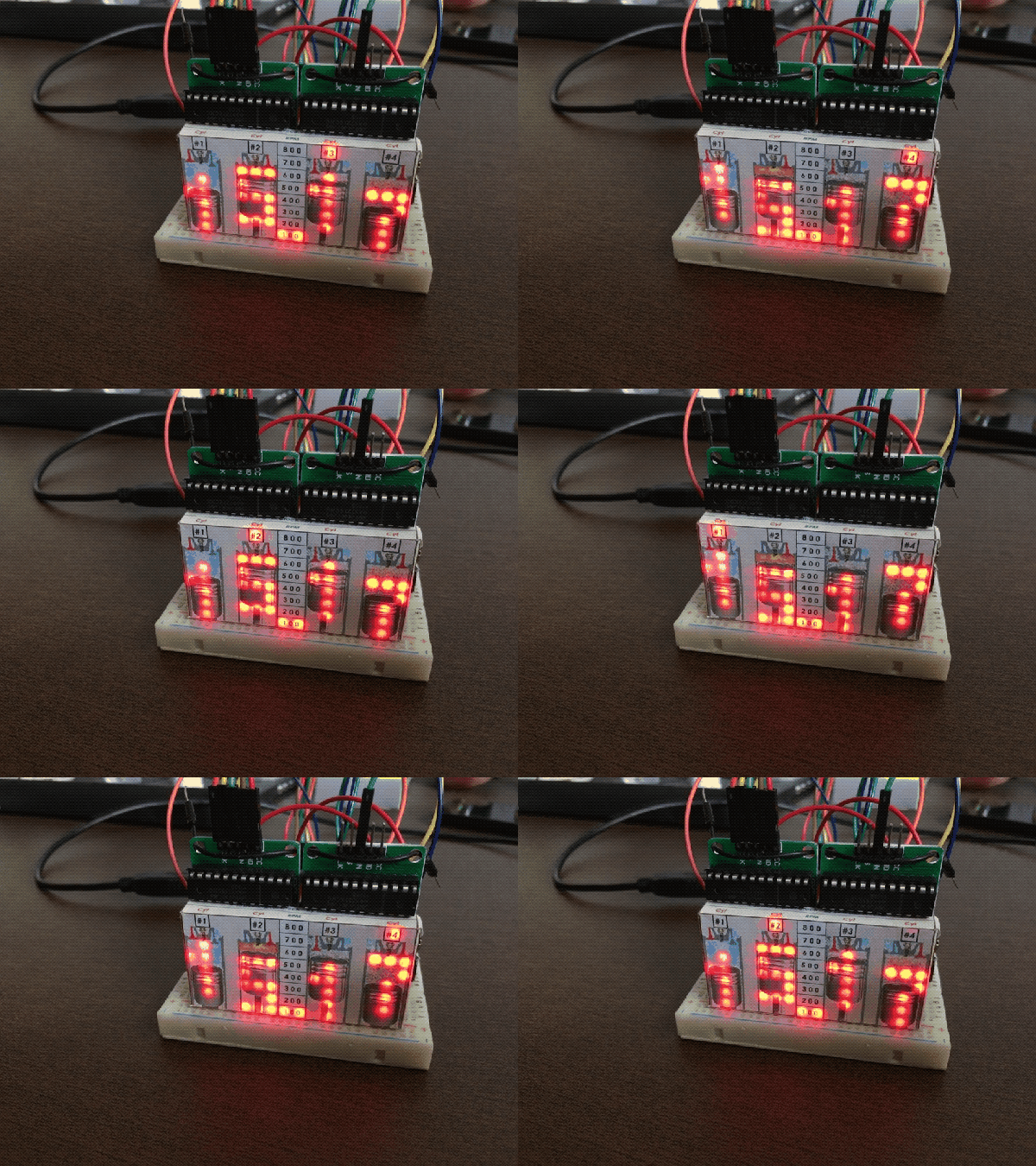
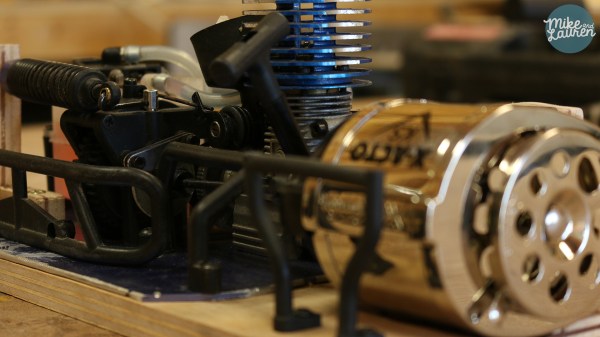

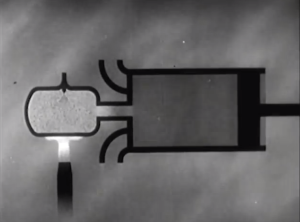 By 1877, [Nikolaus Otto] had completed work on his coal gas engine built on four-stroke theory. This was the first really useful internal combustion engine and the precursor of modern four-stroke engines. It was eventually adapted for transportation with gasoline fuel. In 1890, the hot bulb oil engine was developed under the name Hornsby-Akroyd and primarily used in stationary power plants. Their flywheels had to be started manually, but once the engine was going, the bulb that drove combustion required no further heating.








