Stare Deep Into This Well-lit Interactive Infinity Mirror

infinity-mirror

[acorv] recently sent us a link to a cool, interactive infinity mirror (Translation) he built. He was originally a bit gun-shy about sending the project our way, but our recent Reddit AMA inspired [acorv] to submit it via our tip line, and we’re glad he did.

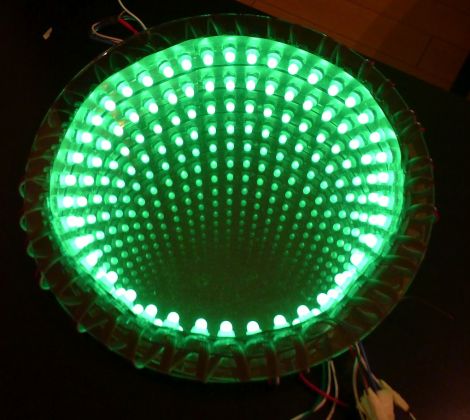
Having been lucky enough to score $100 of gear from Sparkfun’s 2012 Free Day, he picked up a pair of addressable LED strips and a Teensy++. He built an LED ring from reflective foil, sandwiching the strips between a mirror and a piece of mirror glass. The resulting infinity mirror looked nice enough, but [acorv] wanted to make the static display a bit more interesting.

He added an IR receiver and ultrasonic rangefinder to the mirror’s frame, allowing him to both control the display remotely and detect when people were standing nearby. As you can see in the video below, [acorv] can change the patterns on a whim, and the mirror speeds up the display when someone stops to take a closer look.

Continue reading “Stare Deep Into This Well-lit Interactive Infinity Mirror”
Edge-lit Musical Birthday Card

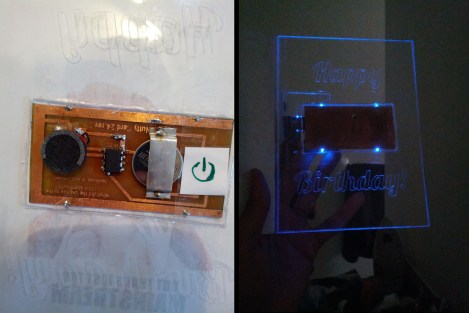
[Monirul Pathan] decided to make the card as unique as this gift when getting ready for a birthday. He designed and built his own musical card with LED edge-lit acrylic to display the message.

The electronic design seeks to keep things as flat as possible. The card-shaped acrylic panel has a void to fit the PCB exactly, and the components are relatively flat. One thing we found quite interesting is that the ATtiny85 which drives the device is surface mounted, but it is not a surface mount component. The layout includes though-hole pads, but instead of drilling holes [Monirul] clipped off the excess of the DIP legs and soldered the remainder directly to the copper. We suppose this isn’t going to get a lot of use so it just needs to hold together for one day.

As you can see in the video after the break, the speaker plays ‘Happy Birthday’ followed by ‘Under the Sea’. At the same time, four blue LEDs pulse to the music, lighting up the words that are engraved in the plastic.

Continue reading “Edge-lit Musical Birthday Card”

Flashing LEDs Protect Livestock From Lion Attacks

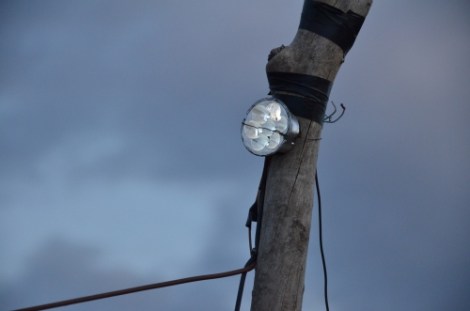
When we think of defense against lion attacks, the first thought is usually guns. Lots and lots of guns.  [Richard Turere], a 13 year old Kenyan tinkerer with neither books nor any technical education, has come up with something entirely different – He’s keeping the lions at bay with a solar powered system of flashing LEDs. Yup. Flashing LEDs.

Since he and his family live next to Nairobi National Park, lion attacks are an ever present danger. The only defense systems available were far too expensive for his family to afford, so he decided to build his own. He utilized the basic resources he had readily available: LED bulbs removed from broken flashlights, some switches, an old car battery, wire, and a solar panel that also operates his family’s TV.

The results speak for themselves. His family has had no lion attacks in over two years, and at least five of his neighbors believe in the system enough to have had him install it on their fences too. With the cost for this set up at less than ten dollars, and all the parts being readily available, this rather basic electrical system is an amazing breakthrough for the Kenyan pastoralists.

We look forward to seeing more of [Richard’s] inventions. Way to go!

LED Cyber Eyes; More Nerdy Than Just Taping Your Glasses

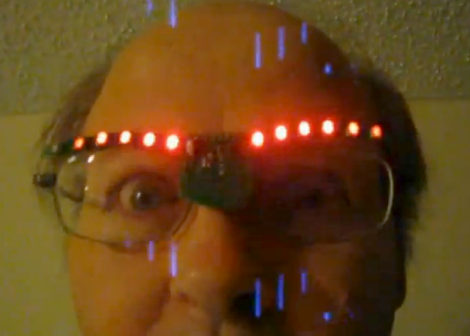
Regular glasses are okay, but these light up and respond to your movement. [Dr. Iguana] is at it again, designing a very interestingly shaped PCB to augment your visual augmentation devices.

The circuit board has two thin curving wings which conform to the shape of a pair of glasses. In the middle there’s a larger area that holds most of the components but it’s still smaller than a common coin cell battery that powers the device. Over each eye there are a half dozen red LEDs which are driven by a PIC 12F1840. It can flash a bunch of patterns the but the interactivity is the real gem of the project. The doctor included an MMA8450 3-axis accelerometer. As you can see in the clip after the break, shaking your head this way and that will be reflected in the pattern of lights.

Continue reading “LED Cyber Eyes; More Nerdy Than Just Taping Your Glasses”

Another Automatic Air Freshener Use

air-freshener-leds-red-on

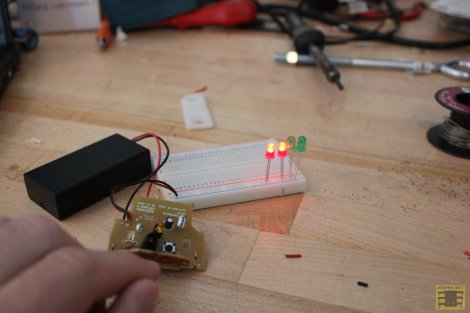
We’ve seen air fresheners used for many hacks here at hackaday. This one is a bit different as it uses the PIR sensor assembly to turn on LEDs in sequence, rather than reversing a motor. Generally, the motor would be reversed by the fact that this assembly is reversing the voltage on a motor (see [H Bridge] on Wikipedia), but instead it turns on one set of LEDs and then the other.

This works because a diode (the “D” in LED) only allows current to flow one way. The LEDs are reversed with respect to the voltage source, making them come on in sequence. An Arduino or other microprocessor could of course be used to accomplish the same thing (see this [HAD] post about harvesting the PIR sensor only). However, if you had $10 or less to start your hardware hacking career, this is yet another way an air freshener can be hacked up to do your bidding.

Be sure to see the video of this simple hack after the break, used to “LED-ify” a Star Wars AT-ST painting. If you’re interested in using the gears and motor of an air fresher as well, why not check out this post on remotely triggering a camera with the internals from a time-based model? Continue reading “Another Automatic Air Freshener Use”

Laser-etched LED Zeotrope Looks Like A Circular Monochrome Screen

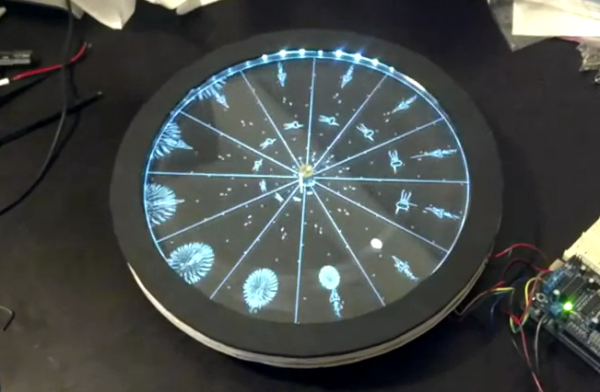
The still image of this animated display really doesn’t do it justice. But you can get an idea of how this really does look like an old monochrome display. It’s actually a zeotrope made from LEDs and etched acrylic. The LEDs blink at a rate that synchronizes with the spinning acrylic to produce an animated image.

You probably already know that a zeotrope uses moving physical models to trick the eye into seeing an animation. In this case the models are etched into a piece of acrylic so that their outline glows when the material is edge-lit. Twelve pie piece shaped panes were designed in Inkscape to look like a scene from the Linux game World War IV. A stepper motor spins the ring which allows for the perfect synchronization seen in the clip after the break.

Continue reading “Laser-etched LED Zeotrope Looks Like A Circular Monochrome Screen”

Nixie Suduku And On-die LEDs

The best booths at Maker Faire draw you in with something unbelievably cool or ridiculously absurd, and bring out a state-of-the-art technology just as your curiosity for the main feature starts to wane. [John Sarik]’s booth for a class he’s TAing at Columbia – Modern Display Science and Technology – is one of these booths.

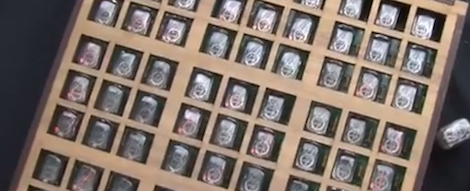
The main feature of the booth is a suduku board filled with 81 Nixie tubes. As shown in the video below, you control the cursor (the decimal point of the Nixies) with a pair of pots. After moving the cursor to the desired location, there’s a keypad to change the number at any one of the 81 locations on a suduku puzzle.

[John]’s presentation then continued to what he’s working on up at Columbia: he’s working on a project to put arrays of LEDs onto silicon, just like any other integrated circuit. He demoed a small LED display built in to a DIP-40 package with a glass (or maybe quartz) window. Yes, it’s a really tiny LED matrix display with a pixel pitch probably much smaller than a traditional LCD display.

Video of the suduku machine after the break, as well as a gallery of the LED matrix on a chip. The matrix was very hard to photograph, so if [John] would be so kind as to send a few more pics in, we’ll be happy to put them up. There’s also a proper video from [John]’s YouTube showing off the Nixie Suduku puzzle solving itself with a recursive algorithm.

Continue reading “Nixie Suduku And On-die LEDs”