10 Meter Long Moving Light Show Is Mesmerizing

light-show

[Marcus] was recently commissioned to put together the electronics for a slick 10 meter long LED installation at the Hsinchu Biomedical Science Park Exhibition Center in Taiwan. While you might assume that he was asked to construct a large LED matrix, this project is a little bit different from what you probably expected.

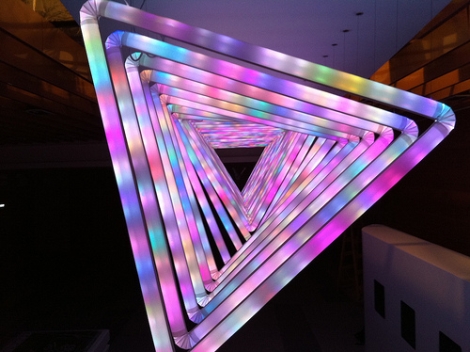
The display is actually a long light tunnel made up of 30 moving triangles suspended from the ceiling. The triangle movement is governed by 60 separate stepper motors, while the lighting is provided by 30 HL1606 RGB LED strips he picked up from Adafruit. The display’s logic is handled completely by an XMOS controller, which is beefy enough to handle controlling all of the stepper motors and the LEDs simultaneously.

After he hand assembled all of the motor driver boards and tested things in his workshop, the whole lot was shipped over to Taiwan for assembly by the on-site crew. After a bit of troubleshooting, they were able to get things working properly, and the display looks great as you can see from the image above.

[Marcus] says that he doesn’t have video of the display in action just yet, though he will update his post whenever he does.

[Thanks, Paul]
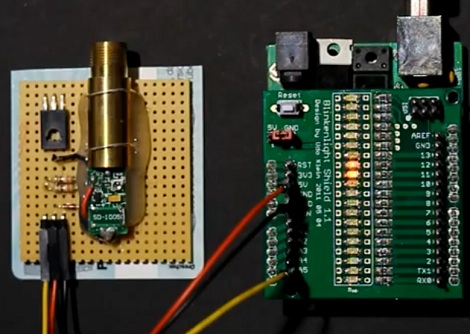
Trying To Measure The Speed Of Light With An Arduino

We know that measuring the speed of light with an Arduino is possible. It’s just that the implementation is hard.

Last month we saw [Udo]’s blinkenlight shield that can be used as a line scan camera. It’s a neat piece of kit, but [Udo] really wants to submit something for the Buildlounge laser cutter giveaway, so he figured measuring the speed of light would be an easy project. If a kid and a chocolate bar can do it, surely it can’t be too hard.

[Udo] hit upon the idea of pulsing a laser pointer and measuring the time of the reflection. Because his blinkenlight shield can be used as a light sensor, all that’s needed is a mirror and a pretty long line of sight. There’s a few problems with the setup though: with the Arduino running at 16 MHz, a photon will travel 19 meters in one clock cycle.

Even with some very clever coding, we’re not really sure detecting an emitted photon is possible at such (relatively) slow clock speeds. We’re thinking [Udo] could source a few hundred meters of optic fiber so the entire experiment could fit on a desk, but feel free to drop a note in the comments if you’ve got a better idea. [Udo]’s demo of his blinkenlight/laser mashup is after the break.

Continue reading “Trying To Measure The Speed Of Light With An Arduino”

Custom Massive LED Panel Lights Up The Party

giant-led-sign

The guys at BuildLounge wrote us to share a giant LED sign they came across in the submission pile for their “Win a Laser Cutter” contest that’s currently under way. [Stephen Shaffer] helps run a huge party called Fantastic Planet, for which the group typically outsources the lighting arrangements. They got tired of hiring light guys several times a year and built their own mega display for the festivities instead.

The LED sign consists of 1,474 LEDs that output well over 10,000 lumens. The sign was produced for just about $800, which is very reasonable for a display of its size. The whole thing is controlled by a pair of Arduinos paired with 34 MIC5891 shift registers, all mounted on custom designed PCBs that the group produced in-house.

The display looks great, but don’t take our word for it – check out the video below to see it in action.

If you are interested in taking a closer look at how it was built, swing by the build thread to see more details.

Continue reading “Custom Massive LED Panel Lights Up The Party”

juke-footwell-lighting

DIY Car Lighting Illuminates Areas The Designers Overlooked

[Dave] just can’t seem to get enough of modifying his new car. Where he lives, it’s typically dark on his ride home from work and he finds himself dropping things on the floor of his car all too often. Nissan decided not to include lighting in the Juke’s foot well or glove box, so [Dave] decided that he needed to rectify the situation.

As you might have noticed by his previous tinkering, [Dave] is a big fan of LEDs and ATTiny microcontrollers. He added some Lego-supported LEDs to the driver and passenger side foot wells, installing an additional light in the glove box while he was at it.

The Juke had a couple of usable blank spots on the dashboard, so [Dave] installed a pair of capacitive touch sensors and a small switch into one of the open slots. When touched, the top-most capacitive pin pair ramps up the foot well lights, while the lower pair turns on the LEDs in the glove box. The switch at the bottom is used to toggle on a light in the back seat which he installed a while back.

It’s a simple addition, but it makes all the difference when he is hunting around on the floor in the dark. We are a bit surprised by how many amenities are missing from the Juke, but tweaking them to his liking seems to keep [Dave] happily occupied.

Continue reading to see a short demo video of his interior lights in action.

Continue reading “DIY Car Lighting Illuminates Areas The Designers Overlooked”

This Giant Hand Made LED Matrix Must Be Ours!

giant-led-matrix

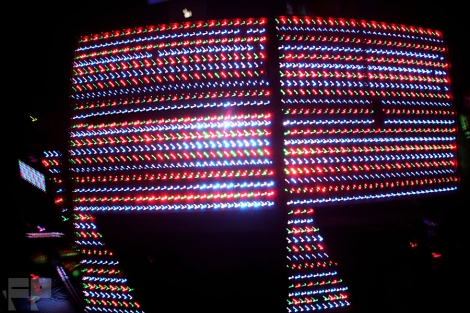
[Martin] wrote in to share a project his company has been working on for some time, a gigantic 1470 pixel LED wall. The group provides lighting for clubs, parties, etc, and their hand-built LED matrix is always certain to be the hit of the show.

The amazing matrix was designed from the ground up and built by hand in [Martin’s] living room. They designed small 32x32mm “pixel” boards, each of which features 6 PLCC6 RGB LEDs driven by a single WS2801 LED controller. The PCBs were populated by hand and each one was reflowed in a small pizza oven that [Martin] owns. After the pixels were completed, they were attached to aluminum bar and combined to build thirty 70x70cm frames which are connected together to form a giant matrix.

As you can see in the collection of videos below, the display is very impressive. We just hope that they will be compelled to release the schematics for their boards so that we can build one of these in the office.

Continue reading “This Giant Hand Made LED Matrix Must Be Ours!”

Monitoring Batch Jobs The Cylon Way With Python And A Parallel Port

parallel-port-trigger

If you happen to do a lot of video encoding, you know that your computer can really drag while the process is carried out. Our own [Mike Szczys] transcodes videos at home fairly often, and because the process is automated, he doesn’t always know if a conversion is taking place in the background.

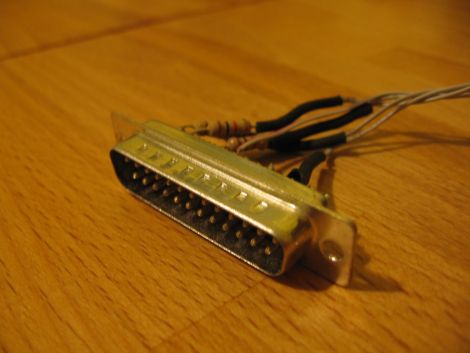
He has been tinkering with Larson Scanners recently and thought he could put everything he’s learned along the way to good use by using the scanner as a “busy” indicator for his PC. He hooked the scanner up to the computer’s parallel port, and took a few minutes to bang out some Python code that would alert him when his PC was busy.

He set his notifier script to launch along with FFMPEG, whenever his MythTV setup had something ready to convert. The Python script drives a pin on the parallel port high, triggering the Larson Scanner’s animation. Every minute, the script checks the status of FFMPEG and continues to hold the pin high until the application exits. Once the conversion is done, the scanner goes back to sleep, letting [Mike] know that the coast is clear.

Check out the video below the break to see his parallel port trigger in action.

Continue reading “Monitoring Batch Jobs The Cylon Way With Python And A Parallel Port”

DIY LED Photography Lights

led-light-box

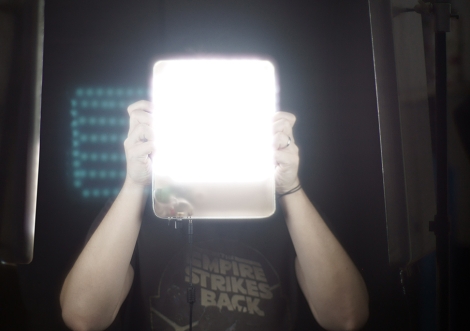
[Markus] had been drooling over some LED panels to use as a soft light source for photography, but being a hobbyist, he didn’t want to spend a ton of money to buy them. He figured that he had enough electronics know-how to build his own panels, while saving a boatload of cash in the process.

He hoped to keep the total cost under £100, so along with new items like LED light strips, he would have to use some stuff he had sitting around, like the metal cooking containers that make up the body of the lights. While originally planned for use in a different project, it turns out that the cooking containers were ideal for his lighting setup, since they are both durable and great heatsink material.

The remainder of the build is pretty straightforward. [Markus] used a pre-made LED dimmer to control the panel’s brightness, along with some tinted plexiglas to diffuse the light while bringing the color temperature into a more usable range.

While he missed his £100 mark, the lights look great – we just might have to build a few of them ourselves.