Towards More Automated Printers

3D printers can be used in a manufacturing context. This might be surprising for anyone who has waited hours for their low-poly Pokemon print, but for low-volume plastic parts, you can actually run a manufacturing line off a few 3D printers. The problem with 3D printers is peeling the print off when it’s finished. If only there were a conveyor belt solution for a bed that wasn’t forgotten by MakerBot.

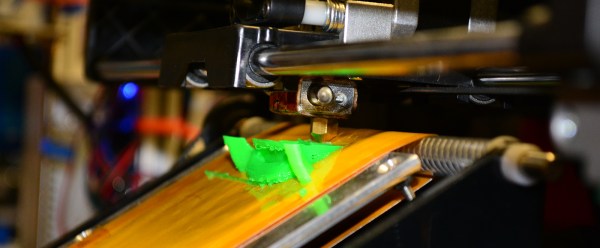
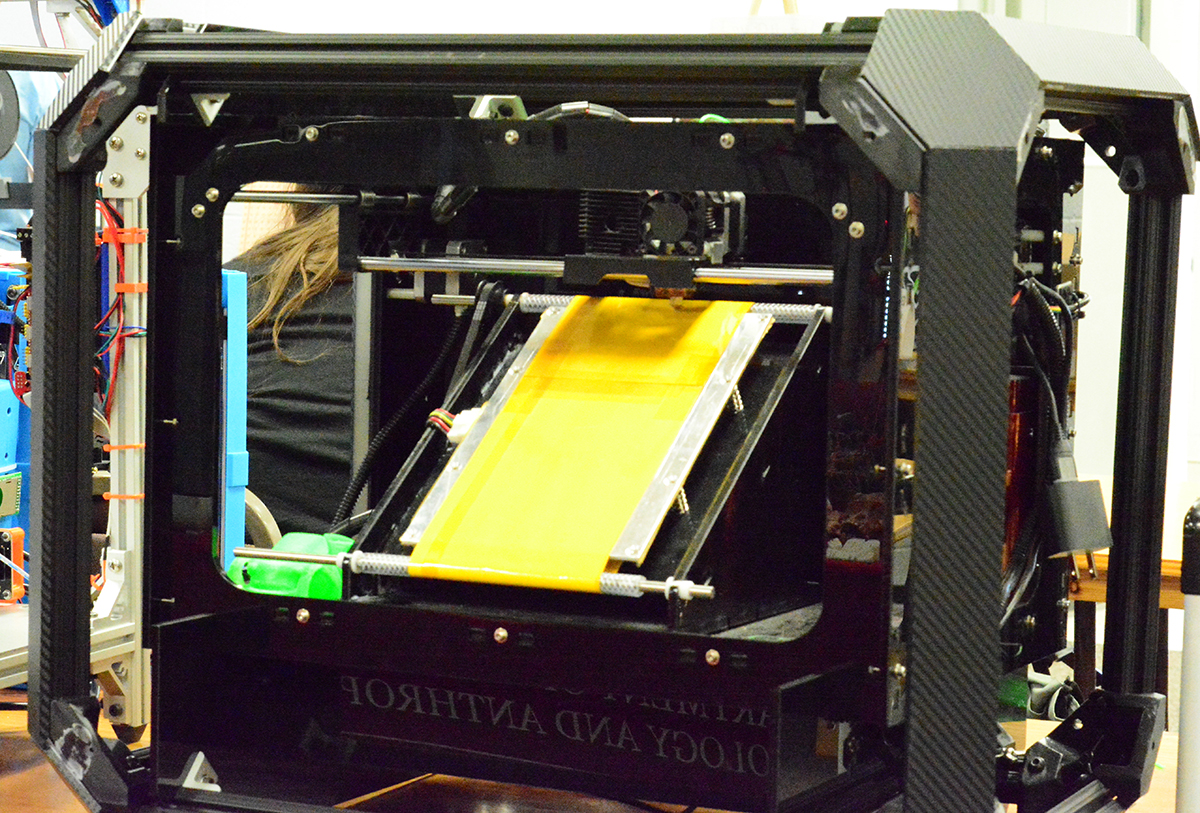
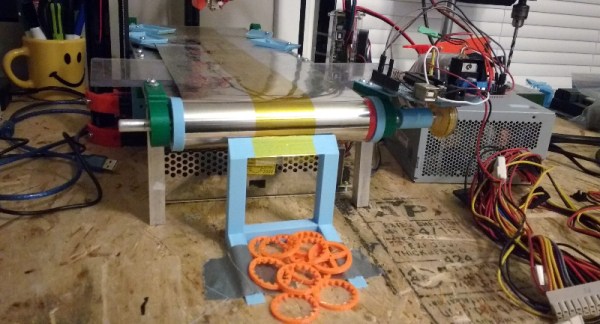
[Swaleh] may have a solution to the problem of un-automated 3D printers. He’s designing the WorkHorse 3D, a printer that uses a conveyor belt as a bed. When the print is finished, the conveyor belt rolls forward, depositing a printed part in a bin. It’s the solution to truly automated printing.

The use of conveyor belts to automate a batch of 3D prints isn’t a new idea. Way back in the Before Time, MakerBot released the Automated Build Platform, and used it in production to print off parts for Thing-O-Matics. This bit of Open Hardware was left by the wayside for some reason, and last year saw the invention of a new type of conveyor belt-based printer, The Infinite Build Volume Printer (for lack of a better name) from [Bill Steele]. This printer angles the print bed at 45 degrees, theoretically allowing for prints that are infinitely long. This idea was turned into the Printrbot Printrbelt, and the Blackbelt 3D printer was made public around the same time.

[Swaleh]’s printer is not of the infinite build volume variety. Instead of concentrating on creating long beams, most of the engineering work has gone into making a printer that’s designed to just push prints out. The conveyor belt bed is flat — and may unfortunately infringe on the MakerBot patents — but if you want a printer that’s designed to dump parts out like a very slow injection molding machine, this is the design you want.

The print queue application for this project is just a simple desktop app that serves as a buffer for G-code files. The app sends one G-code file off to the printer, rolls the bed forward, and queues up the next part. It’s simple, yes, but there aren’t too many things that do this now because there aren’t too many printers built to be factories. It’s impressive, and you can check out a few videos of this printer in action below.

Continue reading “Towards More Automated Printers”

MakerBot Really Wants You To Like Them Again

For the last couple years, a MakerBot press release has generally signaled that more pink slips were going to be heading out to the already shell-shocked employees at their NYC factory. But just last week something that could almost pass as good news came out of the once mighty 3D printer manufacturer, the unveiling of “MakerBot Labs”. A number of mainstream tech sites heralded this as MakerBot’s first steps back into the open source community that launched it nearly a decade ago; signs of a newer and more thoughtful MakerBot.

Reading the announcement for “MakerBot Labs”, you can almost believe it. All the buzz words are there, at least. In fact, if this announcement came from anyone else, in any other field, I’d probably be on board. Sharing knowledge and listening to the community is essential if you want to connect with hackers and makers. But this is MakerBot, and they’ve dug themselves into a very deep hole over the years.

The spectacular fall from grace that MakerBot has experienced, from industry leader to afterthought, makes this hat-in-hand peace offering hard to take seriously. It reads like a company making a last ditch effort to win back the users they were so sure they didn’t need just a few years ago. There is now a whole new generation of 3D printer owners who likely have never even seen a MakerBot printer, and it’s hard to imagine there’s still enough innovation and life in the company to turn that around before they completely fade into obscurity.

Continue reading “MakerBot Really Wants You To Like Them Again”

VCF: 3D Printing In The 80s

The Vintage Computer Festival East is going down right now, and I’m surrounded by the height of technology from the 1970s and 80s. Oddly enough, Hackaday frequently covers another technology from the 80s, although you wouldn’t think of it as such. 3D printing was invented in the late 1980s, and since patents are only around for 20 years, this means 3D printing first became popular back in the 2000’s.

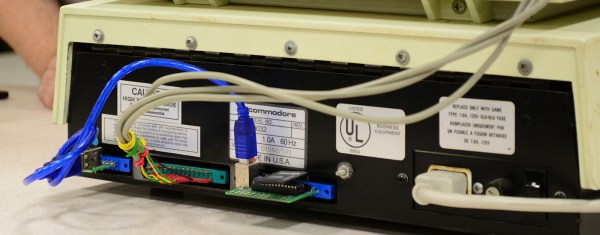
In the 1970s, the first personal computers came out of garages. In the early 2000s, the first 3D printers came out of workshops and hackerspaces. These parallels pose an interesting question – is it possible to build a 1980s-era 3D printer controlled by a contemporary computer? That was the focus of a talk from [Ethan Dicks] of the Columbus Idea Foundry this weekend at the Vintage Computer Festival.

Continue reading “VCF: 3D Printing In The 80s”

MRRF 17: A Working MakerBot Cupcake

The Midwest RepRap Festival is the best place to go if you want to see the latest in desktop 3D printing. This weekend, we saw full-color 3D printers, a printer with an infinite build volume, new extruders, a fantastic development in the pursuit of Open Source filament, and a whole bunch of D-bots. If you want the bleeding edge in 3D printing, you’re going to Goshen, Indiana.

Of course, it wasn’t always like this. In 2009, MakerBot released the Cupcake, a tiny printer that ushered in the era of democratized 3D printing. The Cupcake was a primitive machine, but it existed, it was open source, and it was cheap – under $500 if you bought it at the right time. This was the printer that brought customized plastic parts to the masses, and even today no hackerspace is complete without an unused Cupcake or Thing-O-Matic sitting in the corner.

The MakerBot Cupcake has not aged well. This should be expected for a technology that is advancing as quickly as 3D printing, but today it’s rare to see a working first generation MakerBot. Not only was the Cupcake limited by the technology available to hackers in 2009, there are some pretty poor design choices in these printers. There’s a reason that old plywood MakerBot in your hackerspace isn’t used anymore – it’s probably broken.

This year at MRRF, [Ryan Branch] of River City Labs brought out his space’s MakerBot Cupcake, serial number 1515 of 2,625 total Cupcakes ever made. He got his Cupcake to print a test cube. If you’re at all familiar with the Cupcake, yes, this is a hack. It’s a miracle these things ever worked in the first place.

Continue reading “MRRF 17: A Working MakerBot Cupcake”

MRRF 17: The Infinite Build Volume Printer

Before we dig into this one, a bit of a history lesson is in order. In 2010, MakerBot released the Automated Build Platform for the MakerBot Cupcake. This build platform was like nothing seen before or since. It’s a combination build platform and a conveyor belt for a 3D printer, allowing the Cupcake to become a completely automated production machine. Start a print, let the machine run, and when the print is finished it’s rolled off the bed into a bin, allowing a second print to start. If you’re using 3D printers for production in a manufacturing context – like Makerbot was – this is a phenomenal invention.

The Automated Build Platform was released under an Open Source license, then quickly patented by Makerbot. Since 2010, the idea of an automated build platform has been dead. No one is working on a similar device, lest they draw the ire of a few MakerBot lawyers.

This year’s Midwest RepRap Festival saw a device that’s an even better idea than MakerBot’s Automated Build platform. Yes, it’s a continuous factory of 3D printed parts, but there’s an even better reason for you to build one of these things: this printer has an infinite build volume.

This printer – it doesn’t have a name; this is just a one-off project – is the work of [Bill Steele] of Polar3D. The core of the build is just a hacked up MakerBot Replicator, but with one important difference. This printer has an Automated Build Platform tilted away from the nozzle at a 45-degree angle. What’s the benefit of this setup? Continuous printing and an infinite build volume.

Despite being downright bizarre, the mechanics for this printer are actually pretty simple. The bed is a standard MakerBot heated bed, rotated 90 degrees in the axis you would expect, then rotated 45 degrees in the axis you wouldn’t. A conveyor belt made of Kapton-coated paper is strung between two rollers and connected to a motor.

To produce a print, this printer starts at the very back and the very top of this conveyor belt. The first layer is added, the conveyor belt rolls forward a bit, and the second layer is added on top. The effect for each print is that the layer lines are 45 degrees from what you would expect.

When the print is finished, the belt just rolls forward until the part falls into a bin. Of course, since there’s nothing stopping this printer from producing a meter-long part on this build platform. [Bill] has already produced a 3D printed chain using this printer that was four feet long. Each segment of the chain just fell off the end of the printer when it was done.

There’s still some work to do with this idea. There isn’t a way to tension the belt on this printer, and [Bill] is looking for a material that’s better than Kapton coated paper. Still, this is the most innovative printer you can find at the Midwest RepRap Festival, and it’s not encumbered by the MakerBot patent on the automated build platform. You can check out a video of this printer below.

Continue reading “MRRF 17: The Infinite Build Volume Printer”

More Layoffs At MakerBot

MakerBot CEO [Nadav Goshen] announced that changes are needed to ensure product innovation and support long-term goals in a blog post published yesterday. To that end, MakerBot will reduce its staff by 30%. This follows a series of layoffs over a year ago that reduced the MakerBot workforce by 36%. With this latest series of layoffs, MakerBot has cut its workforce by over 50% in the span of two years.

In addition to these layoffs, the hardware and software teams will be combined. Interestingly, the current Director of Digital Products, [Lucas Levin], will be promoted to VP of Product. Many in the 3D printer community have speculated MakerBot is pivoting from a hardware company to a software company. [Levin]’s promotion could be the first sign of this transition.

When discussing MakerBot, many will cite the documentary Print the Legend. While it is a good introduction to the beginnings of the desktop 3D printer industry, it is by no means complete. The documentary came out too early, it really doesn’t mention the un-open sourceness of MakerBot, the lawsuit with Form Labs wasn’t covered, and there wasn’t a word on how literally every other 3D printer manufacturer is selling more printers than MakerBot right now.

Is this the end of MakerBot? No, but SYSS is back to the pre-3D-printer-hype levels. Stratasys’ yearly financial report should be out in a month or so. Last year, that report was the inspiration for the MakerBot obituary. It’s still relevant, and proving to be more and more correct, at least from where MakerBot’s Hardware business stands.

MakerBot Releases Their 6th Generation Of 3D Printers

Just in time for the back to school and holiday season, Makerbot has released their latest line of printers. The latest additions to the lineup include the new Makerbot Replicator+ and the Makerbot Replicator Mini+.

The release of these new printers marks MakerBot’s first major product release since the disastrous introduction of the 5th generation of MakerBots in early 2014. The 5th generation of MakerBots included the Replicator Mini, priced at $1300, the Replicator, priced at $2500, and the Replicator Z18, priced at $6500. Comparing the build volume of these printers with the rest of the 3D printer market, these printers were overpriced. The capabilities of these printers didn’t move many units, either (for instance, the printers could only print in PLA). Makerbot was at least wise enough to continue building the 4th generation Replicator 2X, a printer that was capable of dual extrusion and printing more demanding filaments.

The release of the Makerbot Replicator+ and the Makerbot Replicator Mini+ is the sixth generation of MakerBot printers and the first generation of MakerBot’s manufactured overseas. This new generation is a hardware improvement on several fronts and included a complete redesign of the Makerbot Replicator and the Replicator Mini. The Replicator Mini+ features a 28% larger build volume than the original MakerBot Replicator Mini and an easily removable Grip Build Surface that can be flexed to remove a printed part. The Replicator+ features a 22% larger build volume than the MakerBot Replicator and a new Grip Build Surface. The Replicator Mini+ is $1000 ($300 cheaper than its predecessor), and the Replicator+ is $2000 ($500 less expensive). Both new printers, and the old Replicator Z18, now ship with the improved Smart Extruder+.

While the release of two new MakerBots does mean new hardware will make it into the wild, this is not the largest part of MakerBot’s latest press release. The big news is improved software. Makerbot Print is a slicer that allows Windows users to directly import 3D design files from SolidWorks, IGES, and STEP file formats. Only .STL files may be imported into the OS X version of the Makerbot Print software. MakerBot Mobile, an app available through the Apple Store and Google Play, allows users to monitor their printer from a smartphone.

Earlier this year, we wrote the Makerbot Obituary. From the heady days of The Colbert Report and an era where 3D printing would solve everything, MakerBot has fallen a long way. In the first four months of 2016, MakerBot only sold an average of about fifteen per day, well below the production estimated from the serial numbers of the first and second generation Makerbots, the Cupcake and Thing-O-Matic.

While this latest hardware release is improving the MakerBot brand by making the machines more affordable and giving the software some features which aren’t in the usual Open Source slicers, it remains to be seen if these efforts are enough. Time, or more specifically, the Stratasys financial reports, will tell.