Adding MIDI To An Old Casio Keyboard

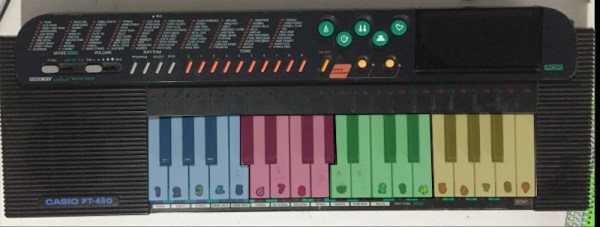
Not content to rule the world of digital watches, Casio also dominated the home musical keyboard market in decades past. If you wanted an instrument to make noises that sounded approximately nothing like what they were supposed to be, you couldn’t go past a Casio. [Marwan] had just such a keyboard, and wanted to use it with their PC, but the low-end instrumented lacked MIDI. Of course, such functionality is but a simple hack away.

The hack involved opening up the instrument and wiring the original keyboard matrix to the digital inputs of an Arduino Uno. The keys are read as a simple multiplexed array, and with a little work, [Marwan] had the scheme figured out. With the Arduino now capable of detecting keypresses, [Marwan] whipped up some code to turn this into relevant MIDI data. Then, it was simply a case of reprogramming the Arduino Uno’s ATMega 16U2 USB interface chip to act as a USB-MIDI device, and the hack was complete.

Now, featuring a USB-MIDI interface, it’s easy to use the keyboard to play virtual instruments on any modern PC DAW. As it’s a popular standard, it should work with most tablets and smartphones too, if you’re that way inclined. Of course, if you’re more into modular synthesizers, you might want to think about working with CV instead!

Drumming A Beat On A Hundred-Year-Old Typewriter

We have seen a fair share of unusual items being turned into musical instruments. Luckily, with a little bit of hacking it is possible to turn almost anything into a MIDI controller. [William Sun Petrus] just converted a 1920s typewriter into a drum machine and delivers a hell of a live performance on it.

The build is rather simple, all [William Sun Petrus] needed was an Arduino Mega and lots of wires to convert a hundred-year-old Remington typewriter into a MIDI controller. Whenever a key is pressed the hammer hits a metal plate at the center of the typewriter and closes the contact between one of the Arduino’s IO pins and the 5 V rail like a regular push button. The Arduino code is based on the MIDI library sending commands to a PC which is running Hairless MIDI and Ableton. As sort of a gimmick, [William Sun Petrus] included an LCD screen which shows a line from Green Eggs and Ham by Dr. Seuss every time a key is pressed.

Interestingly, the latency due to the hammer’s travel time does not disturb [William Sun Petrus’] live play. To calm the skeptics in the comments he also released an unedited version of the video to prove that the performance is real and an instructional video on how to play his beat note by note.

Other unusual MIDI controllers include a bandoneon accordion or this English concertina.

Video after the break.

Continue reading “Drumming A Beat On A Hundred-Year-Old Typewriter”

Signal The End Of A Print With MIDI Of Your Choice

The end of every 3D print should be a triumphant moment, and deserves a theme song. [FuseBox2R] decided to make it a reality, and wrote tool for converting MIDI tracks to G-code that uses the buzzer on your 3D printer.

The tool is up on GitHub, and uses the M300 speaker command that is available in Marlin and some other 3D printer firmware packages. It takes the form of a static HTML page with in-line JavaScript that converts a midi track to series of speaker commands with the appropriate frequency and duration parameters, using the Tone.js framework. Simply add to your slicer G-code to add a bit of spice to your prints. You can also build a MIDI jukebox using the RAMPS board and LCD you probably have gathering dust somewhere. See the video after the break for a demonstration, including a rendition of the DOOM theme song, and off course Mario Bros.

For more quarantine projects, you can also play MIDI using the stepper motors on your printer, or build a day clock if time is becoming too much of a blur.

Continue reading “Signal The End Of A Print With MIDI Of Your Choice”

Quieting Down A Bandoneon Accordion With MIDI

The bandoneon, known as the tango accordion, is quite a loud instrument to practice within the confines of an apartment, and could possibly lead to some neighborly disputes. [HLB] enjoyed playing his but wanted a way to turn down the volume a bit without, in consideration to his neighbors. Instead of building a whole soundproof room, he decided to throw Arduino’s and MIDI at the problem.

Bandoneons, like all accordions, are operated by pushing air from manually pumped bellows through a series of reeds, which are each opened and closed by a valve mechanism. [HLT] turned each valve lever into a simple on/off switch by attaching a magnet, with hall-effect sensors on long custom PCBs next to each row of valves. The hall effect sensors are connected to I2C I/O expander ICs which connect to an Arduino Nano, one for each side of the instrument, which sends out MIDI messages via serial. Everything is mounted inside what looks like quite an old instrument with Blu Tack to avoid having to make a lot of permanent modifications.

The bandoneon still functions normally with no permanent modifications, so to play with MIDI-only the bellow is simply not pumped. This means [HLB] can’t modulate the MIDI velocity (loudness) while playing, which he admits is a limitation but better than not playing at all. He does, however, note that he could add a pressure sensor inside the bellow if we wanted to add velocity to the midi output when neighbourliness isn’t a consideration. On the audio output side [HLB] built a small stand-alone synthesizer with an Odroid SBC running FluidSynth and a HiFi shield.

Continue reading “Quieting Down A Bandoneon Accordion With MIDI”

Unique Musical Instrument Defies Description

Since the first of our ancestors discovered that banging a stick on a hollow log makes a jolly sound, we hominids have been finding new and unusual ways to make music. We haven’t come close to tapping out the potential for novel instruments, but then again it’s not every day that we come across a unique instrument and a new sound, as is the case with this string-plucking robot harp.

Named “Greg’s Harp” after builder [Frank Piesik]’s friend [Gregor], this three-stringed instrument almost defies classification. It’s sort of like a harp, but different, and sort of like an electric guitar, but not quite. Each steel string has three different ways to be played: what [Frank] calls “KickUps”, which are solenoids that strike the strings; an “eBow” coil stimulator; and a small motor with plastic plectra that pluck the strings. Each creates a unique sound at the fundamental frequency of the string, while servo-controlled hoops around each string serve as a robotic fretboard to change the notes. Sound is picked up by piezo transducers, and everything is controlled by a pair of Nanos and a Teensy, which takes care of MIDI duties.

Check out the video below and see if you find the sound both familiar and completely new. We’ve been featuring unique instruments builds forever, from not-quite-violins to self-playing kalimbas to the Theremincello, but we still find this one enchanting.

Continue reading “Unique Musical Instrument Defies Description”

Controlling A Building Sized Pipe Organ With Midi

Musical instruments come in all shapes and sizes. For sheer scale and complexity though, you can’t beat pipe organs. [Rob Scallon] visited the Fourth Presbyterian Church in Chicago to look at their massive pipe organ which boasts over 8000 individual pipes. He also discovered that it has a MIDI interface, and off course hooked up his laptop to play the Mario Bros theme song.

This organ is actually the third one the church has had, and was completed in 2016. Its capabilities are impressive, but the engineering side of it is what really blew us away. Every pipe is unique to allow it to recreate the sound of almost an entire orchestra, and the “control station” looks a bit like the cockpit of modern airliner in terms of complexity. The organ covers multiple stories across multiple parts of the church and every single pipe and part needs to be accessible for tuning and maintenance, which is almost a full time job. Check out the first video after the break for a full demonstration and tour of this incredible machine by [John Sherer], the church’s music director and organist.

The second video after the break goes through the process of hooking up a laptop to the organ after getting a technician to completely wire up the MIDI interface. They go full music geek as they marry ancient and modern music technology. [Rob] says it multiple times, and we have to believe that you need to be in the building to truly experience the sound. Let us know in the comments if any readers have heard this organ in person.

Continue reading “Controlling A Building Sized Pipe Organ With Midi”

Brute-Forced Copyrighting: Liberating All The Melodies

Bluntly stated, music is in the end just applied physics. Harmony follows — depending on the genre — a more or less fixed set of rules, and there  are a limited amount of variation possible within the space of music itself. So there are technically only so many melodies possible, making it essentially a question of time until a songwriter or composer would come up with a certain sequence of notes without knowing that they’re not the first one to do so until the cease and desist letters start rolling in.

You might well argue that there is more to a song than just the melody — and you are absolutely right. However, current copyright laws and past court rulings may not care much about that. Aiming to point out these flaws in the laws, musician tech guy with a law degree [Damien Riehl] and musician software developer [Noah Rubin] got together to simply create every possible melody as MIDI files, releasing them under the Creative Commons Zero license. While their current list is limited to a few scales of fixed length, with the code available on GitHub, it’s really just a matter of brute-forcing literally every single possible melody.

Admittedly, such a list of melodies might not have too much practical use, but for [Damien] and [Noah] it’s anyway more about the legal and philosophical aspects: musicians shouldn’t worry about getting sued over a few overlapping notes. So while the list serves as a “safe set of melodies” they put in the public domain, their bigger goal is to mathematically point out the finite space of music that shouldn’t be copyrightable in the first place. And they definitely have a point — just imagine where music would be today if you could copyright and sue over chord progressions.
Continue reading “Brute-Forced Copyrighting: Liberating All The Melodies”