MIDI Out For A Korg CX-3 Organ

midi-out-for-a-vintage-korg-cx-3-organ

[Michael] loves this old organ of his, but recently he wondered if it would be possible to add MIDI out without altering its original functionality. With a bit of research and more than a bit of hard work he accomplished his goal.

The nice thing about working on a quality piece of hardware like this is the resources you can find regarding how they work (which we bet is tailored for how to repair them when they break). [Michael] found a website with plenty of info on the circuit boards and how they work. From this he was able to locate a few chips which stream serial data regarding which keys have been pressed. Bingo!

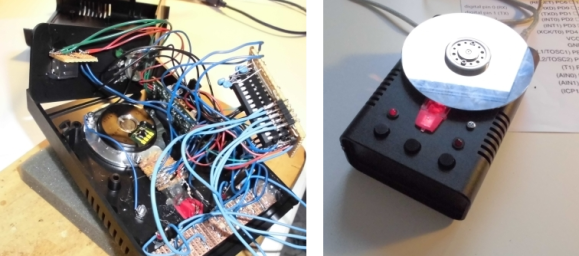
Once he located the three signals he was after he built a board to translate them to the MIDI protocol. His circuit is based around an ATtiny2313. It is supported by a liner voltage regulator circuit as well as a buffer chip which converts the incoming signals to the 5V levels needed. His home etched board is clean and well mounted, and the success of the project can be heard in the clip after the jump.

Continue reading “MIDI Out For A Korg CX-3 Organ”

Automatic Tubular Bells Given A MIDI Interface Too

automatic-tubular-bells

We’ve got to say it… these tubular bells sound awful! They don’t really have a tight pitch center so they sound really out of tune to us. But we think that’s the failing of the instrument itself and not the work which [Tolaemon] did to automate the instrument.

There are three main parts to his project. The first, which is shown above, adds a hammer for each bell. The hammers are hinged, with one side being pulled by a solenoid in order to strike the bell. The second part of the hack also uses solenoids, dampening the bell’s ability to ring by pressing a felt pad up against the bottom of the tube. The final portion of the project brings it all home by adding MIDI control to the hardware.

The clip after the break gives a good overview of the different features including some preprogrammed playback as well as direct control of the instrument using an electric keyboard. This reminds us of that scratch-built solenoid xylophone.

Continue reading “Automatic Tubular Bells Given A MIDI Interface Too”

Hackaday Links: Sunday, April 21st, 2013

hackaday-links-chain

Regular reader and master hacker [Bill Porter] got married. Congratulations [Bill] and [Mara]! The two of them just couldn’t leave their soldering irons at home. The actually swore their vows by soldering together a circuit during the ceremony (blinky wedding dress, el wire tuxedo, and all).

[Kevin] sent in a link to [Red Fathom’s] hacked Wacom tablet. It’s the screen from a Wacom-enabled laptop brought back to life with a Teensy and an LVDS interface module.

The Neato XV-11 is able to find its charging station when the batteries run low. [Derek] figured out that you can make a second station using some reflective tape.

If you use your drill a lot you’ll eventually break the rubber thing that holds the key to the chuck. Here’s a way to 3D print a replacement.

[Torxe] put eight floppy drives to use as a polyphonic Arduino-controlled MIDI player. And while we’re on the subject of Arduino controlled projects you should take a look at this web-interface to tell you if the foosball table is being used.

And finally [Th3 Bad Wolf] sent in this link to a milling machine built out of LEGO. It is able to mill floral foam and uses a lathe-like setup for one of the table axes.

3D Printing Some Sweet Music

3d-printer-music

If you don’t mind ending up with oddly shaped 3D printed parts you can get your printer to sing to you. The exhibit shown above is doing just that. The Lulzbot is being driven specifically to produce a certain frequency of sound with its stepper motors. The results of a few different songs are what’s hanging on the wall to the right. You can hear it printing Bizet’s Carmen in the clip after the break.

[Rickard Dahlstrand] hacked together a Python script capable of parsing a MIDI file and outputting a G-code equivalent that will produce the frequencies and durations necessary to hear the audio on a stepper motor. As we mentioned, he uses a Lulzbot but the script appears to include setting for Cupcake, Thingomatic, Shapercube, and Ultimaker. The parser script as well as the example G-code files for a library of classical music can be downloaded from his repository.

Now if you’re looking for some other crazy CNC music ideas you can’t beat this wineglass music hack.

Continue reading “3D Printing Some Sweet Music”

Horribly Complicated Electric Guitar Keyboard

the-email-gutar

Gutarist, hacker, and mustache enthusiast [David Neevel] brought together way too many pieces of hardware in order to use his electric guitar as a computer keyboard.

So let’s dig into the house of cards he built for the project. It starts off with the guitar which has been fitted with an additional pickup to interface with a Roland GR-33 synthesizer pedal. That outputs a MIDI signal, which many hackers would have connected to the computer and parsed with a simple script. But not [David], he connected it to an Arduino via an optisolator. Well that’s not too ridiculous, right? Don’t you think he’ll just parse the MIDI signals and push them to the computer via the Arduino’s USB port? Wrong! He translates the MIDI signals into combinations for a big relay board which is emulating the key matrix of an old USB keyboard. But as you can see in the demo video after the jump it works quite well.

If you’re more of the drumming sort there’s an electric drum set version of this hack too.

Continue reading “Horribly Complicated Electric Guitar Keyboard”

MIDI Pedal Project Looks As Good As It Sounds

organ-pedal-midi-project

[Lee O’Donnell] is showing off his version of a MIDI organ pedal hack. We’ve been seeing a few of these lately. The organ pedals are a great stating point as they’re easy to patch into electronically, and are designed to take a beating from your feet and come out the other side no worse for wear. The build goes beyond one of our favorite MIDI pedal conversions in both features and finish.

An Arduino Nano pulls this project together. It scans the pedals constantly and converts the key presses into MIDI signals. But the design includes this fabulous looking front-end which [Lee] first prototyped in cardboard before cutting and bending his own Aluminum tread plate. A two-row character display provides a menu system, but the buttons themselves act as feedback based on the behavior of the light inside each of them. One example of this is shown early in the demo video after the break. The blue button toggles between polyphonic and monophonic mode with the light fading in and out for the latter.

Continue reading “MIDI Pedal Project Looks As Good As It Sounds”

Hi-Hat MIDI Controller

midi-hi-hat-controller

Drumming hackers take note, if you’ve got an extra bass drum pedal it’s cheap and simple to use it as a MIDI controller. This rig was thrown together to supplement a DIG DRUM electric drum set. That piece of equipment has a pedal add-on that didn’t come with it. Turns out all it does is feed a resistance value to the set.

To get this up and running a frame was built from a metal base and acrylic side piece. The acrylic hosts a trimmable potentiometer which connects to an 1/4″ stereo jack right beside it. This facilitates connecting the pedal to the drum set using an audio patch cable. Interface with the pedal is accomplished with a few bits from the hardware store. The axle of the pedal sticks out one side, and is clamped between two washers. The other side of the washer grip the timpot causing it to move when the pedal does.

This hardware is a snap to use with your own MIDI device. We’d suggest giving the HIDUINO package a try.