Muon Magnetic Moment Matches Model, Making Major Malaise

Sometimes, a major discovery is exactly what you were hoping not to find. That’s the case with a team at Penn State who seem to have recently closed the door on any new physics stemming from a longstanding discrepency in the magnetic moment of the muon. It turns out, the model was fine, and we just needed better calculations.

The Muon is a heavier cousin to the electron. Like the electron, it has an intrinsic magnetic moment, but the traditional methods to calculate it did not quite match experiments, which was very exciting because it made us hope our models could be improved. Rather than try the traditional approximation methods for the unsolvable equations, the group at Penn State set up what you can think of as the Quantum Chromodynamic equivalent of a Finite Element Model (FEM) simulation–a grid of discrete steps in space and time. Tiny ones, of course, because the muon, like the electron, is a point-like particle with no lower size limit. In any case, according to their paper in Nature, after a decade of refinement and increasingly expensive supercomputer runs, the mystery can be put to bed. Instead of the discrepancy that so exited physicists 25 years ago when it was first found, theory and experiment now match to 11 digits, or a 0.5 sigma discrepancy, if you prefer.

Statistically, the Standard Model works– and that kind of sucks. It sucks, because it’s the gaps in the model where new physics are possible, and everyone has been pushing at those few gaps for the last 50 years to try and find what might be behind the standard model. Even [Zoltan Fodor], the principle investigator behind this project, is sad to see it work out. Sure, it’s a feather in his cap to get the calculations right at last–but ask anybody in the field, and they’d rather keep the door open to new physics than be right. We were certainly hoping it was something novel, last time the topic came up.

You might think muons are the last thing a hacker would ever encounter, but since there’s a steady rain of them from the sky in the form of cosmic rays, it’s not only easy to interact with them, you can actually put them to practical use– like muon tomography, or navigation indoors and underground.

Header Image Credit: Dani Zemba / Penn State
Building A DIY Muon Tomography Device For About $100

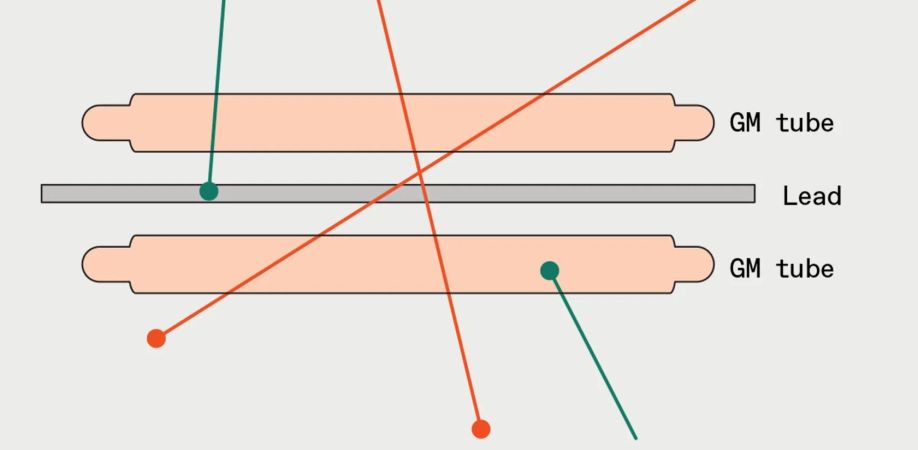
Muon tomography, or muography, is the practice of using muons generated by cosmic rays interacting with Earth’s atmosphere to image structures on Earth’s surface, akin to producing an X-ray. In lieu of spending a fair bit of money on dedicated muon detectors, you can also hack such a device together with two Geiger-Müller tubes and related circuitry for about $100 or whatever you can source the components for.

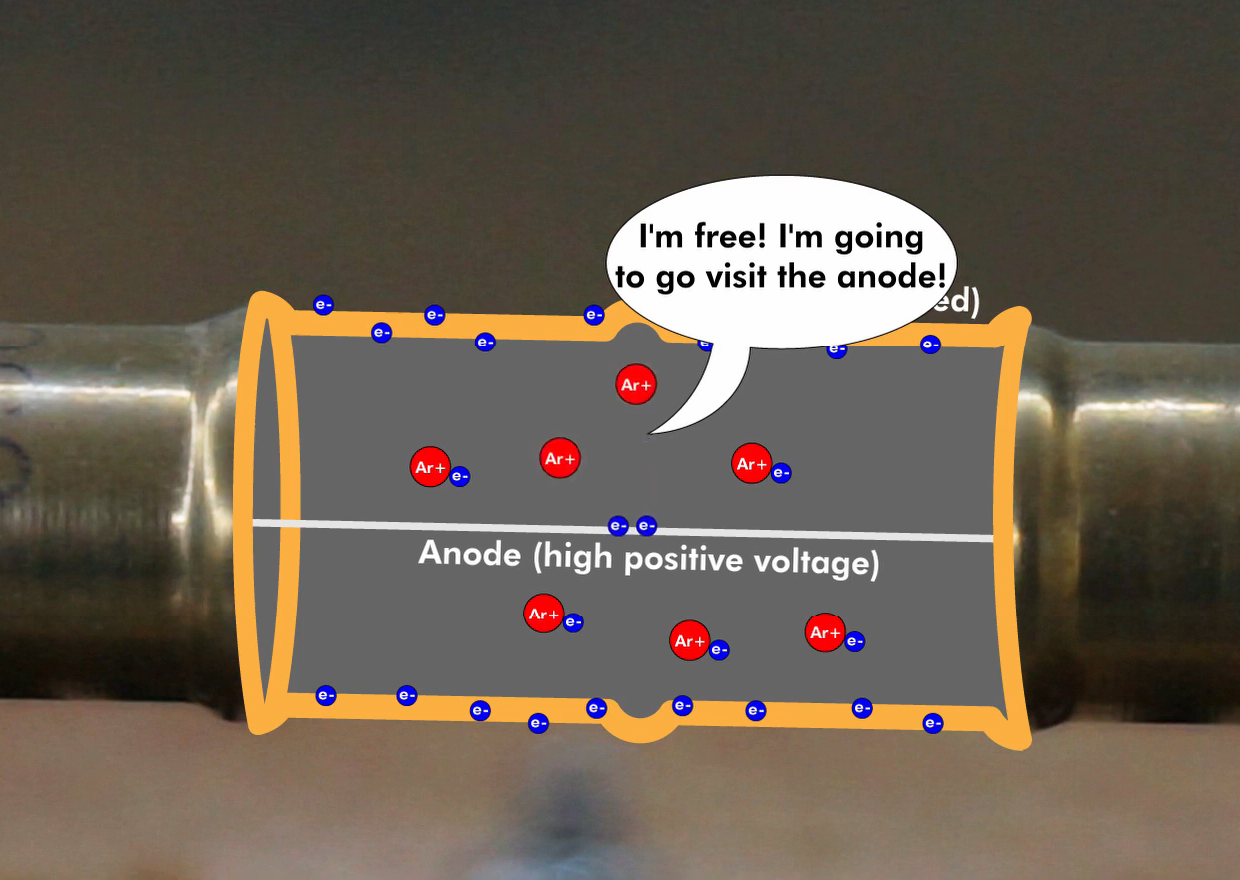
The reason for having two Geiger-Müller tubes is to filter out other much more prevalent sources of ionizing radiation that we’re practically bathed in every second. Helped by a sheet of lead between both tubes, only a signal occurring at the same time from both tubes should be a muon. Specially cosmic ray muons, as these have significantly more kinetic energy that allows them to pass through both tubes. As a simple check it’s helpful to know that most of these muons will come from the direction of the sky.

The author of the article tested this cobbled-together detector in an old gold mine. Once there the presence of more rock, and fewer muons, was easily detected, as well as a surge in muons indicating a nearby void from a mine shaft. While not a fast or super-easy way to image structures, it’s hard to beat for the price and the hours of fun you can have while spelunking.

Demo Relativity For A C-Note

If you are a science fiction fan, you probably hate the theory of relativity. After all, how can the Enterprise get to a new star system every week if you can’t go faster than the speed of light? [Nick Lucid] wants to set you straight: it is real, and you can prove it to yourself for under $100.

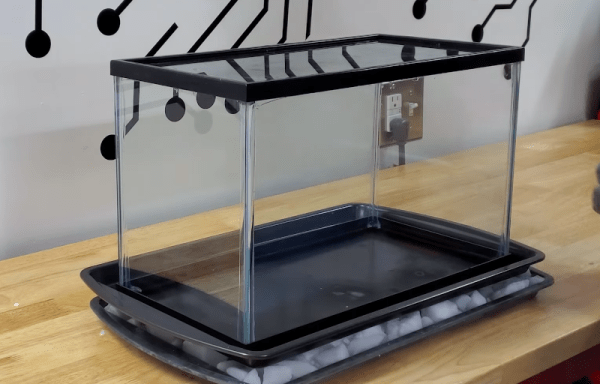
The idea uses muons created in our atmosphere by cosmic rays colliding with gasses in the atmosphere. So how do you detect muons yourself? [Nick] shows you how to do it with a fish tank, dry ice, and rubbing alcohol. If that sounds like a cloud chamber, you aren’t wrong.

A cloud chamber is undeniably cool, but how does it prove relativity? You’ll see several kinds of particles interacting with your cloud chamber, but you can tell which ones are muons by the size and motion of the streaks. The muons don’t last very long. So you’d expect very few muons to make it to the surface of the Earth. But they not only reach the surface but go deep under it, as well.

So how do you explain it? Relatively. The muon experiences its average 2.2 microseconds lifetime in what appears to us to be over 150 microseconds, even if it is moving relatively slowly for a muon. Some muons are faster or live longer, so we see a lot of them hit the Earth every minute of every day. This is due to time dilation and also explains length contraction because the muon moves at a certain speed, yet it appears to go further to us than to the muon.

Coincidentally, we recently discussed this same effect relative to using muons for underground navigation. If you want an easier way to count muons with a computer, you can build a detector for about the same price as the cloud chamber.

Continue reading “Demo Relativity For A C-Note”

Cosmic Ray Navigation

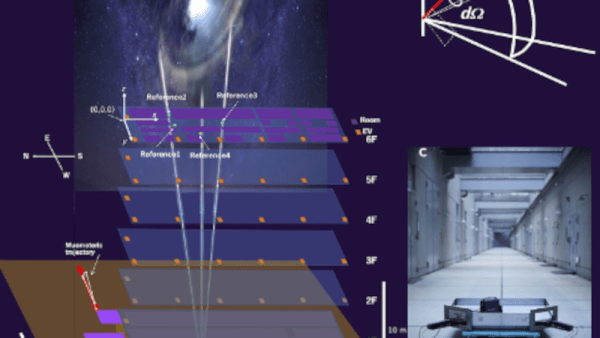
GPS is a handy modern gadget — until you go inside, underground, or underwater. Japanese researchers want to build a GPS-like system with a twist. It uses cosmic ray muons, which can easily penetrate buildings to create high-precision navigation systems. You can read about it in their recent paper. The technology goes by MUWNS or wireless muometric navigation system — quite a mouthful.

With GPS, satellites with well-known positions beam a signal that allows location determination. However, those signals are relatively weak radio waves. In this new technique, the reference points are also placed in well-understood positions, but instead of sending a signal, they detect cosmic rays and relay information about what it detects to receivers.

The receivers also pick up cosmic rays, and by determining the differences in detection, very precise navigation is possible. Like GPS, you need a well-synchronized clock and a way for the reference receivers to communicate with the receiver.

Muons penetrate deeper than other particles because of their greater mass. Cosmic rays form secondary muons in the atmosphere. About 10,000 muons reach every square meter of our planet at any minute. In reality, the cosmic ray impacts atoms in the atmosphere and creates pions which decay rapidly into muons. The muon lifetime is short, but time dilation means that a short life traveling at 99% of the speed of light seems much longer on Earth and this allows them to reach deep underground before they expire.

Detecting muons might not be as hard as you think. Even a Raspberry Pi can do it.

The Mysterious Wobble Of Muons

You might think that particle physicists would be sad when an experiment comes up with different results than their theory would predict, but nothing brightens up a field like unexplained phenomena.  Indeed, particle physicists have been feverishly looking for deviations from the Standard Model. This year, there have been tantalizing signs that a long unresolved discrepancy between theory and experiment will be confirmed by new experimental results.

In particular, the quest to measure the magnetic moment of muons started more than 60 years ago, and this has been measured ever more precisely since. From an experiment in 1959 at CERN in Switzerland, to the turn of the century at Brookhaven, to this year’s result at Fermilab, the magnetic moment of the muon seems to be at odds with theoretical predictions.

Although a statistical fluke is basically excluded, this value also relies on complex theoretical calculations that are not all in agreement. Instead of heralding a new era of physics, it might just be another headline too good to be true. But some physicists are mumbling “new particle” in hushed tones. Let’s see what all the fuss is about.

Continue reading “The Mysterious Wobble Of Muons”

Random Numbers From Outer Space

Need a random number? Sure, you could just roll a die, but if you do, you might invite laughter from nearby quantum enthusiasts. If it’s truly, unpredictably random numbers you need, look no farther than the background radiation constantly bombarding us from the safety of its celestial hideout.

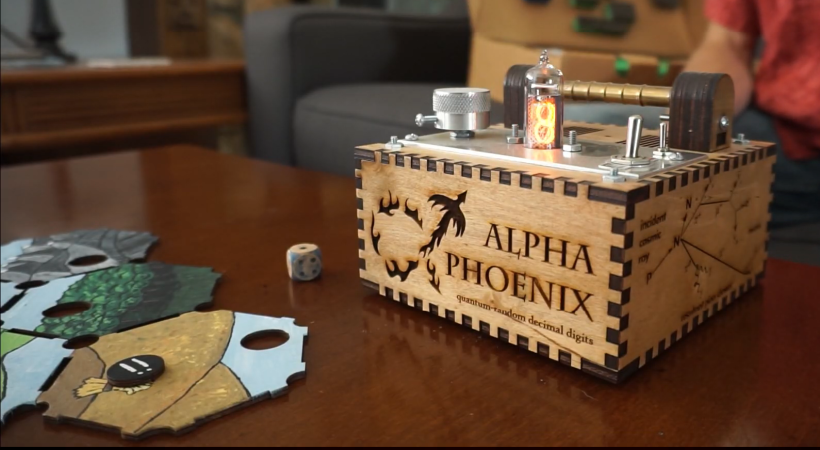
In a rare but much appreciated break from the Nixie tube norm of clock making, [Alpha-Phoenix] has designed a muon-powered random number generator around that warm, vintage glow. Muons are subatomic particles that are like electrons, but much heavier, and are created when pions enter the atmosphere and undergo radioactive decay. The Geiger-Müller tube, mainstay of Geiger counters the world over, detects these incoming muons and uses them to generate the number.

Inside the box, a 555 in astable mode drives a decade counter, which outputs the numbers 0-9 sequentially on the Nixie via beefy transistors. While the G-M tube waits for muons, the numbers just cycle through repeatedly, looking pretty. When a muon hits the tube, a second 555 tells the decade counter to stop immediately. Bingo, you have your random number! The only trouble we can see with this method is that if you need a number right away, you might have to go get a banana and wave it near the G-M tube.

Whether this all makes sense or not, you should check out [Alpha-Phoenix]’s project video, which is as entertaining as it is informative. He’s planning a follow-up video focused on the randomness of the G-M tube, so look out for that.

Looking for a cheaper way to catch your random numbers? You can do it with a fish tank, some air pumps, and a sprinkle of OpenCV.

Continue reading “Random Numbers From Outer Space”

Cheap Muon Detectors Go Aloft On High-Altitude Balloon Mission

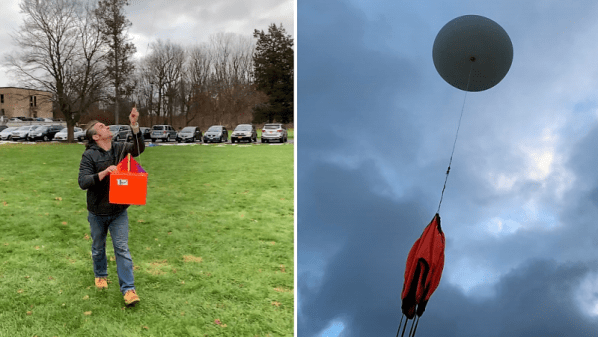
There’s something compelling about high-altitude ballooning. For not very much money, you can release a helium-filled bag and let it carry a small payload aloft, and with any luck graze the edge of space. But once you retrieve your payload package – if you ever do – and look at the pretty pictures, you’ll probably be looking for the next challenge. In that case, adding a little science with this high-altitude muon detector might be a good mission for your next flight.

[Jeremy and Jason Cope] took their inspiration for their HAB mission from our coverage of a cheap muon detector intended exactly for this kind of citizen science. Muons constantly rain down upon the Earth from space with the atmosphere absorbing some of them, so the detection rate should increase with altitude. [The Cope brothers] flew two of the detectors, to do coincidence counting to distinguish muons from background radiation, along with the usual suite of gear, like a GPS tracker and their 2016 Hackaday prize entry flight data recorder for HABs.

The payload went upstairs on a leaky balloon starting from upstate New York and covered 364 miles (586 km) while managing to get to 62,000 feet (19,000 meters) over a five-hour trip. The [Copes] recovered their package in Maine with the help of a professional tree-climber, and their data showed the expected increase in muon flux with altitude. The GoPro died early in the flight, but the surviving footage makes a nice video of the trip.

Continue reading “Cheap Muon Detectors Go Aloft On High-Altitude Balloon Mission”