Hackaday Links Column Banner

Hackaday Links: August 16, 2026

We’re no strangers to unusual hardware failures around these parts, but even so, a swarm of jellyfish clogging up the works is a new one to us. That’s exactly what happened to the cooling system at the Gravelines nuclear power plant in France earlier this week, resulting in three reactors having to be shut down. This isn’t even an isolated incident, as POLITICO points out that the same thing actually happened last year around this same time.

So why are jellyfish staging an annual protest against nuclear power? A warming of the North Sea has extended breeding seasons and produced larger populations of the plankton that the jellyfish feed on. This is great for the gelatinous sea creatures, but not exactly ideal if you’re trying to pump the water they live in through a complex cooling system. The French installed filter screens and monitoring systems after this happened in 2025, but clearly they’re going to need to keep working on the problem.

From a new problem to a very old one, a BBC investigation has revealed that the UK’s National Health Service (NHS) Blood and Transplant department was inadvertently leaking private patient data by sending it in the clear over the pager network. Sniffing pager messages was fairly trivial decades ago, and is even easier these days thanks to the proliferation of cheap software-defined radios and open source decoding software. Given the fragility of the underlying communication network they use, the NHS announced they were going to stop using pagers by 2021, but clearly not everyone got the memo.

Continue reading “Hackaday Links: August 16, 2026”

How The Chornobyl NPP Got Modernized In The 1990s

During the 1990s the Chornobyl Nuclear Power Plant – formerly the Chernobyl NPP – continued operating with its remaining three RBMK reactors, but of course the 1970s-era automation with its very limited SKALA computer required some serious modernization. What was interesting here is that instead of just replacing this entire Soviet-era mainframe with a brand-new 1990s one, the engineers responsible opted to build a new system – called DIIS – around it. This is detailed in a recent video by the [Chornobyl Family] on YouTube.

This SKALA industrial control system was previously detailed in a video, covering this 24-bit mainframe computer and its many limitations. It wasn’t quite a real-time control system, but it basically did what it was designed to do. Since at the time it was not clear for how long these three RBMKs would be kept running, they didn’t want to go overboard with investments either.

Ultimately Unit 2 only was active until 1991 due to a turbine fire, Unit 1 until 1996 and Unit 3 was shutdown for the last time in 2000, so this a sensible decision. During those years, an auxiliary information-measurement system (DIIS) was the big upgrade, which got bridged into SKALA via a Ukrainian-made SM-1210 minicomputer, with the latter connected to an 80386 PC which itself was connected to an ARCnet hub.

Continue reading “How The Chornobyl NPP Got Modernized In The 1990s”

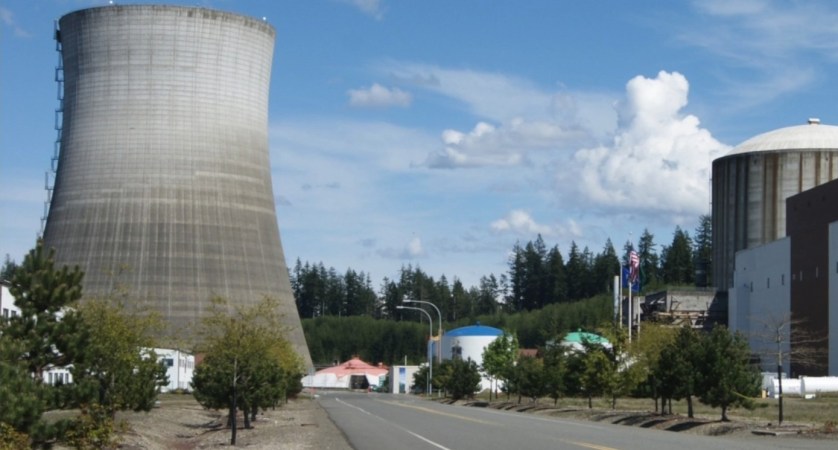
A nuclear coolant tower dwarfs other buildings in the area.

They Hacked A Nuclear Power Plant! Whoops! Don’t Make A Sound!

What do you do with an unused nuclear reactor project? In Washington, one of them was hacked to remove sound, all in the name of science.

In 1977, a little way outside of Seattle, Washington Nuclear Projects 3 and 5 (WNP-3 and WNP-5) were started as part of Washington Public Power Supply System (WPPSS, pronounced “whoops”). They ran over budget, and in the 80s they were mothballed even though WNP-3 was nearly complete.

Continue reading “They Hacked A Nuclear Power Plant! Whoops! Don’t Make A Sound!”