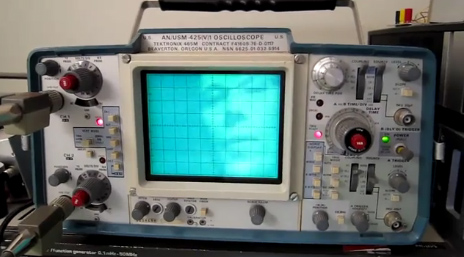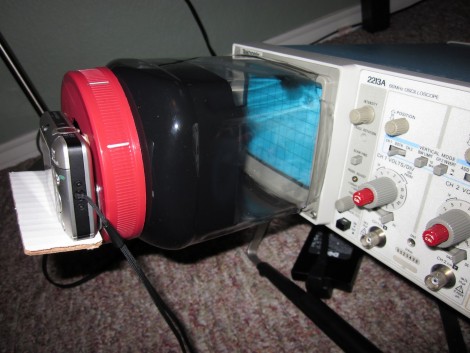
TV Oscilloscope

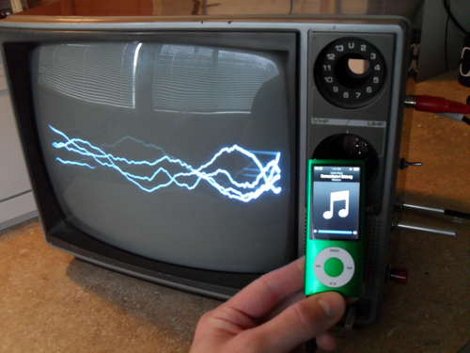
Need an oscilloscope? Want to see the music? Don’t have money, but do have a old TV? Then this TV to oscilloscope mod may be right up your alley. Now don’t go running off just yet, when you’re working inside of a CRT device you are exposed to mains current, high voltage, and high frequency, so extra care needs to be observed .

If you have your rubber welding gloves, and have discharged all your fat capacitors (including the CRT) its pretty much the same magic trick as couple we have previously featured. Patch an amplified input signal into the vertical deflection coil and let her go, but this instructable features much more detailed instruction, and photos so you have a much better chance of replicating this (not quite lab grade) potentially useful device.

Join us after the break for a short video.

Continue reading “TV Oscilloscope”

Giant Oscilloscope Music Display

oscilloscope_wall

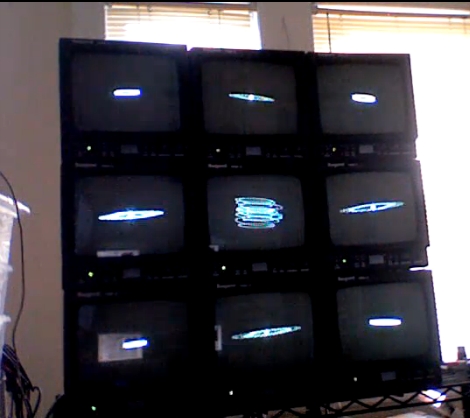
[Andrew] sent us a video of his home made oscilloscope wall, which he uses to visualize different audio tracks he has created. The wall is made up of nine old broadcast monitors he wired together in his studio. At first it appears that the monitors are split into two sets of four, with the center monitor running separately, but upon further inspection it looks as if he can control the display of each monitor independently.

We’re pretty sure he is not using an actual oscilloscope to generate the visuals, but rather visualization software that can approximate the output of an O-scope set in X-Y display mode. Though the screens run independently, it would be great to see all nine screens working in concert to display one large visualization. [Andrew] mentions that an high-def version is in the works, so perhaps we’ll see more features added in that iteration.

Stick around to watch a video of his oscilloscope wall in motion.

Continue reading “Giant Oscilloscope Music Display”

Reverse Engineering Shopping Cart Security

All this talk about 555 timers is causing projects to pop out of the woodwork like this one that reverse engineers a shopping cart security mechanism. The wheel seen above listens for a particular magnetic signal and when encountered it locks down the yellow cowl, preventing the wheel from touching the ground and making the cart very hard to move.

[Nolan Blender] acquired one of these wheels for testing purposes and he’s posted some details about the hardware inside. But the first thing he did was to put together some test equipment to help find out details about the signal that trips the mechanism. He connected a coil to an audio amplifier and walked around the market looking for strong signals. Once he found a few strong bursts with that equipment he grabbed an oscilloscope, hooked it to the coil, and made some measurements. He found an 8 kHz signal at a 50% duty cycle at 30 ms intervals (it would be hard to make a better case for why you need an oscilloscope).

With the specs in hand, [Nolan] grabbed two 555 timers, an audio amplifier, and a 200 turn antenna around a ferrite core to build his own locking mechanism. If you’re ever stopped short in the middle of the market, just look for the hacker at the end of the aisle holding the homemade electronics.

[Photo source]

[Thanks Colin]

Xprotolab: Oscilloscope And Xmega Development Board

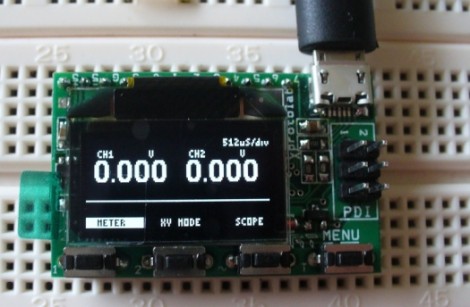
Here’s a nice hands-on overview of the Xprotolab, a development board based around the AVR ATxmega32A4 microcontroller. The tiny DIP package includes an OLED display, four tactile switches, and it can be powered via a micro USB connector. The device ships ready to use as a two-channel Oscilloscope, but check out how small it is in the video after the break to decide if this will actually be useful for you. It’s not that it doesn’t have a lot of features, in fact it’s packed with them, but that screen is quite small for meaningful work. Still, at $35 it’s an inexpensive way to get your hands on the hardware and acquaint yourself with this line of microprocessors. Not that in order to flash new firmware you will need a PDI capable programmer. Continue reading “Xprotolab: Oscilloscope And Xmega Development Board”

Double The Hertz, Double The Pleasure

[tinhead] has opened up a Tekway DST1102B oscilloscope and doubled its bandwidth to 200MHz, sharing his work in the eevblog forum. This is great news to anyone who is looking for a faster sampling rate but can’t afford the high-end models. Mind you, for a lot of us even these Hanteks and Tekways are hard to afford but there are more appropriate options for the ramen-dependent hacker.

In the hacking guide [tinhead] includes comprehensive information on the different scopes he originally considered (a Rigol, Atten and UniTrend) before settling on the Tekway, as well as links to regional distributors for the hackable scope. Good quality benchtop units are invaluable for development and troubleshooting, and it pays off to understand their inner workings. It’s heartwarming to know that even the tools of hacking can be hacked.

Android Oscilloscope

Here’s a 2-channel Oscilloscope for your Android phone. It uses a base module driven by a dsPIC for signal processing. From there, an LMX9838 Bluetooth module broadcasts the data to the phone so that the waveform can be displayed. [Yus] ported some Python code he had been using over to a set of Java and XML files in order to get it working on Android. This was actually the first time he worked with the SDK… we’d say he’s a quick learner. See it in action after the break.

Continue reading “Android Oscilloscope”

40 MSPS Digital Oscilloscope

If you can fabricate single-sided circuit boards at home you can build this digital oscilloscope. It uses mostly through-hole components with just a couple of surface mount chips to contend with. An ATmega162 handles the hardware end of things with a CPLD used to manage the sampling rate. Data is displayed on a 240×128 LCD display which will be the most expensive component to acquire. It’s still a lot cheaper than buying a commercially available oscilloscope, even if you get a base model and hack it to unlock all the features.

[Thanks Juan]