
Bluetooth Shock Collar Keeps Wearer On Task

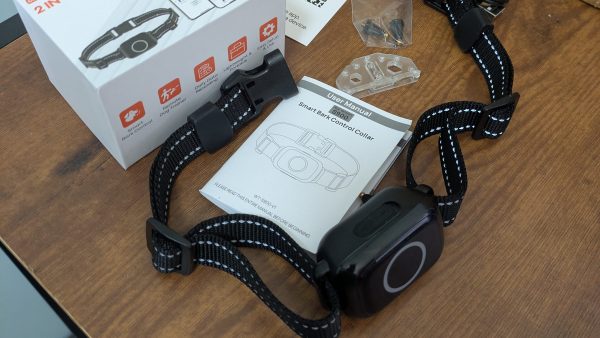
Like a lot of us [Liam Kloppers] had a problem with doomscrolling. Unwilling to go cold-turkey because he does find some utility in social media. He tried a number of things before deciding to say “Screw it” and just go full Pavlov on himself with some old-fashioned classical conditioning. Who needs willpower when you have electric shocks to dissuade you?

The key here was finding an electric-shock dog collar that could be controlled via a smartphone application, which meant he could reverse-engineer its Bluetooth protocol and get it linked up to his own software. The initial implementation ties his quick-and-dirty Python control program with a web server living on his laptop, which he’s configured MacroDroid to call on when his personal criterion for ‘doomscrolling’ is met.

With the shock collar wrapped around his leg, [Liam] was ready to test. It turns out dogs are a lot tougher than people, because even when set to a low level, the shock from the device made him toss his phone across the room and had him hesitant to even pick it up again.

Since he couldn’t bring himself to put the shock collar back onto his leg, he’s now thinking of an audible alarm, something we’ve seen work before. If you’re as unhappy with your habits as [Liam], perhaps consider a device like Commodore’s social-media-free phone before resorting to self-electrocution.

Head-Up Display Augments Bionic Turtle’s Reality

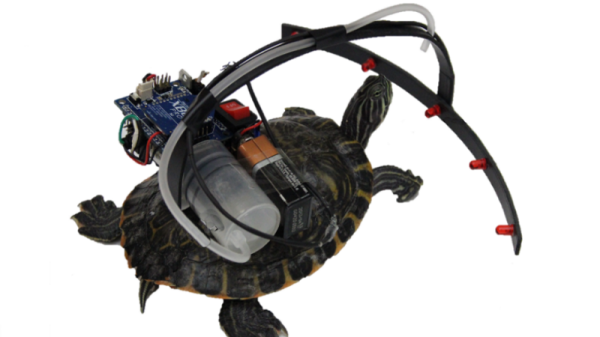
There’s a harsh truth underlying all robotic research: compared to evolution, we suck at making things move. Nature has a couple billion years of practice making things that can slide, hop, fly, swim and run, so why not leverage those platforms? That’s the idea behind this turtle with a navigation robot strapped to its back.

This reminds us somewhat of an alternative universe sci-fi story by S.M. Stirling called The Sky People.  In the story, Venus is teeming with dinosaurs that Terran colonists use as beasts of burden with brain implants that stimulate pleasure centers to control them. While the team led by [Phill Seung-Lee] at the Korean Advanced Institute of Science and Technology isn’t likely to get as much work from the red-eared slider turtle as the colonists in the story got from their bionic dinosaurs, there’s still plenty to learn from a setup like this. Using what amounts to a head-up display for the turtle in the form of a strip of LEDs, along with a food dispenser for positive reinforcement, the bionic terrapin is trained to associate food with the flashing LEDs. The LEDs are then used as cues as the turtle navigates between waypoints in a tank. Sadly, the full article is behind a paywall, but the video below gives you a taste of the gripping action.

Looking for something between amphibian and fictional dinosaurs to play mind games with? Why not make your best friend bionic? Continue reading “Head-Up Display Augments Bionic Turtle’s Reality”








