PICMAN, A Diy Prototyping Setup

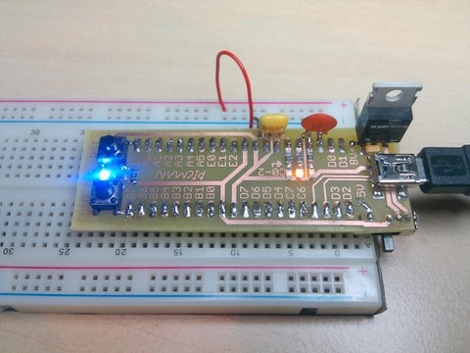
[Ytai Ben-Tsvi] wanted a rapid prototyping tool that could be easily and cheaply built at home. He came up with the PICMAN, a breadboard compatible PIC based board that has everything you need to get the ball rolling. He’s using a PIC18LF4553 which has built-in USB support that can be used with a bootloader for programming. The board also features a voltage regulator for non-USB power sources, some indicator LEDs, a user-defined button, and a reset button. The chip is on the underside and a combination of through-hole and surface-mount parts make for a one-sided PCB that can easily be etched using the toner transfer method. You will need a PIC programmer to burn the bootloader firmware the first time but once that’s done this becomes a self-contained package.
Home Fabricated Boards In Any Color

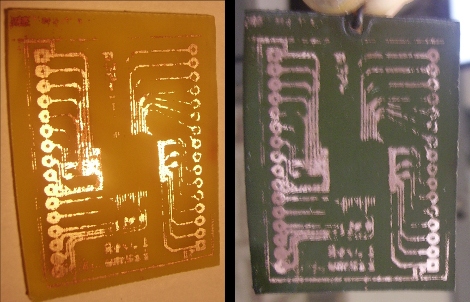
Tired of every printed circuit board you etch coming out brown? Take a page out of [Dane’s] book and dye your PCB to just about any color you want. One hour submerged in a 200 degree bath of Rit dye turned his brown FR4 substrate to the desired dark green. We give him points for being dangerous enough to use a broken bottle as a vessel, yet wearing eye protection at the same time.

We never really thought of doing this, but it’s pretty interesting that it works. We’ve stained the substrate when removing etch resist so this should have been obvious, but wasn’t.

Laser Cutting Solder Stencils

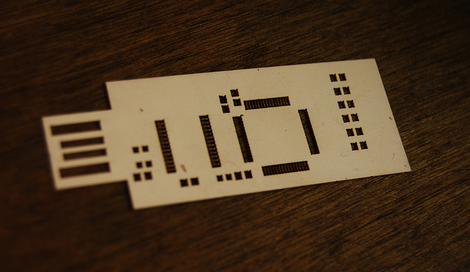
Do you have access to a laser cutter? If so, you can use [Riley Porter’s] method to cut your own solder stencils. He starts with the Eagle files and exports the Dimension and tCream layers to a PDF. That file is then processed using Ghostwriter, Gview, and finally, Corel draw. The result is a 1200dpi file to feed to your Epilog laser. Now you’re ready to stencil on the solder paste and populate the PCB.

[Thanks Travis Goodspeed]

PCB Drill Press On A Budget

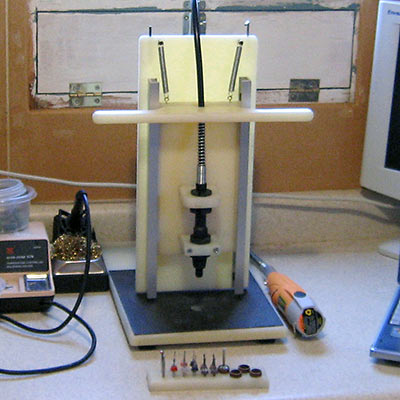
An accurate drill press is an essential tool for making your own through-hole printed circuit boards at home. Reader [Josh Ashby] offers up a solid design using scrap bin materials.

A major issue with PCB drilling is that even the slightest horizontal play will snap the delicate carbide drill bit. Hobbyist-grade tools such as Dremel’s drill press attachment are usually too sloppy for this task, while a more precise instrument might set you back a couple hundred bucks.

[Josh’s] design uses a nylon “sled” moving vertically in an aluminum u-channel track. Most of these materials were salvaged or were acquired inexpensively from a local hardware store, and assembled in less than a day. Surprisingly, this low-tech approach has proven sufficiently smooth that he’s yet to break a bit while drilling. And the entire setup, including the knockoff Harbor Freight rotary tool, cost less than the wobbly name-brand accessory alone.

BatchPCB Pays You

SparkFun’s BatchPCB has been a well-known service to get your PCBs fabbed, and now it is sporting a new feature. It has just come out of its downtime chrysalis with the ability to pay you for making your designs. If you have designed a PCB and want people to pay you to use it, BatchPCB will now do that for you. [Patrick] says “We want engineers to benefit from the low-cost production for prototypes and have the ability to sell their work, conveniently.” There are a few caveats. First of all, each seller must be a resident of the United States and send BatchPCB a W-9. Secondly, PCBs are only warranted against manufacturing defects, so buyers should make sure the PCB they are buying is a working design. Finally, the sellers must only be selling designs of their own or with proper permission. We are big fans of free, open-source designs, but we can see how this would help an engineer recover some of their costs to develop a board and might lead to some interesting brokering of designs. What do you think of this new service?

The UltimateSIMON

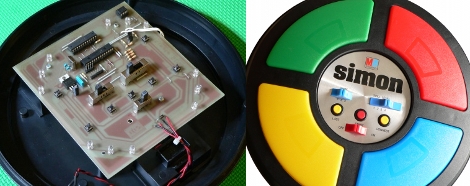
[Simon Inns] designed a circuit board to retrofit an original Simon electronic game. This hack is immediately a win because he made sure that his design required no modification of the original case. The new PCB has many improvements. It moves the device from using 2 D-cells over to a 9 volt battery, the incandescent bulbs were out swapped out for three LEDs per button, and the use of tactile switches makes the buttons a lot more responsive (but does require a bit of modification to the colored button covers). Under the hood there’s a PIC18F2550 controlling a serial LED chip and handling input monitoring and sound generation. The video after the break is safe to watch at work, there’s no swearing involved this time. Continue reading “The UltimateSIMON”

CES: Guts Guts Guts

We knew going into CES that we had to find some pictures of guts. It didn’t matter what it was, if there were guts showing, we snapped a picture. We were a little let down that the guts we found were basically consumer goods like cameras, TVs, and tons of amplifiers. The amplifier guts were so prolific, we actually just stopped taking pictures.  We were hoping for some insides of tablets and such. There may not be anything new here for you, but if you are like us, you just can’t help but look. Join us after the break for a gallery.

Continue reading “CES: Guts Guts Guts”