Passive RFID Tag Cloning

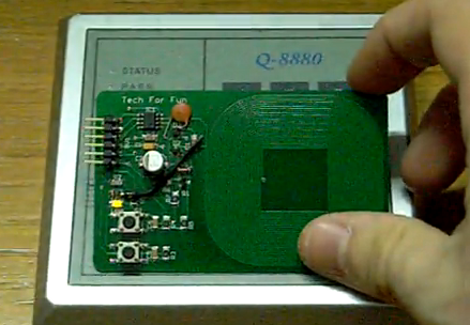
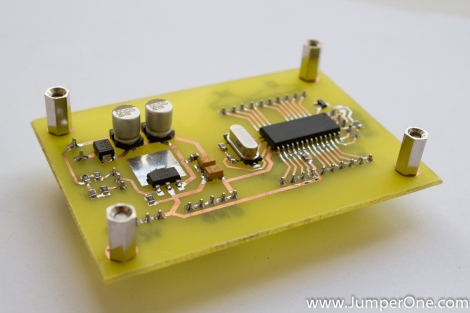
Here’s an open source RFID cloner design that is about the same size as a standard RFID key card. It doesn’t need a battery to capture key codes, just the magnetic field generated by an RFID reader. You can see the functionality demonstrated in the video after the break. By holding the bottom button as the cloner is moved in range of the RFID reader, the microcontroller goes into learning mode. Now just hold up the card you wish to clone and the LED just above the buttons will light up when it has captured the code. Now the device will act just as the original RFID tag did.

This was developed by [Ramiro], the same person who built the barebones RFID emulator we saw a few days ago. When researching that story we complete skipped over this gem. He’s posted a ton of information on the tag itself. It doesn’t look like he has any PCBs or kits left, but the schematic and code are available for download. You should check in on the design considerations section because it discusses the read/write function that isn’t built into the current version. That’s why you see some add-on components on the hardware used in the demo video.

It seems like this is a lot more user-friendly than the last RFID spoofer we looked at.

Continue reading “Passive RFID Tag Cloning”

Video: Soldering Our PIC Development Board

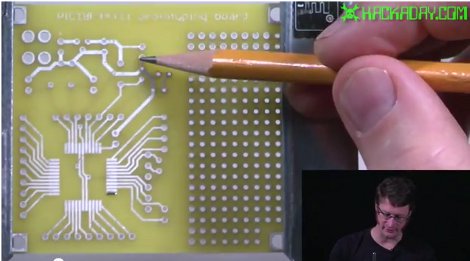
For those of you who followed along with our Eagle CAD series, here is the final payoff where we assemble the circuit board that was designed. In this video, [Jack] explains where things will go on the board and then shows you how to solder the parts. For the advanced folks out there who haven’t moved to solely surface mount parts when you can get away with it, he shows an easy way to solder the processor, which is a TQFP-44 part. This can seem like a daunting task but it really isn’t.

If you would like to make your own board like this, you can find the files here. Please note that although this board shouldn’t have any issues, we haven’t tested it ourselves yet. [Jack] is going to do some videos about a different topic for a few weeks but will pick back up with this board again when they are done.

Video is after the break. Continue reading “Video: Soldering Our PIC Development Board”

Fully Fretted Guitar MIDI Controller

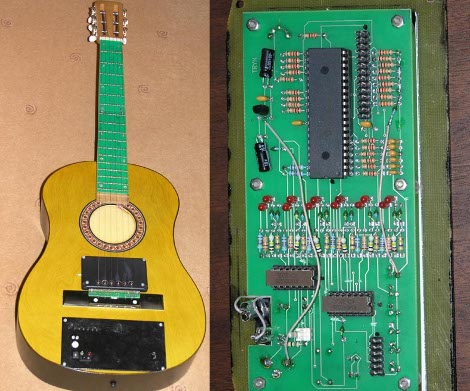
[Andy] came across this guitar midi controller project from way back and decided to send us a tip about it. The English version, translated from the original Russian, is easy to follow and documents the build process from first prototypes to the version you see above. It can connect via a standard MIDI cable and then be used to control anything you want. The only thing missing is the ability to transmit velocity data, but that’s certainly not a deal breaker.

The device has two sensory parts. The first is a set of pickups that can be seen underneath the strings near the bridge. These work like standard magnetic pickups but instead of extrapolating fret data from the pitch picked up on the string, there is a second sensor mechanism for every fret of each string. Since the strings are made of metal, it’s possible to detect which fret is depressed based on continuity sensing. Of course this means you need a conductor between every fret, and that’s why the fingerboard has been replaced with one made of printed circuit boards. All of this data is gathered, then sent to the MIDI device via a PIC 16F74 microcontroller.

If this leaves you wanting for more guitar hacks, don’t miss this one that adds addressable LEDs in between each fret.

Battery-less Electronic Dice For All Your D&D Needs

electronic_20_sided_die

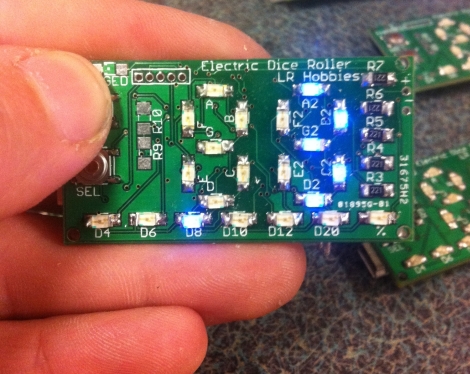
[Anthony] is a big fan of Dungeons & Dragons, but he thought the game would be far more fun to play with an electronic die rather than the traditional fare. Electronic dice are nothing new around here, though we can’t help but like his design.

He wanted to keep his electronic die as small as possible while ensuring it would last an entire gaming session, so rather than use a battery to power it, he opted for a super capacitor instead. His 1F 5.5V cap keeps the PIC18 and 22 SMD LEDs chugging along quite nicely without ever requiring a break in the action for a charge.

The electronic die looks great, and give him the choice of rolling a 4, 6, 8, 10, 12, and 20 sided die with a simple push of a button. While a bit less interactive than tossing a die on the table, we certainly wouldn’t mind having one.

Barebones PIC RFID Tag

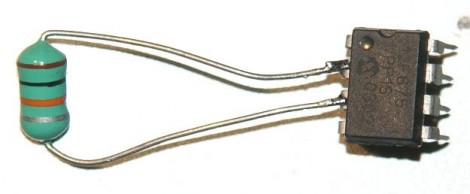
An inductor and 8-pin microcontroller are all that make up this barebones RFID tag. You might have done a double-take when first seeing the image above. After all, there’s nothing hooked up to the power and ground pins on the chip. As [Ramiro Pareja] explains in his post, the power is actually supplied via the I/O pins to which the inductor is soldered. It seems that each I/O pin has a parasite capacitor and a pair of clamping diodes inside the chip. When the AC current that is induced by the magnetic field of the RFID reader hits those pins, the capacitors charge and the clamping diodes form a bridge rectifier. This results in power being injected into the chip, which turns around and sends the RFID code back through the inductor.

This isn’t the first time that we’ve seen this concept. We featured a hack that is exactly the same except it used an AVR chip. This one uses a PIC 12F683 but should work with just about any 12F or 16F model. The code is written in Assembly and shouldn’t need any changes for different hardware. [Ramiro] does talk a bit about adding a decoupling capacitor to Vss and Vdd, as well as a tuning capacitor to the two I/O pins used above to help make the device a little more robust. But, as you can see in the video after the break, it works just fine without them.

Continue reading “Barebones PIC RFID Tag”

PIC LC Meter Improvements Add Li-Ion Battery And Charging Circuitry

[Trax] needed an LC meter and decided to use a tried-and-true design to build his own. The only problem was that he didn’t want to be tied to a bench supply or power outlet, which meant a bit of auxiliary design was in order. What he came up with is the battery-powered LC meter you see above.

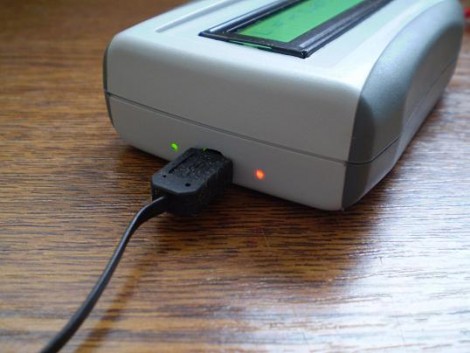
The core of the original [Phil Rice] design remains the same, with slight modifications to drive a different model of character LCD. The code is mostly unchanged, but some calibration routines became necessary after [Marko] noticed bugs in the behavior after power cycling. Now the device will perform what amounts to a hardware reset about 700ms after powering on or changing between inductance and capacitance measuring functions. The project box is quite small, and to get everything to fit [Marko] sourced the Lithium Ion battery from a Bluetooth headset. He needs 5V for the LCD screen so he used a TPS61222 boost converter. To top off the battery he’s included a MAX1811 single-cell Li-ion charger, which has a couple of status LEDs visible through the case as seen above.

[Thanks Marko]

Karate Chop Is Simon Without All The Touching

[Alan Parekh] and his daughter [Alexis] just premiered their entry in the Avnet Dog Days of Summer contest. It’s a game called Karate Chop that is basically an electronic Simon Says. The video after the break shows a demonstration of the device. When switched on it’ll play a little tune and start cycling the LEDs on the front of the case. Players interact by breaking the infrared beams in the two cutouts on either side of the case. You need to keep your hand flat to do this, which is where the name comes from. There are four different game modes which are selected at the start of the game. There are two difficulty levels of a Simon Says game which shows the player a pattern in light and sound, then watches for the user to repeat that pattern back. The other mode that [Alexis] demonstrates is a reflex game which requires the player to quickly react to randomly illuminated LEDs.

The circuit is built on a breadboard hiding behind the front bezel and uses a PIC 16F1827 microcontroller to drive the game. The case itself is made from laser cut MDF and plywood. We’re not sure how much time [Alan] spent on the case, but we think it looks wonderful. If you’re planning to participate in the contest you better get rolling, the entry deadline is tomorrow.

Continue reading “Karate Chop Is Simon Without All The Touching”