Toybox Tractor: Plywood, Lathe Hacks, And 350W Of Fun

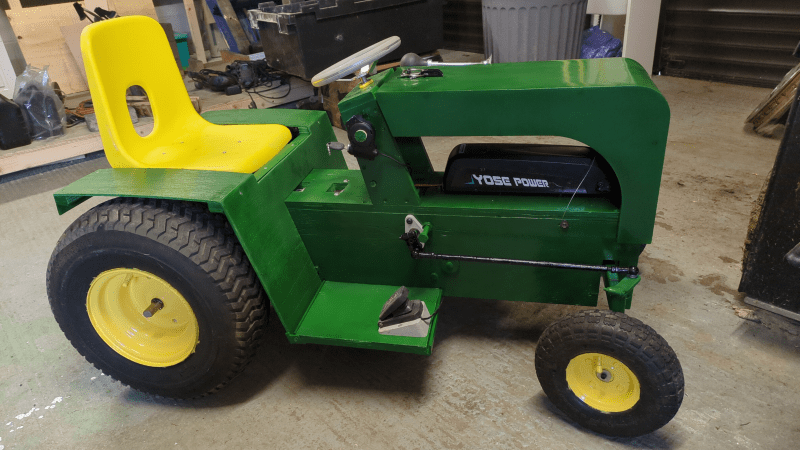
When you think of a toy tractor, what probably comes to mind is something with fairly simple lines, maybe the iconic yellow and green, big rear tires, small front ones. Well, that’s exactly what [James] built, with simple, clean lines and a sturdy build that will hold up to driving around off-road in the garden. This Tractor is a great build, combining CAD, metal and wood work, some 3D printing, and electronics.

Starting at the power plant for the build, [James] went with a 350W DC motor powered by a 36V Li-ion battery from an e-bike. The motor turns a solid rear axle he made on a mini-lathe, connected to a set of riding lawn mower wheels. The mini-lathe spindle bore was too small to accommodate the shaft, and the lathe was not long enough to use the tailstock, so [James] had to get creative, using a vice and a piece of wood to make a stand–in tailstock, allowing him to turn this custom rear axle. The signature smoothly curved bonnet was made possible with plywood and body filler, rather than the sheet metal found on full-sized tractors. In fact, most of the build’s frame used plywood, giving it plenty of strength and, once painted, helping give it the appearance of a toy pulled out of a toybox.

This build had a bit of many domains in it, and all combined into a fantastic final result that no doubt will bring a smile to any face that gets to take the Tractor for a ride. Thanks [James] for documenting your build process, the hacks needed to pull off the tough bits along the way in making this fun toy. If you found this fun, be sure to check out another tractor related project.
There’s Nothing Backwards About This Laser Cut Retrograde Clock

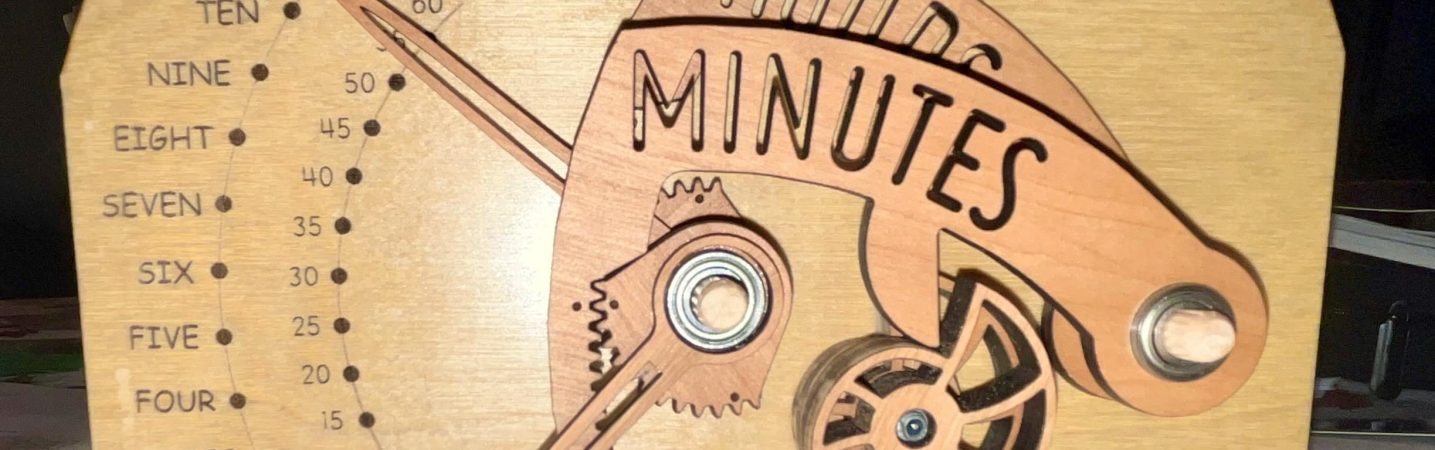
It’s clock time again on Hackaday, this time with a lovely laser-cut biretrograde clock by [PaulH175] over on Instructables. If you’ve never heard of a ‘biretrograde clock,’ well, we hadn’t either. This is clearly a form of retrograde clock, which unlike the name implies doesn’t spin backwards but oscillates in its motion– the hands ‘go retrograde’ the same way the planets do.

The oscillating movement is achieved via a pair of cams mounted on the hour and minute shafts of a common clock mechanism. As the shafts (and thus cams) turn, the minute and hour arms are raised and drop. While that could itself be enough to tell the time, [Paul] goes one further and has the actual hands on pivots driven by a gear mechanism on the cam-controlled arms. You might think that that extra reversal is what makes this a ‘biretrograde clock’ but in the clockmaker’s world that’s just saying it’s a retrograde clock with two indicators: in this case, minute and hour.

It’s a fairly rare way to make a clock, but we’ve seen one before. That older project was 3D printed, which might be more your speed; if you prefer laser-cutting, though, [Paul]’s Instructable includes SVG files. Alternatively, you could take a different approach and use voltmeters to get the same effect.

Spinning Top Chair Revisited

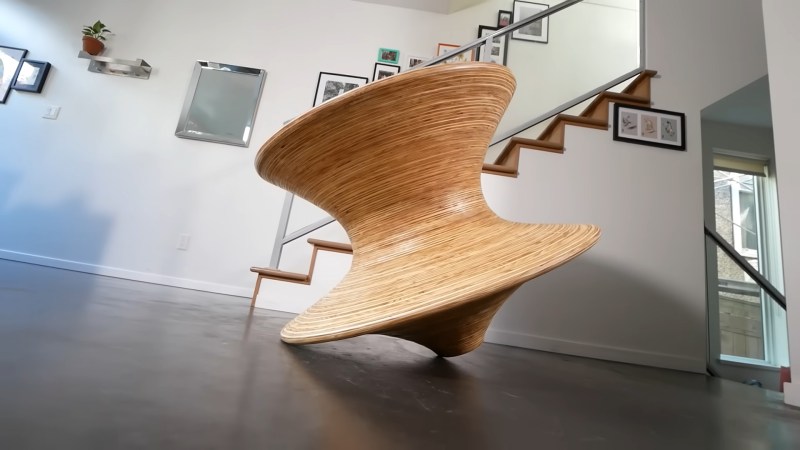
Designer furniture generally comes with excellent aesthetics and (sometimes) functionality. However, such furniture comes with a price to match. One such piece of furniture is the Magis Spun Chair. It’s a striking piece with a fun party trick to match: it works like a top spinning while you sit inside. However, it has a prohibitively expensive price tag of $1,200 to match. That’s why [Morley Kert] is on a mission to build one for less. 

This isn’t [Morley]’s first time building a spinning chair. The first attempt featured numerous 3D printed pieces glued together. It did not inspire confidence in spinning, nor was it a striking piece of furniture. So a revisit was in order.

This time around the chair’s construction was CNC milled plywood. Some surfaces featured 3D carving, but the majority were left raw with carving the final shape handled manually. Despite its size, the chair only took four and a half sheets of 3/4 inch plywood by hollowing out the base allowing for more efficient use of material. Once the router had completed the pieces, they were stacked and glued together. Each layer was aligned with hidden dowels making the assembly process fairly straightforward.

However, while usable, the chair looked rather unfinished, so [Morley] went to town on it with a power carving angle grinder. To ensure even carving on the circular profile of the chair, he placed it, or for some sections glued it, on an electronic lazy Susan. After some practice, the carving process turned out really well with a well-shaped and professional looking chair. Some wood varnish and a large amount of sanding finished up the chair very nicely for a total material cost of under $500.

We were happy to see the completion of this chair building saga. If you want to see [Morley] make even more designer furniture for cheap, make sure to check out his other 3D printed chair!

Continue reading “Spinning Top Chair Revisited”

Matthias Wandel Hates CNC Machines In Person

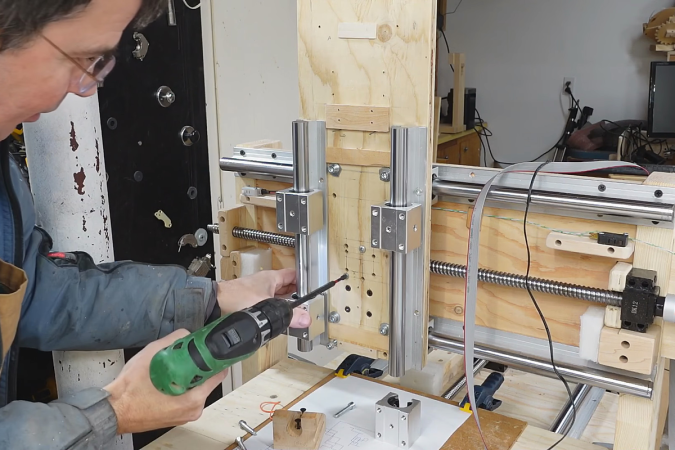
Prolific woodworking YouTuber [Matthias Wandel] makes some awesome mechanical contraptions, and isn’t afraid of computers, but has never been a fan of CNC machines in the woodshop. He’s never had one either, so until now he couldn’t really talk. But he had the parts on hand, so he built a wooden CNC router. It’s lovely.

The router itself is what 3D printer folks would call a bed-slinger, and it’s cobbled together out of scrap plywood. Some of the parts have extra holes drilled in them, but “measure once, drill twice” is our motto, so we’re not one to judge. He spends a lot of time making “crash pads” that keep the frame from destroying itself while he’s building it – once the CNC is actually controlling things with the limit switches, we presume they won’t be necessary, but their design is fun anyway.

If you’re at all interested in CNC machines, you should give this video a watch. Not because it’s done the “right” way, but because it’s a CNC that’s being built on a budget from first principles, by an experienced wood builder, and it’s illuminating to watch him go. And by the end of the video, he is making additional parts for the machine on the machine, with all the holes in the right places, so he’s already stepping in the right direction.

He doesn’t love digital design and fabrication yet, though. If you’re making one-offs, it probably isn’t worth the setup time to program the machine, especially if you have all of his jigs and machines at your disposal. Still, we kind of hope he’ll see the light.

Of course, this isn’t the first wooden CNC router we’ve seen around these parts, and it probably won’t be the last. If you want to go even more fundamental, [Homo Faciens]’s series of CNC machines is a lovely mashup of paperclips and potential. Or, if refinement is more your style, this benchtop machine is the bee’s knees.

Continue reading “Matthias Wandel Hates CNC Machines In Person”

Need A Tube? Reach For Plywood!

To be clear, when we are talking about tubes, we mean ordinary cylinders, not vacuum-amplifying elements. With that out of the way, when we need a tube like that, we usually think of PVC or some other kind of pipe product. Or maybe we’ll 3D print what we need. But not [GregO29]. He made his tubes from plywood.

You can make tubes as small as 12 inches in diameter, and [GregO29] made some that were 16 inches. The first step was to make a mold or form. In this case, he elected to make a form that the tube-to-be wraps around. The plywood is thin 2-ply white birch. This makes it easy to shape.

The basic idea is to wrap the wood around the form and glue it. You hold it together with a strap until it dries. Then, you can add more layers until it is the thickness you need.

The real problem turned out to be removing the form once it was done. Why make a tube like this? In [Greg]’s case, he’s building a telescope, which is as good a reason as any to have a tube, we suppose.

We build a lot of things, but we always forget about plywood. It even mixes well with electricity.

You Wouldn’t Download A House

Shelter is one of the most basic of human needs, so it shouldn’t be a surprise that we continually come up with new ways to build homes. Most building systems are open source to an extent, and the WikiHouse project tries to update the process for the internet age. 

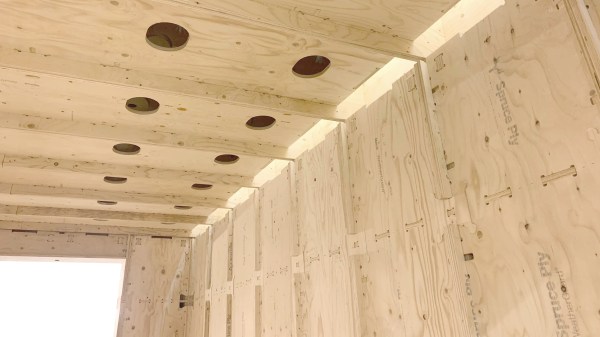
WikiHouse is a modular building system similar to structural insulated panels (SIPs) but designed to be made on a CNC and insulated in the shop before heading to the site. Using this system, you can get the advantages of a manufactured home, but in a more distributed manner. Plywood or oriented strand board (OSB) can be used to make up the chassis of the blocks which can then be assembled very quickly on site versus traditional wooden construction.

One of the more interesting aspects of WikiHouse is that it takes design for disassembly seriously. How many houses have parts that are still good when they’re demolished to make way for something new? In most places, the good is hauled to the dump along with the bad because it isn’t economical to separate the two. Building with end of life in mind makes it so much easier to recover those materials and not waste them. There are certainly examples of careful material recovery, but they’re few and far between.

If you’re looking for some other ways to quickly build a house from wood, checkout the PlyPad or Brikawood.

Continue reading “You Wouldn’t Download A House”

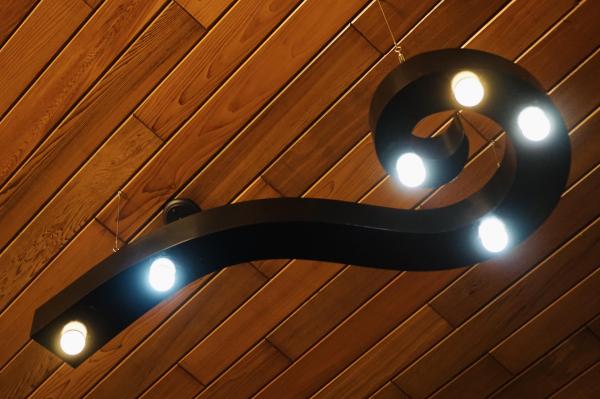
A black chandelier that looks somewhat like a fern frond. It has four lights arranged roughly in a circle around the curly end and two clustered near the tail. It is mounted on a dark wood panel ceiling.

Put A Constellation In Your Dining Room

We love lamps here at Hackaday, especially if they imitate natural light sources. [Scott McIndoe] used his love of lamps to fashion a chandelier replicating his favorite constellation, the Southern Cross.

Starting with the Southern Cross’s four major stars and the pointers of Alpha and Beta Centauri, [McIndoe] sketched out a breaking wave form between the six stars to form the spine of this light source. By using smart bulbs for each of the six star positions, he was able to set a scene that replicates the color and relative brightness of each star for that extra astronomical touch.

The top and bottom of the chandelier is laser cut from 3 mm plywood and fitted together using glue and finger joints while the sides are a wood veneer. The entire piece was sanded and coated with a bit of filler before painting. Mounting is accomplished using three eye hooks mounted on the top side of the chandelier.

If you want more celestial lamps, check out [McIndoe]’s previously-featured analemma chandelier or this lithophane moon lamp.