Player Guitar Sounds Wonderful; Makes Us Drool Because Of The Complexity

It becomes obvious when you listen to this player guitar that it’s not a human being playing. But the only reason for that is the unrelenting precision with which the songs are played. In addition to that accuracy, it’s interesting to note that this tune is normally played by a group of guitarists but here the machine manages to do it on one instrument. And we think it sounds fantastic!

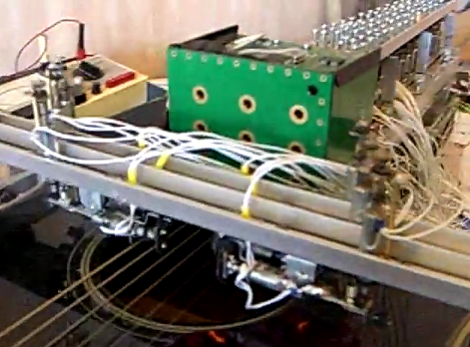
This comes from [Vladimir Demin], a maker who previously built an automatic Bayan (like an accordion but with buttons where the keyboard is normally found). This time around it’s the six strings and many frets of a guitar that have been outfitted with one solenoid each. In the image above you can see the strumming mechanism mounted near the tone hole. Six picks are held in place, and it appears that each has two solenoids. From what we can observe in the video, one of the solenoids is used to strum the sting, the other tilts the pick mount so that there won’t be a second strumming when the pick is returned to its starting position.

Continue reading “Player Guitar Sounds Wonderful; Makes Us Drool Because Of The Complexity”
Dexterity Enhancing Guitar

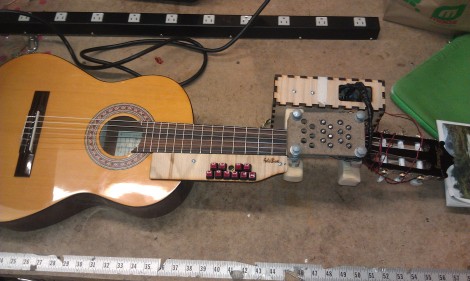
[Justin Lange’s] dad loves playing guitar, but an accident left him with nerve damage that makes it pretty much impossible these days. He just doesn’t have the dexterity needed to form the cords using his left hand. But his son’s hacking skills are helping him get back into it. [Justin] built a button-based add-on that forms the cords for him.

The build has two parts. A frame mounts over the finger board with slots for eighteen solenoids which push the strings down between the frets. These are controlled by the replacement finger board which is mounted below the neck. It has a double-row of buttons that let the player select the desired chord. One button chooses the key, with a second button acting as a modifier to switch to a seventh cord, or minor cord.

The project, which [Justin] has named folkBox, relies on a microcontroller. We spy an Arduino Mega in one of the build photographs but it will be interesting to see if the final project moves to a standalone chip. He’s set a goal for a more robust version of the build some time this summer.

[via Make]

Steam Fife

This auto-flute does it with steam. Well, electricity gets its piece of the action too as the tone holes are opened and closed using a set of solenoids.

We’re at a loss on how the sound is actually produced. We would think that a penny whistle has been used here, except if that were the case the solenoid nearest the kettle would have no use. Then again, after watching the demo after the break we’re not sure that it does have much of an effect. It may be meant to stop the sound but it doesn’t really work all that well.

At any rate we’d love to see some spin-off hacks. Assuming the plastic can stand up to the steam heat this would be a perfect robot controller for recorder controlled snake. You can get a recorder for a buck at the right dollar store, and solenoids can be made out of simple materials. If you know of a way to produce the sound yourself, all it takes are a few careful calculations to place the tone holes.

Continue reading “Steam Fife”

Displaying Bubbles In Mineral Oil

After he saw a ‘falling water display,’ [Matt] figured he could turn that idea on its head. He built a display that uses bubbles for pixels. Even though the build isn’t complete, we love the results so far.

[Matt] began his build constructing a tall, thin water tank out of acrylic. Eight solenoids were mounted in the base of the tank, attached to an aquarium air supply, plastic tubing, and one way valves. The first run of the bubble display didn’t go too well, but after adding dividers between each column the display started working.

With the dividers, [Matt] no longer had to worry about bubbles colliding or moving any direction but up. The bubbles weren’t moving consistently, so he replaced the water with mineral oil. Oil made a huge improvement, but the bubbles still float up at different speeds. [Matt] ascribes this to the unregulated air supply, but we’re thinking this problem could be mitigated with glycerine like the previous bubble display we saw.

It may still have some problems, but we love the result. Check out the video of bubbles in mineral oil after the break.

Continue reading “Displaying Bubbles In Mineral Oil”

Weapon Of Mass Graffiti

What uses a fire extinguisher, a bike pump, and provides hours of probation, community service, and possibly jail time? If you said an automatic graffiti writer you’re correct! [Olivier van Herpt] calls this little job the Time Writer. We call it defacing property… but tomato, tomahto.

Details are a bit scarce, but you get a fine overview of the system from the video after the break. [Olivier] tagged the post as Arduino; it’s obviously running the dot matrix printer made up of seven solenoid valves on a metal rod. These are fed ink via a tube connected to a fire extinguisher which serves as the reservoir. The bike pump is used to pressurize the enclosure so that a pump isn’t necessary when out and about.

Obviously you shouldn’t try this at home, but let’s talk about possible improvements as an academic exercise. First off the mix of the ink/paint needs to be reigned in to get rid of the dripping. We’d also like to see the inclusion of some proper spray can nozzles to tidy up the results. That, paired with an IMU board should be able to smooth out the printed designs.

This might make an interesting add-on to that rainbow graffiti writer.

Continue reading “Weapon Of Mass Graffiti”

Thumper The T-Shirt Launcher

Thumper The T-Shirt Launcher

[joe] and [ryan] built Thumper for their high school FIRST robotics team. The cannon itself is a solenoid-fired compressed air launcher that gets its juice from three large PVC tanks stored in the box below the turret, and the cannon is able to be fired nine times between visits to the air compressor. It was intentionally designed to resemble an M2 Browning 50 Caliber heavy machine gun, with the two vertical handles and boxy body.  They finished construction in about a week with a budget of only $300. When they saw that a lot of their friends had also built cannons, they scrounged for parts from their garages to re-use to build the mobile platform simply for one-upmanship sake. The motor and drive-train propelling this behemoth came out of a 1980s-era mobile X-Ray machine that had been discarded by a local hospital. The rear wheels were specially modified to fit the drivetrain, and the front end is a chopped, hacked, and welded axle and steering mechanism from an old lawn tractor. Sections of unistrut form the rest of the frame.

[joe] and [ryan] were even asked to bring Thumper to their high school prom as a unique way to hand out T-Shirts for the evening. Unfortunately, there’s no website for this build.

See video of Thumper in action with a Nerf Football after the break. Hack A Day even got to take it for a spin around the Power Wheels Racing Series track at Maker Faire KC!

Continue reading “Thumper The T-Shirt Launcher”

Washing Machine Mechanical Timer Replaced With Microcontroller

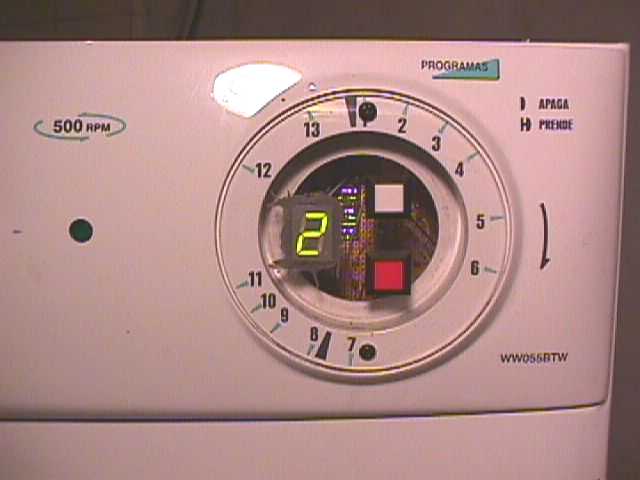
After the electromechanical timer on [Paul Canello’s] washing machine broke for the third time he decided he needed to stop repairing it and find a more permanent fix. He decided to build his own microcontroller-based system for washing his clothes (translated). Caution: The image links on [Paul’s] page seem to be broken and will unleash a never-ending storm of empty pop-up windows if you click on them. We’ve embedded all of the images after the break to save you some hassle.

The controller on a washing machine is nothing more than a mechanical alarm clock. It starts the cycle, then moves through various modes based on the passage of time. [Paul] started his hack by observing how long the delay between cycles was meant to be, and recording which parts of the machine were switched on and off at each stage.

It turns out that when the mechanical knob is turned, it reroutes how water flows through the detergent chamber. Since that knob won’t be in the new system [Paul] came up with a way for the microcontroller to handle this by using a servo motor. The rest of the control involves relays to control the motor, and solenoid valves for the water. There are also pressure switches that give feedback for the level of the water in the machine. A PIC 16F872 serves as the new controller, with the help of a 7 segment display, a buzzer, and a pair of buttons as the user interface.

This is an older project, but after reading about the Arduino controlled dishwasher [Ramiro] sent us a link. Thanks! Continue reading “Washing Machine Mechanical Timer Replaced With Microcontroller”