Adding Words To Catch Phrase

[Brandon Meyer] spared no expense in modding the Catch Phrase game to use custom word lists. The altered version of the game, normal sold for around $25, now comes in at a whopping $230! That’s because the internals were gutted and replaced with an Arduino, 20×2 LCD display, and some other interesting bits. The device now features an SD slot for storing your own lists and a USB port for programming.

At first glance we were hoping some simple EEPROM hacking had unlocked the secrets of the device but that wasn’t he case. We’d love to see some more economical versions of [Brandon’s] prototype. Perhaps reusing the original LCD, replacing the Arduino with the ATmega168 that makes up its core, and using a diy SD cradle for a card reader.

So yes, this version is a bit of overkill but still very nicely done!

[Thanks Zoidberg]

USB HDD Enclosure To DVD Connector

This is a “why didn’t I think of that?” idea. [Alec] needed a way to connect an IDE DVD drive using USB. Rather than order a connector he pulled the circuit board out of an old USB hard drive enclosure and connected to his DVD drive. Bang, recognized and running.

This will prove extremely handy if you have a netbook without an optical drive. We’ve used Unetbootin to move Linux ISO images to a thumb drive in the past. In addition to getting around the lack of an optical drive, this saves burning the data to a piece of plastic. But, you should be able to use this with a Leopard retail DVD instead of a 16GB thumb drive for a Hackintosh conversion. That means you could install Leopard on a netbook without needing a Mac to transfer the disk image to your thumb drive first.

SNES System In The Controller

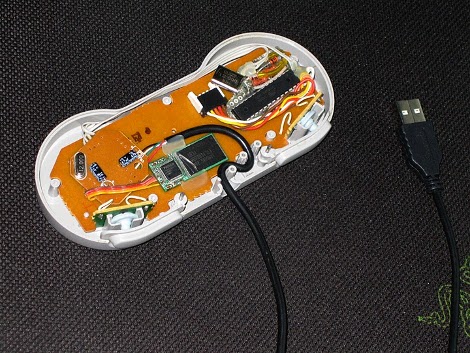
Want to take your SNES emulation to your friend’s house? [Chris] worked out a way to fit the important parts inside of an original Super Nintendo controller. He removed the case from a 4GB thumb drive as well as a USB hub. Using a RetroZone kit he gave the controller a USB interface. By soldering the thumb drive and RetroZone board directly to the hub he’s reduced the package down to just one cable. Everything fits inside the controller case and now when you plug it into the computer you can fire up the ROMs you copied from your original cartridges that are stored on the thumb drive.

Of course this isn’t limited to SNES emulation but the real question is can you boot from the thumb drive?

A Random USB… Hourglass

[Peter] thought of a creative, way to generate random entropy for under $100.

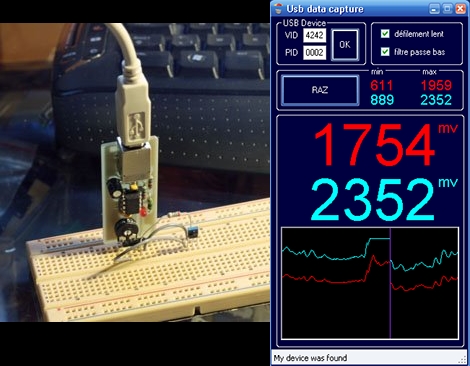
The USB Hourglass combines a sand timer with a rotating mechanism and an optical beam through the center of the timer to observe the falling sand. The amount of light reaching a detector is digitized at frequent intervals and processed by a microcontroller to determine when to rotate the hourglass. The digitized light levels are also sent by USB to a host PC where they can be used as a source of random entropy. Power is supplied over the USB cable.

With the USB Hourglass, the user can look at the sand falling through the center of the hourglass and monitor the randomness in the USB output data. And one can read the code line-by-line, compile it, and upload it to the microcontroller using only open-source and widely supported tools.

Tiny Keyboard/touchpad Has “hack” Written All Over It

Yes, we know, this is not a hack, yet it just has the vibe of something we’ll likely be seeing in many small form-factor systems and wearable hacks in the future.

The USB Wireless Handheld Keyboard is a diminutive keyboard and mouse replacement with a passing resemblance to a BlackBerry PDA — where the screen has been replaced with a laptop-style trackpad sensor. This seems a shoo-in for home theater PC use; it’s unobtrusive and won’t look out of place on the coffee table alongside the universal remote. But any tiny system requiring only occasional input could likely benefit.

The keyboard layout is funky as heck, though likely adequate for its intended use of couch web-surfing and interactive messaging (or whatever wild applications our readers will surely come up with). A USB wireless receiver and a charging cable are included in the $62 package. Video after the break…

[USB Geek via Engadget]

Continue reading “Tiny Keyboard/touchpad Has “hack” Written All Over It”

TI Sports Watch For Hacking

How would you like to have a 3-axis accelerometer, pressure sensor, temperature sensor, RF wireless, and an LCD screen in a development package?  What if we told you that you can have it in the form factor of a wristwatch offering from Texas Instruments? How much would you pay for such a device? Quit guessing, you can pick it up for just $49 with an estimated delivery in mid-February of next year.

Our tip-line has been packed with emails about this since it was announced on Monday. The device ships with the firmware to serve as a sports watch with heart rate monitor. The price is pretty good just for that functionality but this package also includes a USB programming and emulation dongle so that you can develop your own firmware. It looks like the included development software is written for Windows but we’re hoping you can get it running on other platforms as well.

The LCD is a segment display, so you won’t see DOOM running on board. That said, we expect your first project to turn this into a wireless controller using the buttons and accelerometer.

STM8S-Discovery: Microcontrollers Reach A New Low

A complete microcontroller development kit for little more than the cost of a bare chip? That’s what STMicroelectronics is promising with their STM8S-Discoveryseven dollars gets you not only a board-mounted 8-bit microcontroller with an decent range of GPIO pins and functions, but the USB programmer/debugger as well.

The STM8S microcontroller is in a similar class as the ATmega328 chip on latest-generation Arduinos: an 8-bit 16 MHz core, 32K flash and 2K RAM, UART, SPI, I2C, 10-bit analog-to-digital inputs, timers and interrupts and all the usual goodness. The Discovery board features a small prototyping area and throws in a touch-sense button for fun as well. The ST-LINK USB programmer/debugger comes attached, but it’s easy to crack one off and use this for future STMicro-compatible projects; clearly a plan of giving away the razor and selling the blades.

The development tools are for Windows only, and novice programmers won’t get the same touchy-feely community of support that surrounds Arduino. But for cost-conscious hackers and for educators needing to equip a whole classroom (or if you’re just looking for a stocking stuffer for your geeky nephew), it’s hard to argue with seven bucks for a full plug-and-play setup.

[thanks Billy]