Remember When Flash Drives Were Going To Make Your PC Faster?

The 2000s was a decade of great change in the computer industry. The world had grown accustomed to corruptible floppy disks, blue screens of death, and achingly slow load times. In a few short years, all of that would change, as USB drives, better operating systems, and faster processors brought forth a new age of stability and speed.

Amidst this era of upheaval, Microsoft introduced a new technology. It was intended to increase performance on the cheap to a new generation of machines, but it would turn out to be little more than a gimmick that never really caught on. Let’s explore the easily-forgotten legacy of ReadyBoost.

Continue reading “Remember When Flash Drives Were Going To Make Your PC Faster?”

Get That Windows 7 Feel In An OS That Still Gets Updates

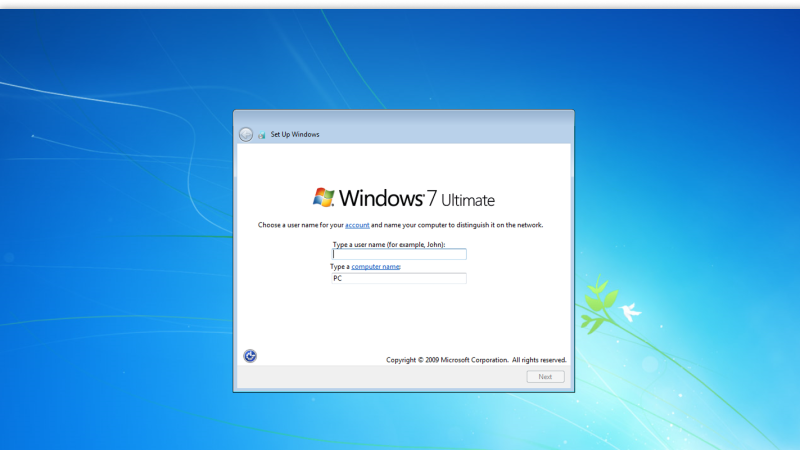
Do you want to go back to an era when Windows was… simpler? Back when things worked, before the AI and the bloat took over your hard drive and RAM space in equal measure? You might like to give Classic 7 a spin (via The Register).

From the drop, we should state that Classic 7 is not Windows 7 at all. Instead, it’s a reskin of Windows 10, specifically, the IoT Enterprise LTSC version. This is a particularly attractive version of Windows 10, as Microsoft has promised long-term support in terms of security updates until 2032. It also strips out annoying consumer-focused bloat like the Xbox gaming overlay and Cortana, and it eliminates forced feature updates that have become the norm in modern Windows installs. Combine all those niceties with the clean and simple feel of the recreated Windows 7 interface, and you have a beautiful operating system that has everything you need and nothing you don’t.

There are, of course, some hurdles to jump over; you’d need to find an appropriate license for this version of Windows and all that jazz. But if you long for the days before Microsoft so cruelly eviscerated the Start Menu and started making everything worse, you might find that Classic 7 is for you.

[Thanks to Stephen Walters for the tip!]

a torn-up printer with a very long image of different frames

Playing DOOM On A Receipt Printer

Gaming is a wonderful thing. Unfortunately for many of us, work takes up our valuable time, which should be allocated to our gaming. What if there was a better way? Well, printers can print an image quickly, and receipt printers can print a lot of images. This sounds like an effective display for DOOM in a pinch. [Bringus Studios] managed to find such a printer and got the classic shooter running.

Getting the printer’s attached computer, which was only designed for printing the cost of your chicken sandwich, to run Half-Life was far from easy. [Bringus] struggled through the process of swapping operating systems from Windows 7 to Linux just to return to Windows 7 after a painful process of maintaining compatibility between 32 and 64 bit software. Driver issues followed through the entire process just to get anything running at all.

But we can’t play DOOM while at work on a normal screen. The printer MUST display our glorious 480p gameplay. To achieve such a workflow, [Bringus] implemented a script to print out a frame of the display, allowing for “visible gameplay”. Along with some heat issues from the nature of thermal receipts, eventually the printer displayed the glory of DOOM.

Playing games on a thermal printer might be one of the weirdest things you’ve seen today, but what if we could reverse the script a bit and create a printer from something else? Here at Hackaday, we have exactly the thing for you: a printer made from a vintage typewriter!

Continue reading “Playing DOOM On A Receipt Printer”

Vintage Stereo Reborn With All The Bells And Whistles

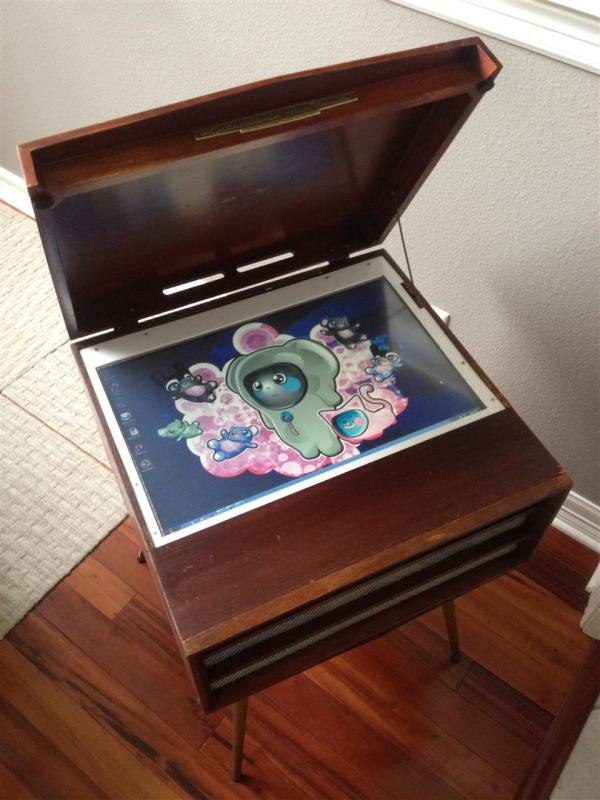
We always like seeing projects that salvage a classic piece of technology, and this one doesn’t disappoint. It’s a vintage kiosk- or console-style stereo, repurposed with every useful feature imaginable, but still made to look original. Until you open the lid, that is.

[Julian] has been hard at work on rebuilding this 1957 RCA stereo, and since he’s no stranger to these types of rebuilds, the results are pretty impressive. Underneath the hood is a 22″ touchscreen running Windows 7 and a Lepai amplifier. The controls for the stereo were placed towards the back, along with USB ports and an RJ45 connector for the computer.

The speakers in the stereo also needed to be replaced. For this, [Julian] used a set of Dayton speakers that worked well enough for this application. After mounting the speakers and all the other hardware in the unit, [Julian] noted that while it isn’t an audiophile’s dream stereo, it was nice to have all of these parts integrated together into something that looks nice. We’d have to agree!

There are a lot of rejuvenated antique stereos around too, like this Bluetooth-enabled tube amp radio, or this Soviet-era handheld, or even this slightly more modern stereo. There’s just something classy about having a vintage-looking thing spruced up with modern technology!

Hackaday Links: February 28th, 2013

Xbox 360 control for a toy heli

links-xbox-helicopter-remote

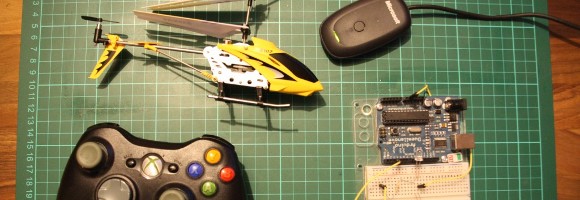
[Jason] leveraged the IR control libraries for Arduino to use an Xbox 360 controller to fly his Syma S107G helicopter.

Windows 7 running on Raspberry Pi

links-win7-rpi

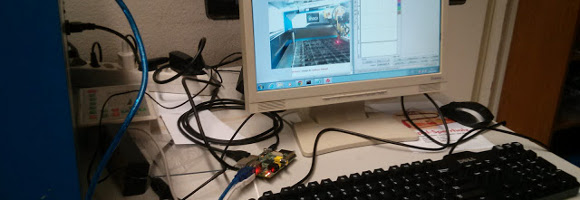
Why, oh god why? Well, the guys at Shackspace got their hands on a laser cutter that can only be driven with a Windows program. Their solution was to run Win7 on RPi as a virtual machine.

Twin-servos for your third hand

links-servo-third-hand

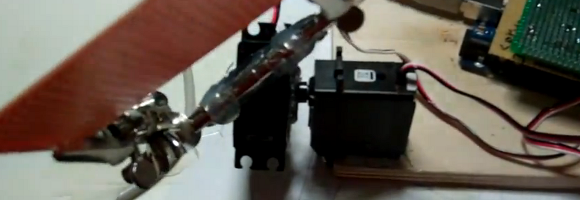
After growing tired of constantly flipping over the substrate being held with a third hand [Nidal] came up with a better way. He mounted his third hand on two servo motors so that it can be positioned with a joystick.

Depopulating SMD resistors

links-removing-smd-resistors

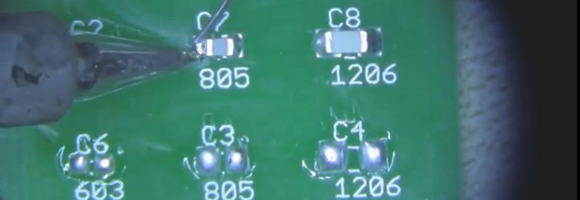
If you’ve ever tried to remove small surface mount resistors or capacitors with an iron you know it can be tricky. Take a look at the technique that [Scott] uses to remove the components.

Photographing the die of MSP430, Z80, PIC, and several other chips

links-decapping-chips

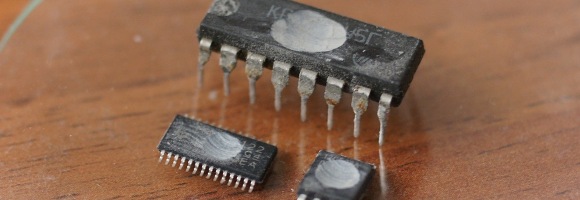
Here’s the latest work from [Michail] on photographing the die of various chips. You may remember reading his previous post on decapping chips with boiling sulfuric acid.

MythTV Library On Apple TV Without A Jailbreak

[Dan] wrote in to share a link to his MythTv to Apple TV setup. He found a way to make the recordings he made on his Linux box available on the 2nd Generation Apple TV. Our first thought is that he would use XBMC on a jailbroken device  but that is not the case. The secret is to roll iTunes into the mix.

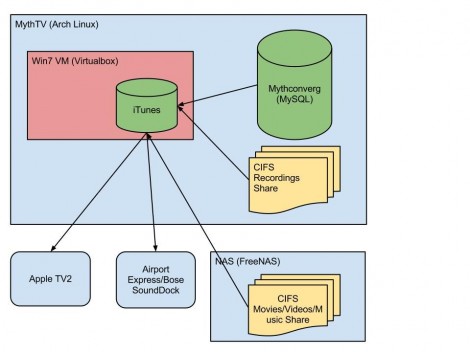
Take a look at the diagram above. The system starts with an Arch Linux box that runs MythTV, an open source program which allows you to record from tuner or encoder hardware. But actually watching those recordings on an iOS device is difficult for a couple of reasons. First, Apple likes to keep their devices locked up tight in hopes that you buy your entertainment rather than watching over-the-air records. Second, if you’re recording ATSC channels the files may be 1080i or 1080p, neither of which can be handled by the Apple TV 2. [Dan] gets around this by first using the command line version of Handbrake to transcode the recordings to an h264 format. He then uses iTunes running on an Windows 7 virtual machine (on the Linux box) to host the transcoded files in a library the Apple TV can access.