Buy Break Build: A Hackaday Contest Series

posted Oct 28th 2010 1:00pm by
filed under: contests, news

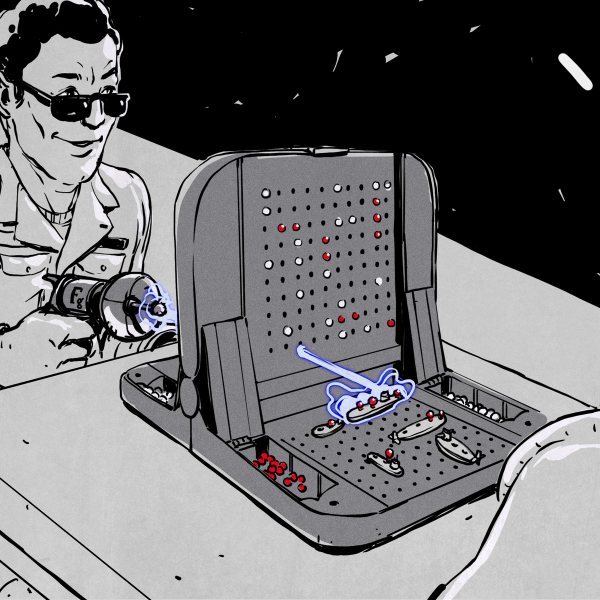
We are proud to introduce a new contest here at Hackaday. Buy Break Build will be regular event where we challenge you to make something from something else. We want to work out your hacker brains to come up with inventive ways to use limited parts. We may have a specific product or genre in mind, and a specific out come we would like to get, then we let you guys loose to make it happen. The contests will usually be judged for winners in 3 categories; best presentation,  best use of only the existing parts, and most massive overkill. You don’t have to be an electronics engineer, or even know how to program a microcontroller. You simply document your entire hack with pictures and notes, then submit it to BBB@hackaday.com and we’ll choose the winners. Those winners will be awarded fabulous prizes and Internet fame as we’ll publish your writeup for everyone to enjoy.

Here’s an example to make things a little more clear. Don’t actually go do this one, it is just an example.

Contest: Radio controlled faces.  Everyone has an old R/C car lying around right? Can you use those parts to make an animatronic face? It doesn’t have to be humanoid, but at least recognizable as a face. There would be 3 winners, the one that made the best use of only the included parts, the one that had the best presentation, and the one that went absolutely the furthest overboard.

Remember, this one is just an example, so please don’t run out and get started just yet. We’ll be announcing our first Buy Break Build very soon.

Servicing an Epson projector

posted Oct 28th 2010 12:00pm by
filed under: repair hacks

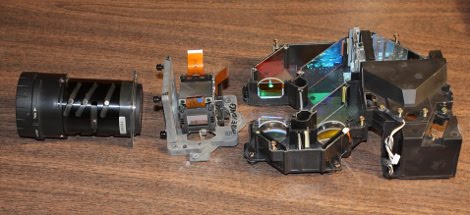
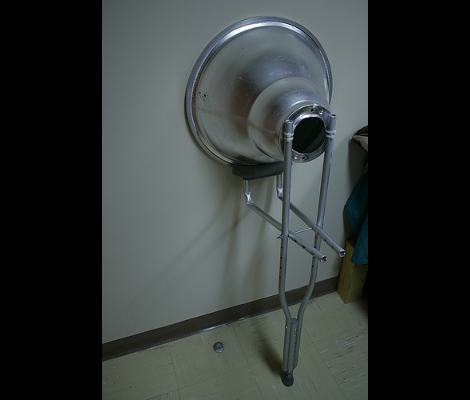
[Socket7] got his hands on a projector that had some color calibration problems. Of course the servicing manual says that there are no technician serviceable parts inside, but he cracked it open and fixed it anyway. This is an Epson PowerLite 5500c which was showing blue and yellow bands around the outside of the projected image. He could hear something rattling around inside which happened to be the lenses. It turns out there are foam pads that hold them in place that had shriveled over time. After a bit of careful work he replaced them and now has a working projector.

We’d love to have a projector of our own; there’s a lot of cool stuff you can do with them. Fixing a broken one is a great way to get one cheap, [Socket7's] was free!


We knew we were doomed when the T-shirt cannon bots showed up

posted Oct 28th 2010 11:00am by
filed under: robots hacks

The newest addition to the Skynet armada is this 10-barrel t-shirt cannon. It’s capable of storming the battlements at over twelve feet per second with a firing rate of three T-shirts per second (ooh, is that cotton?).

The members of Team 254, which is hosted by Bellarmine College Preparatory School, built the robot over the summer. This involved a full production cycle; planning, 3D modelling, acquiring the materials, and finishing the build. All of this is well documented in their build blog and for video, check out their media page.

We already know how to customize the T-shirts for use as ammo, now what this needs is some tank treads.

Software security courtesy of child labor

posted Oct 28th 2010 10:00am by
filed under: security hacks

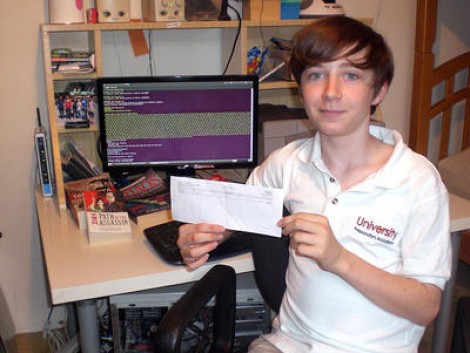
We couldn’t help but poke a little fun in the headline. This is [Alex Miller], a twelve year old who claimed a $3000 bounty from Mozilla. See, [Alex] is a self-taught security guru. When Mozilla upped the reward for discovering and reporting critical security flaws in their software he went to work searching for one. He estimates that he spent an hour and a half a day for ten days to find the hole. Fifteen hours of work for $3000? That’s pretty good!

Is it good or bad to pay for these kind of submissions? The real question: Is the bounty high enough to get blackhats to report vulnerabilities, rather than selling software that exploits them? Let us know what you think in the comments.

[via Zero Day]

Hacking: a disobedient act that drives change

posted Oct 28th 2010 9:04am by
filed under: misc hacks

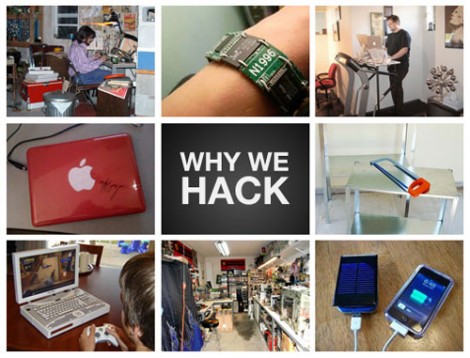
[Adam Dachis] published an essay a couple of days ago called Why We Hack. In it he discusses the outlook that hacking, on all of its various levels, is a simple form of disobedience. We have to agree with him. Manufacturers would like you to think that voiding the warranty is as good as smashing the product to bits. But we all know that if you can’t crack it open you don’t really own it. [Adam] says we can sit around and complain about it, or we can do better. So crack it open, dump the firmware, and make it do your bidding.

If you haven’t already seen it, you should also go back and watch [Corey Doctorow's] keynote address from Toorcon 8. He discusses freedom of information and hits especially hard on End User License Agreements (EULA) and the ills they cause. We’ve never seen someone hit the target quite as well as he does in this fantastic speech.


Artisans Asylum Takes on the Machine

posted Oct 28th 2010 6:16am by
filed under: misc hacks

You’ll probably lose your appetite after watching part one and part two of Artisans Asylum as they Take on the Machine. Based around the Wallace and Gromit “automated” set of contraptions, the team from Boston set out to make their own breakfast machine. Of course, with only three weeks to work it didn’t exactly turn out as planned. They certainly had some good ideas though, and we were amazingly impressed at their egg cracking machine. But in the end, we wouldn’t want to be first in line for a plate of breakfast. Next is the final team, The Transistor, who will be making a live action zombie video game.

[Thanks Deven]

Unreal speaker build

posted Oct 27th 2010 2:00pm by
filed under: digital audio hacks

These speakers are hand made and almost one of a kind. [Lluís Pujolàs] didn’t come up with the original design, but he sure did an amazing job of crafting them, including an eleven page build log (translated). They’re called the Odyssey 2, after the original design. The shell-shaped cavity on the bottom was built as a wooden skeleton first, then covered over for the finished shape. But the mid and high range enclosures were turned on a lathe from wood glued-ups. A serious machine shop is necessary to do this kind of woodworking. The bases are poured concrete, impregnated with lead beads to help with vibration isolation. At 330 pounds each it’s understandable that he tested them on wheels before parking them in their final position as seen above.

[Thanks Neorazz]

Power supplies and transformers; a learning experience

posted Oct 27th 2010 1:00pm by
filed under: misc hacks

[Ladyada] is working on a tutorial series covering power supplies. If you’ve ever built an electronic project you’ve used some type of power supply but we think that most people have no idea how you get from mains power to the DC voltages that most small projects use. So if you want to learn, get started with the first installment which covers AC/DC converters based on a transformer like the one seen above.

These transformers are inside the heavy and hot wall-wart plugs that come with many electronics. We used one along with a breadboard power supply when building the pumpkin LED matrix. They use a pair of coils to step down the voltage to a much smaller level. From there it’s a matter of rectifying the AC into DC power, which she talks about in an easy to follow discussion.

We understand this type of converter quite well but we’re a bit foggy on switch-mode AC/DC converters that don’t use a transformer. They’re much better because you don’t have to build a regulator into the target project like you do with wall-warts. Can’t wait until she gets to that part of the series!


Hack a Day serves up fresh hacks each day, every day from around the web as well as hacking related news.

Send us your hacks


Hacks

Resources