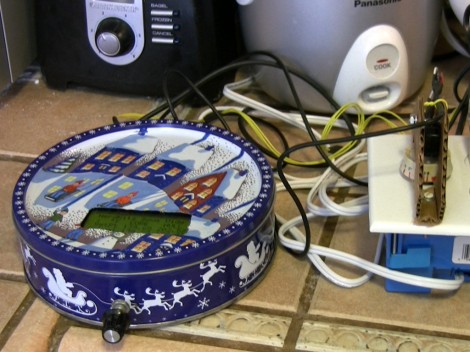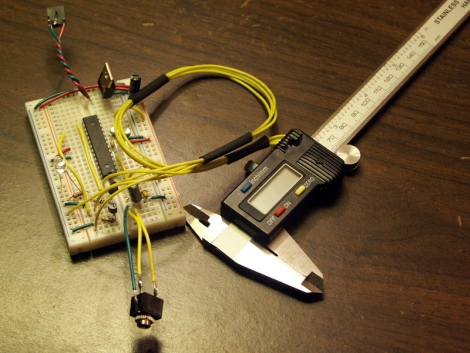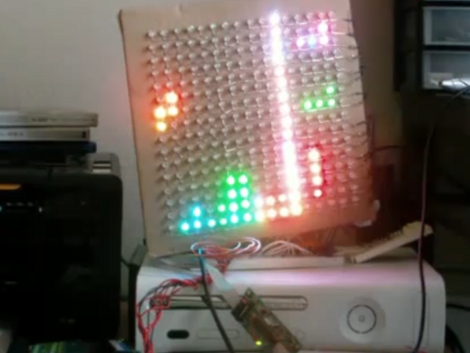
[Humberto] is at it again with a NerdKits video detailing the use of an SPI bus to communicate between microcontrollers. He started with a previous LED marquee project which was limited to a 5×24 LED Matrix and developed a modular solution to increase the size limitation.
The writeup and video embedded after the break do a great job of detailing the important differences between a stand-alone and a modular system. The good news is that the ATmega168 chips being used have a built-in interrupt based SPI protocol. Once wired correctly, a master control chip addresses each module separately, adding data to their buffer until a full frame has been transferred, then moves onto the next module.
Some of the caveats to this system such as digital transmission over long distances are discussed. We do wonder about power limitations if all LED’s in the marquee are illuminated at once. But that concern aside, if you’re thinking of playing around with an LED display don’t forget that there’s usually a huge price break for orders of 500 or 1000 LEDs!
[Humberto] from NerdKits is one of our favorite tipsters. We like how he can take a concept that seems so extremely complicated, in this case touch capacitance sensing, and present it in a clear and concise manner thats impossible to not love. As previously mentioned the most recent NerdKits hack is on touch capacitance; by using a resistor capacitor pair and some clever switch timing, anyone is able to detect the presence of a human limb. Now who’s going to be the first to adapt this concept further in their own hack?
The guys at Nerdkits have put together this tutorial on connecting a PS/2 keyboard to a microcontroller. Though this tutorial is written for one of the kits they sell, you should be able to apply this to pretty much any microcontroller. It is also a lesson in using interrupts instead of polling. They have several pre built examples ready to download as well as source code for the basic setup.
[Humberto] from NerdKits sends in the newest addition to their excellent collection of videos. This video goes over the basics of DC motor control with microcontrollers. They begin by showing nine experiments and observations that can be done by the average hacker with a multimeter, motor, LED, and jumperwire. Using the results from these they show how to model and calculate the properties of a motor. Lastly, it shows how to control a motor using PWM. They have supplemental text and demonstration code for an ATmega168 on their website.
The guys over at NerdKits put together a really informative video on a meat thermometer using predictive filtering which is viewable below. The video, supplemental text, and code is available on their website. The thermometer is constructed of a LM34 temperature sensor attached to a piece of 12 gauge solid copper wire. The thermometer signal is processed on an ATmega168 microcontroller and visualized using the pygame library for python. The real gem in this project is their excellent explanation of predictive filtering, which could easily be utilized for a large number of projects.
Here is a great project for learning how to control servos. They’ve made a USB controlled squirt gun using the USB NerdKit, a pump and a servo. This is a great tutorial to learn about PWM and controlling servos. The tutorial is very thorough, with great pictures and a video of it all , which you can see after the break.
Is controlling an R/C car with its own remote too mundane for you? Do you feel the need to involve a web server and an iPhone in the process? This project might just be perfect for you. By connecting the R/C controller to a microcontroller board, and feeding it signals via a website from your iPhone, you can control the car as if you had the original controller in your hand. In case you missed it, he’s lugging a laptop, a circuit board, and the original controller along with him. They do make a few improvements though, such as speed control by using pulse width modulation. I guess that makes up for having to lug the computer around too.