Voice Controlled Robot Controlled By An Android Phone

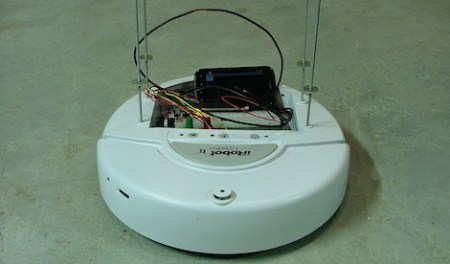
[Jeff] sent in a build of a voice controlled robot he just finished based on the Android ADK and an iRobot Create.

The robot is able to obey voice commands telling it where to go. Currently the robot responds to forward, reverse, left, right, stop, and ‘whistle while you work.’ It’s a creative use of the Android ADK with some obvious applications, but this project really shines with the write up on instructables. It’s rare that we’ve seen a project so well documented; it’s a great project for someone who wants to get their feet wet in the world of robotics.

[Jeff]’s write up goes through the steps of hooking up the ADK board to iRobot and providing all the electronic necessities. [Jeff] graciously provided the code for his robot if anyone would like to add to his project.

The ultimate goal [Jeff] is currently working towards is something akin to a TurtleBot, while keeping the voice control of the robot. In all, a very nice project.

Augmented Reality Game Could Come From The Seventies

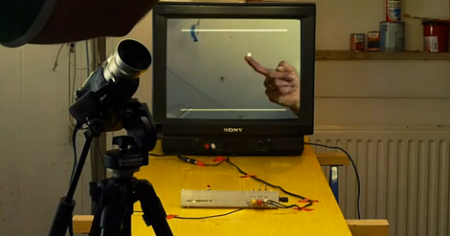
[Niklas Roy] sent in a project he just completed called PING! Augmented Pixel. At first glance the entire build is just a plain jane retro video game stuffed into an ATmega8 but looks can be deceiving. The video game is actually an augmented reality device that inserts a pixel into a video feed. The bouncing pixel can be manipulated with a camera – push the pixel and it goes off in another direction.

The project runs on an ATmega8 clocked at 16 MHz, and reads the video feed with the help of an LM1881 sync separator. There’s no schematics, but he thankfully included some code for his project. Everything is set up for PAL video, but this could be easily adapted for NTSC. Any Hack A Day readers want to take up the challenge of building this from just a description?

[Niklas] says there’s no reason this couldn’t have been done by Atari in the late seventies. There were economic reasons for not putting out a video camera controller, of course, and the R&D department may have been too busy playing Breakout with their eyebrows.

Check out the demo of the augmented pixel after the break.

Continue reading “Augmented Reality Game Could Come From The Seventies”

Fog Horn Built From Plumbing Supplies

diy_plumping_supply_fog_horn

Instructables user [rog8811] was looking to build a fog horn that resembled hand-pumped units found on small ships in the early to mid 1900s. His budget was a bit limited, so he set off to build the cheapest replica possible.

While the original horns were likely constructed from steel, copper and wood, he opted to use cheap plumbing components he found at his local hardware store. He used a simple double-acting air pump to drive the horn, combining it with a slightly modified bottle trap. The trap was shortened, and a diaphragm cut from a dish washing glove was added to generate sound.

He added a few more pieces of PVC piping to enhance the output, giving him the results you see in the video below. He says that the best thing about his design is the ability to easily tweak the pitch and volume of the horn by simply adding different drain components to the pump.

Watch out vuvuzela, there’s a new cheap and annoying horn on the block!

Continue reading “Fog Horn Built From Plumbing Supplies”

Alarm Clock Forces You To Play Tetris To Prove You Are Awake

tetris_alarm_clock

Oversleeping sucks, but we’ve all been there. Whether its a matter of hitting the snooze button a dozen times too many, or turning off the alarm and drifting back to sleep – sooner or later, you are going to wake up late.

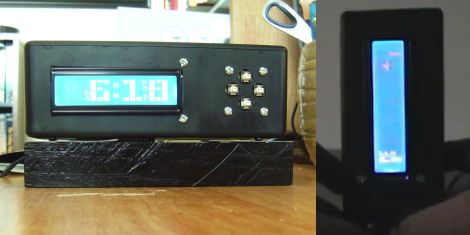
Instructables user [nolte919] has overslept a time or two in his life, and he set out to design a clock that would make it nearly impossible to wake up late. His clock is Arduino-based and shares many features with off the shelf models including multiple alarms, a backup battery, and snooze features. His alarm however goes one step further and ensures you are fully awake each morning.

If you hit the user-defined snooze limit, the alarm sounds and will not turn off until you have cleared 4 lines in Tetris. That’s right, you have to prove to the clock that you are awake and coherent before it will shut off. Technically you can silence the alarm for a 30 second period so you can focus on Tetris, but that’s all the break you get.

It really is a novel way of ensuring you are awake in the morning, and heck, how bad can the day be when you start off by playing video games for a few minutes?

Stick around to see a quick video of his Tetris alarm clock in action.

Continue reading “Alarm Clock Forces You To Play Tetris To Prove You Are Awake”

CEE Is A Swiss Army Knife For Analog Electronics

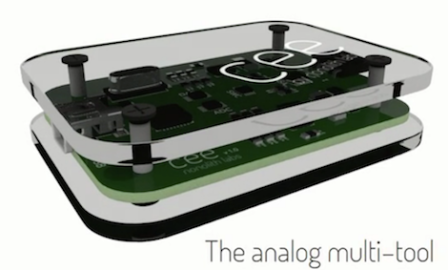
The team at nonolith labs announced their CEE, a device for billed as, “an analog buspirate” that is meant to control, experiment, and explore the world of analog electronics. Nonolith labs started a kickstarter campaign for the CEE.

The CEE is capable of sub-millivolt and milliamp sampling at 44.1k samples/second, and sourcing 2 channels of 5V @ 2A with a little bit of soldering. This allows for precise control of motors and sensors with the web-based UI. We’re thinking this would be a great way to teach high schoolers the art of electronics, and would be great combined with a few lectures from Paul Horowitz.

The CEE ties into nonolith labs Pixelpulse, a pretty handy tool for visualizing analog and digital signals. You can check out a demo of Pixelpulse simulating a charging capacitor here.

We’re hoping this focus on education on analog electronics catches on – you can learn a lot more by building a 555-based mini Segway than you can slapping a microcontroller in every project. This would go under the same theory as, “any idiot can count to one.”

Check out the video of the CEE on the kickstarter campaign page.

Bottle Rocket POV Video

pov_fireworks_video

It’s a holiday weekend, and much like you, we’re taking a bit of time to relax and kick back a few drinks while we mingle with friends and family. Obviously, one of the bigger events this weekend plays host to is the fireworks show put on by your city or your drunken neighbors.

Roman candle wars aside, have you ever wondered what the 4th of July looked like from the fireworks’ point of view? We did, and so did [Jeremiah Warren], who put together an awesome video showing what really happens after you light the fuse and run away like a little girl.

The dizzying video was shot using a pair of key chain cameras that he strapped directly to the rockets before launching. It’s pretty entertaining, so be sure to check it out if you have a few minutes to spare.

This probably doesn’t quite fit the criteria to be considered a hack, but with explosions and the crazy point of view video, we had to pass it along.

Continue reading “Bottle Rocket POV Video”

Sandbox Game In A Sandbox

The team at Monobanda have been working on a sandbox game called Mimicry that uses a Kinect to read the terrain of a sandbox.

From the teaser video and press release, the eventual goal appears to be controlling both a character in the game and the environment simultaneously. By reading the terrain of the sandbox with a Kinect, the team was able to import that into the game world. The team says the game world is inhabited by tiny virtual characters that, “roll around, jump and glide through the Mimicry world.” Anyone playing Mimicry can create obstacles for these little creatures or build them a race track. The Monobandia team says the point of this game is, “to create your own games.” With a fully editable world and its ‘rolling ball’ inhabitants, we can’t wait to make our own custom Beyblade arena.

Since the release of the Kinect SDK a few weeks ago, we’ve been seeing some really amazing projects that should have been day-1 demos from Microsoft. We’ve been impressed with the projects we’ve seen so far, and can’t wait to see what others come up with next. If you have a neat build, be sure to send it into the tip line.

Check out a video testing the game mechanics after the break.

Continue reading “Sandbox Game In A Sandbox”