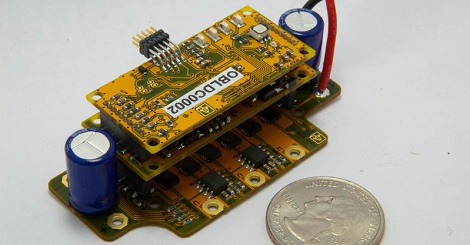
Open Source Brushless Motor Controller

It’s been a long time coming, but efforts to create Open Source brushless motor controller are finally paying off.

The Open-BLDC project aims to create an open source motor controller for the brushless motors usually found in remote control airplanes, helicopters, and quadcopters. Normally, these motor controllers – usually called electronic speed controllers – can’t supply more than a few dozen amps, and are usually only controllable via a servo signal.

The Open-BLDC goes far beyond the capabilities of off-the-shelf ESCs with up to 200 amps of output, TTL level serial input, and the ability to use regenerative breaking.

While the Open-BLDC project is far from complete, the team working on the hardware hopes to add I2C, CAN, and PPM interfaces, along with speed and torque control.

There is no word on when, or even if, the Open-BLDC will ever be available for sale, but with the features it has it would be welcomed by just about any builder constructing a gigantic RC vehicle.


Zeppelin On The Fisher Price Record Player Now Thanks To A 3D Printer

[Fred Murphy] went ahead and revised his method of making custom records for a Fisher Price toy record player. He’s now able to 3D print the discs. The toy works much like a music box, with a comb in the “cartridge” of the record player and notches in the record that pluck the fingers of the comb as it turns. He had previously developed a subtractive method that let him mill records out of a solid piece of plastic. But this additive method means less waste.

The music creation portion of the project is the same as the previous version. That’s because it’s pretty hard to outdo the C# software he wrote which serves as a composition studio. The difficulty comes in getting a clean print for the disk. The ridges on the discs are 0.7mm so you’re going to need a well-aligned printer with fine resolution. [Fred] printed in both ABS and what he calls “Vero clear” plastic. The former works but he got better results with the latter.

Hands On With The Electric Imp

A while ago we caught wind of the Electric Imp, a very cool little device that packs an ARM microcontroller and a WiFi adapter into an SD card. We got our hands on an Imp last week, and now it’s time to show off what this little device can do. You can check out the rest of this hands on tutorial with the Electric Imp after the break.

Continue reading “Hands On With The Electric Imp”

Playing Around With Kerf Bending

With laser cutters popping up in hackerspaces and maker’s tool sheds like weeds, it’s no surprise we’re seeing an explosion in manufacturing techniques that would be nearly impossible without a laser cutter. One of these techniques is kerf bending, a method of bending plywood simply by burning patterns along the desired bend. [Martin] just put up a great tutorial on kerf bending with a laser cutter, and even came up with a few very interesting patterns that can be used to build your own case with rounded corners.

[Martin]’s adventures into kerf bending began with a small radio transmitter case he built. This case used the very common ‘vertical slit’ method, but in the first version of the case, the slits were placed too far apart. By moving the slits closer together, [Martin] was left with a very easy to bend and very strong wooden case.

There are also a few other patterns [Martin] tried out. A herringbone pattern made for a wooden case nearly as bendable (and a little stronger) as the traditional vertical slit method. From there, [Martin] branched out into more esoteric patterns such as a medieval cross and Space Invader pattern, both ideal for your next highly stylized enclosure.

In the end, [Martin] says just about any pattern will work for kerf bending, so long as the design isn’t diagonal to the bend. We’d love to see some proper engineering analysis for kerf bending, so if you can figure out the optimal pattern for high strength, low machine time bends, send it in on the tip line.

Tindie Is Growing Up

Tindie, the etsy for electronics and DIY projects is growing up. After growing 300% in August, the creator of Tindie,  [emile], is now working full-time as the head of Tindie, LLC.

Intended to be a place to connect makers with homebrew project connoisseurs, Tindie is seeing new projects and builds added every day. [emile] figures since some Tindie contributors are using the platform as the source of their livelihood, the least he could do would be to focus his energies into turning Tindie into a profitable and sustainable enterprise.

From the humble beginnings of an empty storefront, Tindie has grown large enough to feature some very cool projects such as a GoPro time lapse control board, a CNC router control board, a LiPo charger the size of a USB plug, a Raspi case milled out of a billet of aluminum, and a gag gift we wouldn’t want to take through airport security. Not bad for a web site that only launched a few months ago.

atmos

Autonomous Plane? Quadrotor? Both? Meet The ATMOS!

If you’ve been trying to decide between building an autonomous quadcopter or a fixed wing UAV, you may not have to choose anymore.  [Team ATMOS] from Tu Delft University in the Netherlands, has developed a UAV that can autonomously transition from quadcopter flight to that of a fixed-wing aircraft. Although the world has seen several successful examples of transitioning-flight or VTOL aircraft, team [ATMOS] claims to have made the first autonomous transition of this type of craft.

This UAV was featured in their school newspaper, which provides a write-up about the work that went into creating this hybrid UAV. When you’re done with that, be sure to check out the two videos after the break. The first shows the [ATMOS] taking off vertically and flying off as a flying-wing fixed aircraft. The second video shows this and other UAVs in the [DARPA] competition that it was designed for. Fast forward to 2:24 to see this aircraft do a fly-by.

http://www.youtube.com/watch?v=81NvfLFzhqQ

Thanks for the tip [Dirk]!

Carrot Gun Packs A Punch; Improves Eyesight

Just in time for your garden’s carrot harvest [Lou] shows us how to make a carrot firing rifle. It’s cheap, easy, and quick. If you’ve got 15 buck and 15 minutes you can have one to call your own.

The loading method is quite easy. Shove a carrot in the muzzle as far as it will go, then cut of the excess. Finish up by using a ramrod to push the carrot stub the rest of the way into the barrel. Once you’ve gnawed down the rest of the carrot nub and connected a compressor hose to the rifle you’re ready to do some damage. The video after the break shows a carrot fired all the way through a cardboard box, and penetrating a gallon jug of water.

[Lou] uses CPVC for the project. It takes just a few lengths of pipe, pipe fittings, a valve, and a threaded metal compressor fitting. After gluing everything together he threads the compressor attachment in place and heads to the firing range.

Continue reading “Carrot Gun Packs A Punch; Improves Eyesight”