Building A Ranque-Hilsch Vortex Cooling Tube

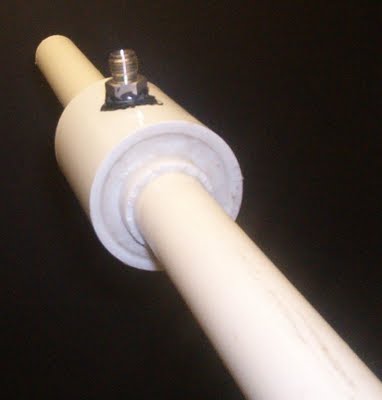
The Ranque-Hilsch vortex tube is an interesting piece of equipment. It can, without any moving parts or chemicals, separate hot and cold compressed gasses that are passed through it. Interestingly enough, you can cobble one together with very few parts for fairly cheap. [Otto Belden] tossed one together in a weekend back in 2009 just to see if he could do it. His results were fairly good and he shared some video tutorials on its construction.

His latest version, which you can see in the video below, takes compressed air at about 78degrees and spits out about 112degrees on the hot side and  8degrees on the cold side. Not too bad!

Continue reading “Building A Ranque-Hilsch Vortex Cooling Tube”
Making A Miniature X-Ray Tube From Scratch

We know that most of you will have no reason to ever make a miniature X-ray tube. However, we also know that many of you will find this video mesmerizing like we did. [Glasslinger] does a fantastic job of explaining the entire process of creating the mini x-ray tube from, procuring the uranium glass and tungsten stem, creating the filament from scratch, all the glass work, and the testing.

Admittedly, most of us here at hackaday won’t go any further than admiring the craftsmanship, though we’re curious to see what [Adam Munich] has to say when he sees this story.

If you enjoyed the tube construction in the video, be sure to check out [Glasslinger’s] other videos. He makes all kinds of tubes in his shop and usually shares so much information along the process that each one has useful information beyond that particular project. Another crazy part is that he has made most of his own tools, including his glass lathe.

We really shouldn’t have to point out that X-Rays are dangerous. Don’t mess with them unless you have researched how to do it safely.

Brawndo Drinking Fountain – It’s Got What Geeks Crave!

brawndo fountain

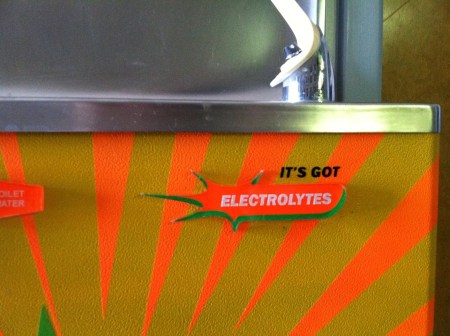
If you’re tired of drinking mere water, like from the toilet, then you should definitely install a Brawndo drinking fountain. Apparently, in addition to being what plants crave, geeks also enjoy this futuristic beverage.

As with many hacks, this fountain started out with a broken piece of equipment – a water fountain. After searching unsuccessfully for a new pushbutton valve [Dave] and [Craig] decided to use a solenoid valve instead. Logically, they decided that if a new valve was needed, some new features to go along with it were also needed. Along with this valve, a peristalsis pump was installed to add flavoring to the water if Brawndo was selected (as opposed to toilet water).

The hack was finished off with some nice decals and a switch plate. As you may have suspected, the Brawndo fountain was custom made for a makerspace.  In this case Kansas City’s own Hammerspace. Be sure to check them out if you’re in the area!

Tron Costume Fits Nice And Snug

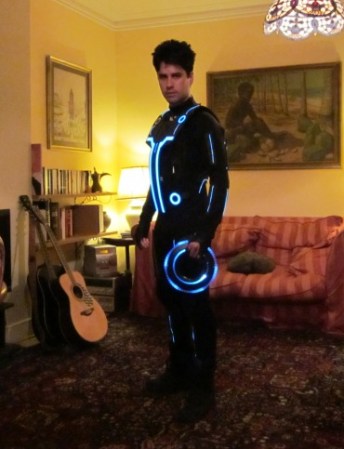
We’ve seen our fair share of Tron costumes and props, but much like [Sean-h] points out, they are usually pretty bulky and baggy. He’s gone a slightly different route by starting with a wetsuit instead of bulkier items like leather jackets. The lighting is done in the same manner we’ve seen before, copious amounts of EL wire and EL tape. The additional layers of this costume were made from foam, so they could be fairly form fitting as well.

[Sean-h] points out that there are some downfalls to his design. The wetsuit, while looking great, gets pretty hot while indoors and the foam layers have a tendency to detach if you move around too much. We think it looks great though. Good job [Sean-H]

Solidoodle, A $500 3d Printer

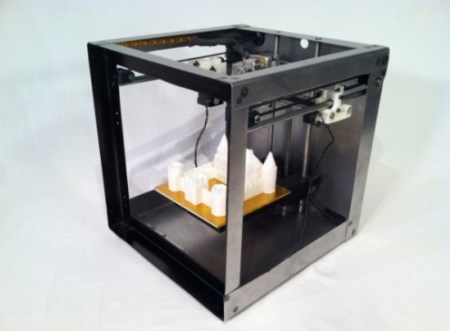
3D printers are very popular right now. We’ve seen them go from an interesting project to multiple commercial entities. Makerbot seems to be the poster child for the commercial side of things, at least they were. Their former COO [Samuel Cervantes] is now in charge of a new company called Solidoodle. Their main product is a complete 3d printing kit for $499. You supply power and a computer.

The Solidoodle is capable of building things 6″x6″x6″. The quality seems to be comparable to most of the others we’ve seen. They tout a .1mm layer thickness in HD mode (makerbot shows .2-.3mm). Not bad considering it is less than 1/3 the price of the makerbot replicator with a single extruder. The video after the shows it in action, as well as both with the optional case and door and without.

Mother’s Day Heart Chaser

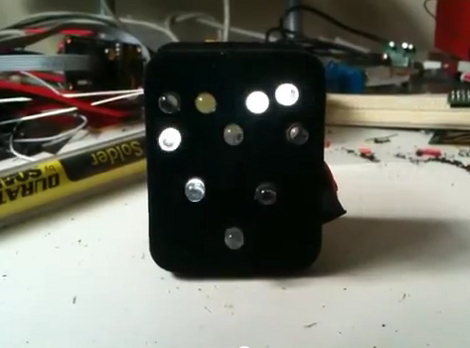
[Robert Mibus] took on a project which his kids could present to Mom on Mother’s Day. It’s an LED heart built into a ring or necklace box. The series of white LEDs are animated in a chase pattern. The project let [Robert] push his comfort boundaries by moving past a stock Arduino board.

Inside you’ll find an ATtiny85. He picked up the chip to try running Arduino sketches on smaller hardware. But the total of five available I/O pins presented an issue with driving the LEDs. Ten LEDs are used here and even a standard multiplex display would need no less than seven to control them without additional chips or the need for Charlieplexing. His solution was to drive two opposite LEDs at once, which cuts the need down to his five available pins.

Once he got it all soldered together he realized that he had made a coding error. But a few soldered wires let him reflash it in place using ISP.

Continue reading “Mother’s Day Heart Chaser”