
An Environmentally Conscious, Solar-Powered Throwie

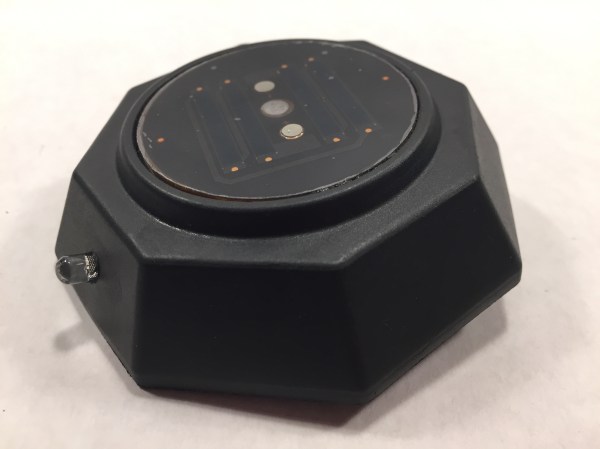
The basic throwie is a a type of street art/graffiti/vandalism — depending on where you stand — consisting of a coin cell, an led, and a magnet taped together. Seeking to be a slightly more eco-friendly troublemaker, [Alaric Loftus] has kindly put together an Instructable on how to build a solar-powered throwie!

In order to be the best maker of mischief possible, [Alaric Loftus] tried a number of different products to find one that was hackable,  supplied the right voltage, had the right form factor, and cheap enough to literally throw away. Turns out, garden path lights hit that sweet spot. Once [Alaric Loftus] has drilled a hole in the light and opened it up, de-soldering the stock LED, attaching some leads to the contacts and sticking it into the freshly-drilled hole is simply done. Hot-gluing a strong magnet on the bottom completes the throwie.

[Alaric Loftus] also advises that drilling the LED hole slightly smaller and sealing up any cracks with hot glue will strengthen its water resistance — because if it’s worth doing, it’s worth doing it right.

We’ve featured some really cooleven creepy — takes on the throwie concept, but please don’t contribute any further to e-waste buildup.

A Compact, Portable Pantograph Camera Slider

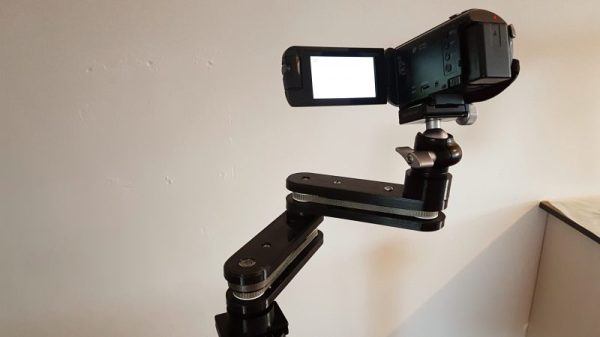
Ho, hum, another camera slider, right? Wrong — here’s a camera slider with a literal twist.

What sets [Schijvenaars]’ slider apart from the pack is that it’s not a slider, at least not in the usual sense. A slider is a mechanical contrivance that allows a camera to pan smoothly during a shot. Given that the object is to get a camera from point A to point B as smoothly as possible, and that sliders are often used for long exposures or time-lapse shots, the natural foundation for them is a ball-bearing linear slide, often powered by a stepper motor on a lead screw. [Schijvenaars] wanted his slider to be more compact and therefore more portable, so he designed and 3D-printed a 3-axis pantograph mechanism. The video below shows the slider panning the camera through a silky smooth 60 centimeters; a bonus of the arrangement is that it can transition from panning in one direction to the other without any jerking. Try that with a linear slider.

Granted, this slider is not powered, but given that the axes are synced with timing belts, it wouldn’t be difficult to add a motor. We’ve seen a lot of sliders before, from simple wooden units to complicated overhead cranes, but this one seems like a great design with a lot of possibilities.

Continue reading “A Compact, Portable Pantograph Camera Slider”








