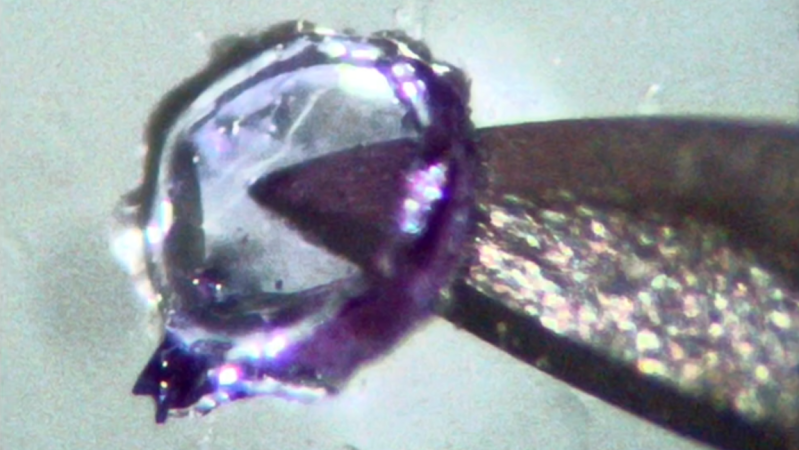
A small plastic object can be seen in front of the tip of a hypodermic needle. The object is made of clear, slightly purple-tinted plastic. It is roughly circular, with edges thicker than the center.

The Latest From RepRapMicron – Nail Gel, First Objects, And More

We’ve been following [Vik Olliver]’s progress on the μRepRap project with interest for some time now. The project’s goal is to build a 3D printer that can print feature sizes down to about 10 microns – the same feature size used in the Intel 4004 processor. At the recent Everything Open 2026 conference, [Vik] presented an overview of all the progress he’s made in the last year, including printer improvements, material woes, and the first multi-layer prints (presentation slides).

The motion stage has undergone some fundamental improvements recently. The original XY motion table was supported on four flexures which allowed movement in X and Y, but also introduced slight variations in Z – obviously a problem in a system that needs to be accurate down to the microns. The latest version now uses complementary flexures to maintain a constant Z height, and eliminates interference between the X and Y axes. The axis motion drivers were also redesigned with parallel-bar linear reducers inspired by a pantograph, increasing their usable range from two to eight millimeters.

Rather than extruding material, the μRepRap uses an electrochemically-etched needle point to deposit UV-curable gel on the build surface. [Vik] found that a bit of nitric acid in the needle etching solution gave the edges of the probe a bit of a rough texture which let it hold more resin. He started his test prints using normal 3D printer resin, but it turns out that dissolved oxygen inhibits curing – quite a problem for small, air-exposed droplets. Fortuitously, UV nail gel does cure in air, and the next set of tests were printed in nail gel, including the first layered prints (one of which can be seen above, on top of a hypodermic needle). The μRepRap can’t yet print large numbers of layers, but [Vik] did print some hinged parts that could be folded into shape.

There’s much more in the presentation than can be covered here, including some interesting thoughts about the possibility of 3D printing electrochemical memory cells in ionic gel. Near the end of the presentation, [Vik] listed some pieces of related work, including necroprinting and this homemade micro-manipulator.

 

Antique Mill Satisfies Food Cravings

Everyone knows what its like to get a hankering for a specific food. In [Attoparsec]’s case, he wanted waffles. Not any waffles would do, though; he needed waffles in the form of a labyrinth. Those don’t exist, so he had to machine his own waffle maker.

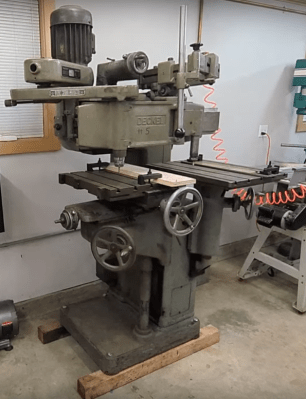
Antique pantograph mill
When computers were the size of rooms, these stood in where we’d use CNC today.

Most of us would have run this off on a CNC, but [Attoparsec] isn’t into CNCing–manual machining is his hobby, and he’s not interested in getting into another one, no matter how much more productive he admits it might make him. We can respect that. After a bit of brain sweat thinking of different ways to cut out the labyrinth shape, he has the opportunity to pick up an antique Deckle pantograph mill.

These machines were what shops used to do CNC before the ‘computer numeric’ part was a thing. By tracing out a template (which [Attoparsec] 3D prints, so he’s obviously no Luddite) complex shapes can be milled with ease. Complex shapes like a labyrnthine wafflemaker. Check out the full video below; it’s full of all sorts of interesting details about the machining process and the tools involved.

If you don’t need to machine cast iron, but are interested in the techniques seen here, a wooden pantorouter might be more your speed than a one-tonne antique. If you have a hankering for waffles but would rather use CNC, check out these design tips to help you get started. If pancakes are more your style, why not print them?

Shoutout to [the gambler] for sending this into the tip line. We think he struck the jackpot on this one. If you have a tip, don’t be shy. Continue reading “Antique Mill Satisfies Food Cravings”

A grey car sits in the background out of focus, its front facing the camera. It sits over an asphalt roadway with a metal rail extending from the foreground to behind the car in the distance. The rail has a two parallel slots and screws surrounding the slots running down the rail.

What Happened To Sweden’s Slot Car EV Road?

Many EVs can charge 80% of their battery in a matter of minutes, but for some applications range anxiety and charge time are still a concern. One possible solution is an embedded electrical rail in the road like the [eRoadArlanda] that Sweden unveiled in 2016.

Overhead electrical wires like those used in trolleys have been around since the 1800s, and there have been some tests with inductive coils in the roadway, but the 2 km [eRoadArlanda] takes the concept of the slot car to the next level. The top of the rail is grounded while the live conductor is kept well underground beneath the two parallel slots. Power is only delivered when a vehicle passes over the rail with a retractable contactor, reducing danger for pedestrians, animals, and other vehicles.

One of the big advantages of this technology being in the road bed is that both passenger and commercial vehicles could use it unlike an overhead wire system that would require some seriously tall pantographs for your family car. Testing over several Swedish winters shows that the system can shed snow and ice as well as rain and other road debris.

Unfortunately, the project’s website has gone dark, and the project manager didn’t respond when we reached out for comment. If there are any readers in Sweden with an update, let us know in the comments!

We’ve covered both overhead wire and embedded inductive coil power systems here before if you’re interested in EV driving with (virtually) unlimited range.

Continue reading “What Happened To Sweden’s Slot Car EV Road?”

Tracing In 2D And 3D With Hall Effect Sensors

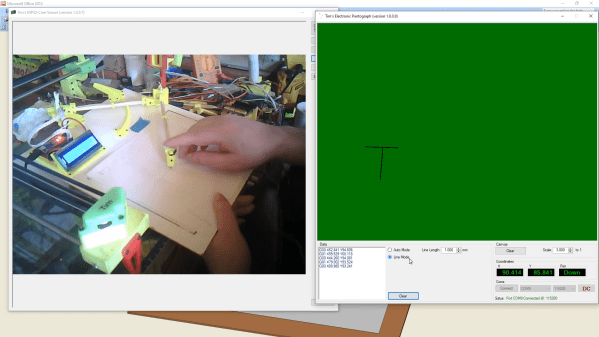
Pantographs were once used as simple mechanical devices for a range of tasks, including duplicating simple line drawings. [Tim] decided to make a modern electronic version that spits out G-Code instead.

The design relies on a 3D-printed pantograph assembly, mounted upon a board as a base. A pair of Hall effect sensors are mounted in the pantograph, which, along with a series of neodymium magnets, can be used to measure the angles of the pantograph’s joints. The Hall sensors are read by an Arduino Nano, which computes the angles into movement of the pantograph head and records it as G-Code. This can simply be displayed on the attached LCD display, or offloaded to a computer for storage.

[Tim] explains the basic theory behind the work in an earlier piece, where he built a set of electronic dividers using the same techniques. He didn’t stop there, either. He also built a more complex version that works in 3D that he calls it the Electronic Point Mapper, which can be used to generate point clouds with a 3D-capable pantograph mechanism.

It’s a neat way to learn about geometry, and could even be useful if you’re doing some work in tracing 2D drawings or measuring 3D objects.

Continue reading “Tracing In 2D And 3D With Hall Effect Sensors”

Trucks Could Soon Run On Electrified Highways

Electric vehicles make for cleaner transport. However, they’re hung up by the limited range available from batteries. Long recharge times further compound the issue.

These issues are exacerbated when it comes to trucks hauling heavy goods. More payload means more weight, which means less range, or more batteries, which means less payload. Electric highways promise to solve this issue with the magic of overhead wires.

Continue reading “Trucks Could Soon Run On Electrified Highways”

Brachiograph: A Simple And Cheap Pen-Plotter

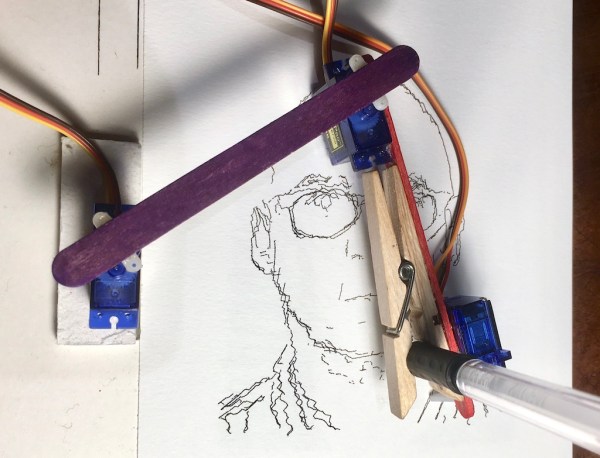
The BrachiGraph project consists out of two parts, the hardware design for a servo-driven drawing arm (pen plotter) and software utilities (written in Python) that allow the drawing arm’s servos to be controlled in order to convert a bitmap image into a collection of lines that can be used to draw an image resembling the original, in a variety of styles. All of the software and designs needed to make your own version can be found on the Github page for the project.

docs/images/readme_combined_image.png

Considering an estimated €14 worth of materials for the project, the produced results are nothing short of amazing, even if the principles behind the project go back to the Ancient Greek , of course. The basic hardware is that of a pantograph, which provides the basic clues for how the servos on the plotter arm are being driven.

The main achievement here is definitely that of minimalism, with three dirt-cheap SG-90 microservos along with some bits of wood, a clothes-peg or equivalent, and of course a pen providing a functional plotter that anyone can assemble on a slow Sunday afternoon from random bits lying around the workshop.


Cycloid Drawing Machine Uses Sneaky Stepper Hack

Stepper motors are great for projects that require accurate control of motion. 3D printers, CNC machines and plotters are often built using these useful devices. [InventorArtist] built a stepper-based cycloid drawing machine, and made use of a nifty little hack along the way.

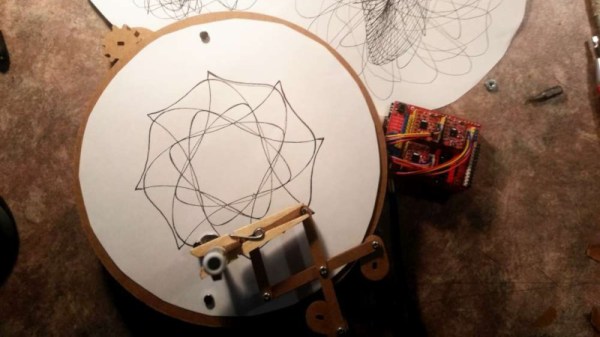
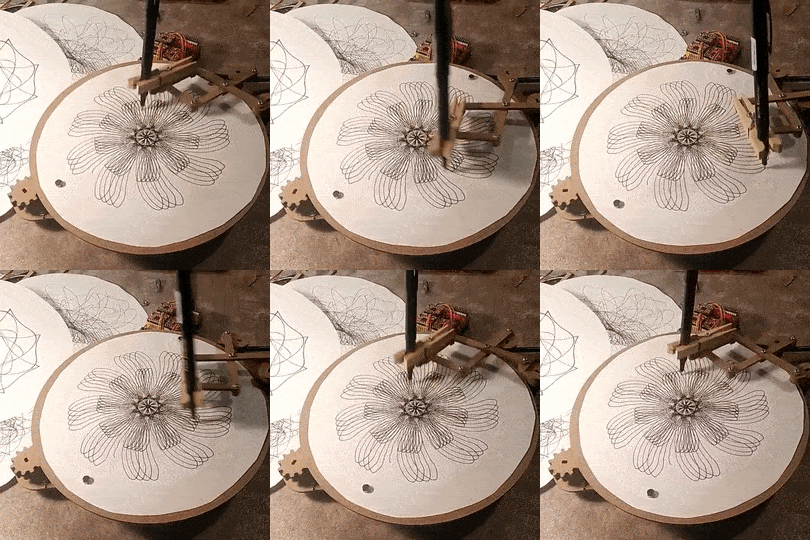
The machine uses a rotating turntable to spin a piece of drawing paper. A pen is then placed in a pantograph mechanism, controlled by another two stepper motors. The build uses the common 28BYJ-48 motor, which are a unipolar, 5-wire design. A common hack is to open these motors up and cut a trace in order to convert them to bipolar operation, netting more torque at the expense of being more complex to drive. [InventorArtist] worked in collaboration with [Doug Commons], who had the idea of instead simply drilling a hole through the case of the motor to cut the trace. This saves opening the motor, and makes the conversion a snap.



[InventorArtist] was able to create a machine capable of beautiful spirograph drawings, and develop a useful hack along the way. Reports are that a jig is in development to make the process foolproof for those keen to mod their own motors. We expect to see parts up on Thingiverse any day now. We’ve also covered the basic version of this hack before.

[Thanks to Darcy Whyte for the tip!]