This Week In Security: Getting Back Up To Speed

Editor’s Note: Over the course of nearly 300 posts, Jonathan Bennett set a very high bar for this column, so we knew it needed to be placed in the hands of somebody who could do it justice. That’s why we’re pleased to announce that Mike Kershaw AKA [Dragorn] will be taking over This Week In Security! Mike is a security researcher with decades of experience, a frequent contributor to 2600, and perhaps best known as the creator of the Kismet wireless scanner.

He’ll be bringing the column to you regularly going forward, but given the extended period since we last checked in with the world of (in)security, we thought it would be appropriate to kick things off with a review of some of the stories you may have missed.


Hacking like it’s 2009, or 1996

Hello all!  It’s a pleasure to be here, and it already seems like a theme of the new year so far has bringing in the old bugs – what’s old is new again, and 2026 has seen several fixes to some increasingly ancient bugs.

Telnet

Reported on the OpenWall list, the GNU inetd suite brings an update to the telnet server (yes, telnet) that closes a login bug present since 2015 linked to environment variable sanitization.

Under the covers, the telnet daemon uses /bin/login to perform user authentication, but also has the ability to pass environment variables from the client to the host. One of these variables, USER, is passed directly to login — unfortunately this time with no checking to see what it contains. By simply passing a USER variable of “-froot”, login would accept the “-f” argument, or “treat this user as already logged in”. Instant root!

If this sounds vaguely familiar, it might be because the exact same bug was found in the Solaris telnetd service in 2007, including using the “-f” argument in the USER variable. An extremely similar bug targeting other variables (LD_PRELOAD) was found in the FreeBSD telnetd service in 2009, and other historical similar bugs have afflicted AIX and other Unix systems in the past.

Of course, nobody in 2026 should be running a telnet service, especially not exposed to the Internet, but it’s always interesting to see the old style of bugs resurface.

Glibc

Also reported on the OpenWall list, glibc — the GNU LibC library which underpins most binaries on Linux systems, providing kernel interfaces, file and network I/O, string manipulation, and most other common functions programmers expect — has killed another historical bug, present since 1996 in the DNS resolver functions which could be used to expose some locations in the stack.

Although not exploitable directly, the getnetbyaddr resolution functions could still ease in breaking ASLR, making other exploits viable.

Address Space Layout Randomization (ASLR) is a common method of randomizing where in memory a process and its data are loaded, making trivial exploits like buffer overflows much harder to execute. Being able to expose the location of the binary in memory by leaking stack locations weakens this mechanism, possibly exposing a vulnerable program to more traditional attacks.

MSHTML

In February, Microsoft released fixes under CVE-2026-21513 for the MSHTML Trident renderer – the one used in Internet Explorer 5. Apparently still present in Windows, and somehow still accessible through specific shortcut links, it’s the IE5 and Active-X gift that keeps giving, being actively exploited.

Continue reading “This Week In Security: Getting Back Up To Speed”
Linux Hotplug Events Explained

There was a time when Linux was much simpler. You’d load a driver, it would find your device at boot up, or it wouldn’t. That was it. Now, though, people plug and unplug USB devices all the time and expect the system to react appropriately. [Arcanenibble] explains all “the gory details” about what really happens when you plug or unplug a device.

You might think, “Oh, libusb handles that.” But, of course, it doesn’t do the actual work. In fact, there are two possible backends: netlink or udev. However, the libusb developers strongly recommend udev. Turns out, udev also depends on netlink underneath, so if you use udev, you are sort of using netlink anyway.

If netlink sounds familiar, it is a generic BSD-socket-like API the kernel can use to send notifications to userspace. The post shows example code for listening to kernel event messages via netlink, just like udev does.

When udev sees a device add message from netlink, it resends a related udev message using… netlink! Turns out, netlink can send messages between two userspace programs, not just between the kernel and userspace. That means that the code to read udev events isn’t much different from the netlink example.

The next hoop is the udev event format. It uses a version number, but it seems stable at version 0xfeedcafe. Part of the structure contains a hash code that allows a bloom filter to quickly weed out uninteresting events, at least most of the time.

The post documents much of the obscure inner workings of USB hotplug events. However, there are some security nuances that aren’t clear. If you can explain them, we bet [Arcanenibble] would like to hear from you.

If you like digging into the Linux kernel and its friends, you might want to try creating kernel modules. If you get overwhelmed trying to read the kernel source, maybe go back a few versions.

Building A Heading Sensor Resistant To Magnetic Disturbances

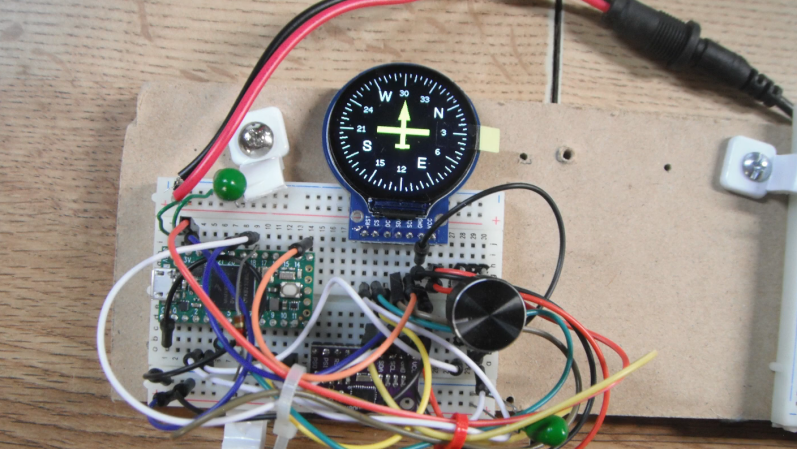
Light aircraft often use a heading indicator as a way to know where they’re going. Retired instrumentation engineer [Don Welch] recreated a heading indicator of his own, using cheap off-the-shelf hardware to get the job done.

The heart of the build is a Teensy 4.0 microcontroller. It’s paired with a BNO085 inertial measurement unit (IMU), which combines a 3-axis gyro, 3-axis accelerometer, and 3-axis magnetometer into a single package. [Don] wanted to build a heading indicator that was immune to magnetic disturbances, so ignored the magnetometer readings entirely, using the rest of the IMU data instead.

Upon startup, the Teensy 4.0 initializes a small round TFT display, and draws the usual compass rose with North at the top of the display. Any motion after this will update the heading display accordingly, with [Don] noting the IMU has a fast update rate of 200 Hz for excellent motion tracking. The device does not self-calibrate to magnetic North; instead, an encoder can be used to calibrate the device to match a magnetic compass you have on hand. Or, you can just ensure it’s already facing North when you turn it on.

Thanks to the power of the Teensy 4.0 and the rapid updates of the BNO085, the display updates are nicely smooth and responsive. However, [Don] notes that it’s probably not quite an aircraft-spec build. We’ve featured some interesting investigations of just how much you can expect out of MEMS-based sensors like these before, too.

Continue reading “Building A Heading Sensor Resistant To Magnetic Disturbances”