Age-Verification And The World Before Social Media

Although it may be hard to believe for current generations, there was a time when the Internet and the World Wide Web were not as integrated into society as it is today. The only forms of online ‘social media’ that existed came in the form of IRC, forums, BBSes, newsgroups and kin, while obtaining new software for your PC involved generally making your way over to a physical store to buy a boxed copy, at least officially.

In this era – and those before it – age-verification already existed, with various goods ranging from tobacco and alcohol to naughty adult magazines requiring you to pass some form of age check. Much like how movies also got age-gated, so did video games, with a sales clerk taking a very good look at you before selling you that naughty puzzle game or boxed copy of Quake 3.

Today we’re seeing a big fuss being made about online age-verification, with the claim being that it is ‘for the children’, but as any well-adjusted adult can attest to, this is essentially a big bucket of hogwash.

Continue reading “Age-Verification And The World Before Social Media”
Building A Monitor Light Bar For Better Productivity

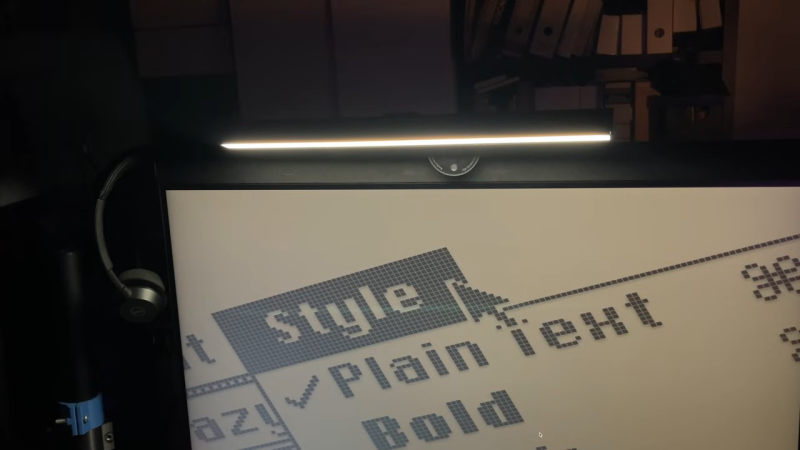
If you’re intending to work at your desk for long periods of time, good lighting is a must, as it can help stave off eye strain and mental fatigue. It was a desire for more comfortable productivity that drove [Jade] to whip up a monitor-mounted lighting system for her workstation.

The build uses an ESP32 to run the show, with a rotary encoder for manual control and firmware that allows the monitor light to be neatly integrated with Home Assistant. The light itself comes from light strips that feature both warm white and cold white LEDs. Simple MOSFETs are used to control the brightness of the LEDs and which of the warm and cold LEDs are activated at any time. Everything is wrapped up in a 3D printed housing that neatly sits on top of the monitor with the aid of a simple printed clamp. The LED strips also have a nice soft glow thanks to a strip of diffuser material that [Jade] snatched from an old television.

We love a good lighting build, from the work-focused to the creative and beautiful.

Continue reading “Building A Monitor Light Bar For Better Productivity”

From Zip To Nought: The Rise And Fall Of Iomega

If you were anywhere near a computer in the mid-to-late 1990s, you almost certainly encountered a Zip drive. That distinctive purple peripheral, with its satisfying clunk as you slotted in a cartridge, was as much a fixture of the era as beige tower cases and CRT monitors. Iomega, the company behind it, went from an obscure Utah outfit to a multi-billion-dollar darling of Wall Street in the span of about two years. And then, almost as quickly, it all fell apart.

The story of Iomega is one of genuine engineering innovation and the fickle nature of consumer technology. As with so many other juggernauts of its era, Iomega was eventually brought down by a new technology that simply wasn’t practical to counter.

The House That Bernoulli Built

Iomega was founded in Utah, in 1980, by Jerome Paul Johnson, David Bailey, and David Norton. The company soon developed a novel approach to removable magnetic storage based on the Bernoulli effect. The Bernoulli Box arrived in 1982, which was a drive relying on PET film disks spun at 1500 RPM inside a rigid, removable cartridge. The airflow generated by the spinning disk pulled the media down toward the read/write head thanks to the eponymous Bernoulli effect. While spinning, the disk would float a mere micron above the head surface on a cushion of air. If the power cut out or the drive otherwise failed, the disk simply floated away from the head rather than crashing into it—a boon over contemporary hard drives for which head crashes were a real risk. The Bernoulli Box made them essentially impossible. Continue reading “From Zip To Nought: The Rise And Fall Of Iomega”

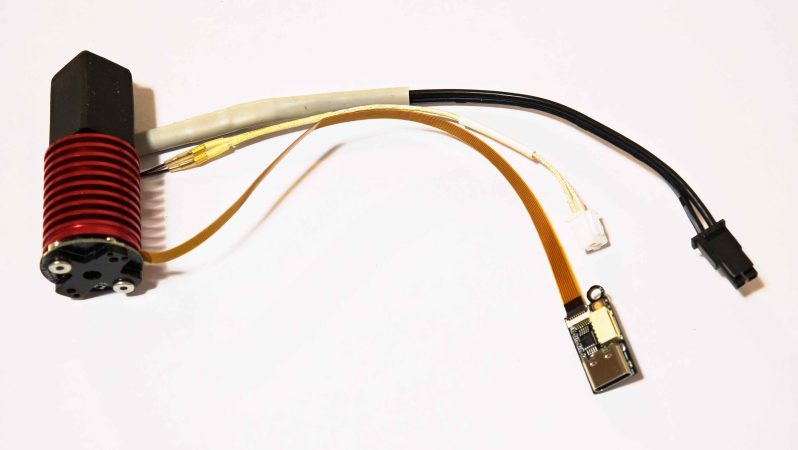
A hotend equipped with the bd_pressure sensor. The nozzle is facing upwards.

Direct Pressure Advance Measurement For Fast Calibration

Some people love fiddling with their 3D printers, others love printing. Some fiddle so they can spend more time printing, which is probably where this latest project comes in: an automated pressure advance calibration tool by [markniu].

Most of us don’t take enough care with pressure advance (PA). But if you want absolutely perfect prints, its something you should be calibrating for every type filament in your collection. Some would argue, ideally every individual spool. While that sort of dialing in can be fun, it takes away from actually running off prints. Bambu printers automate PA by scanning the usual sort of calibration print, but that’s still a very indirect measurement. Why not, just advance the filament, and measure the pressure at the nozzle directly? That is what PA is meant to account for, after all: the pressure of the plastic in the hotend causing oozing and blobbing at corners.

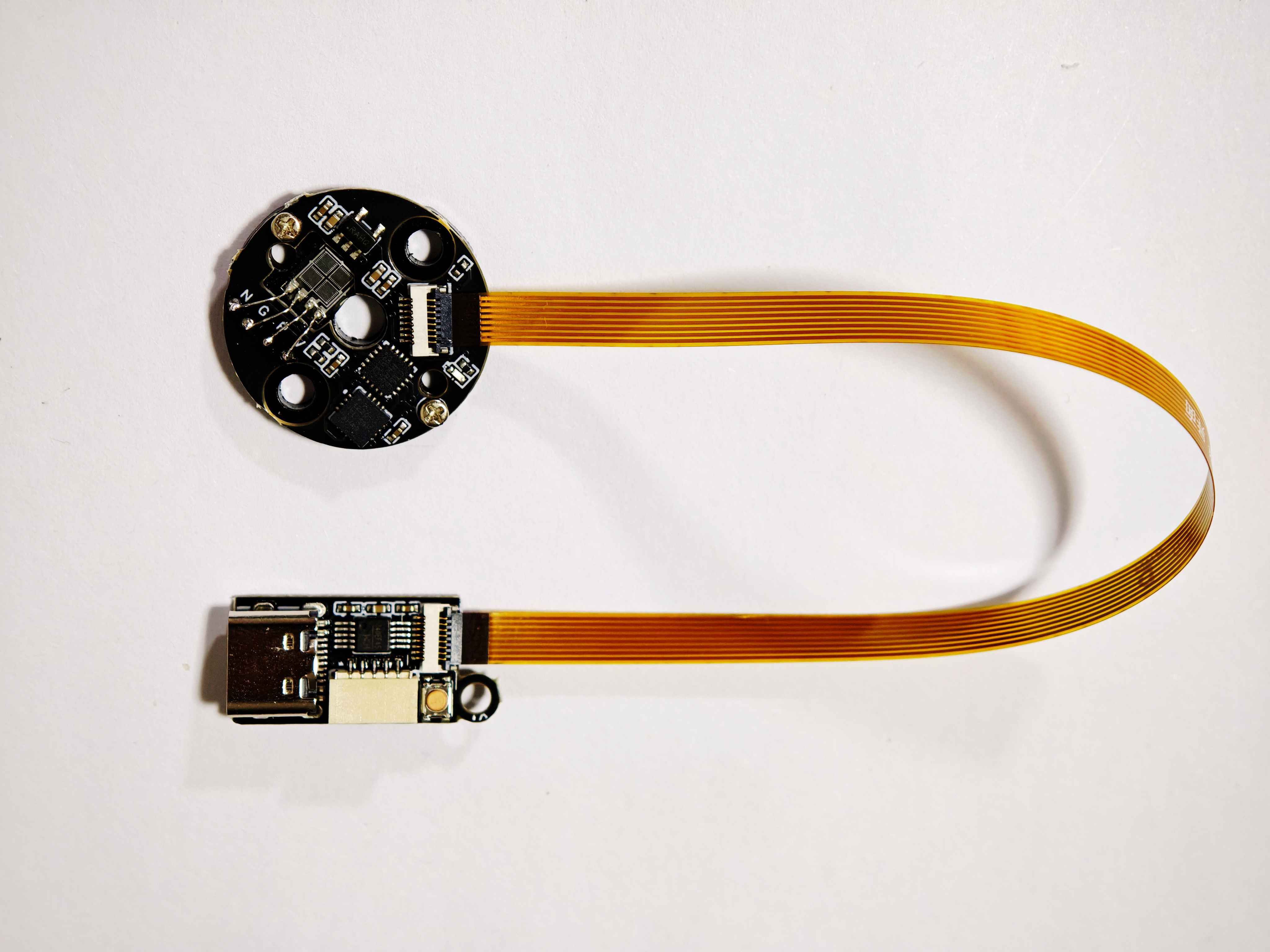
Did we mention it connects via USB-C? That’s helpfully broken out well away from the heat with a ribbon cable.

[mark]’s solution comes very close to a direct measurement. It uses a strain gauge that sits directly on top of the heatbreak, with the sound logic that the strain there experienced will be directly proportional to the pressure inside, at least along the axis of flow. Instead of filling half the bed with lines, the calibration process instead is a ‘printer poop’ style extrusion that doesn’t take nearly as long, and seems to save plastic, too. Since this puts a strain gauge in your hotend, you also get the bonus of being able to use it for bed leveling if you should so desire.

[mark] is claiming sub-90 second calibration — as you can see in the demo video embedded below — versus over seven minutes for the indirect calibration print. The value is plugged directly into Klipper, assuming you configured everything correctly, which should be easy enough looking at the instructions on the GitHub. Continue reading “Direct Pressure Advance Measurement For Fast Calibration”

Disposable Vape Becomes Breath-Activated Synth

Makers and hardware hackers have been collecting disposable vapes for some time now, usually to salvage their batteries or the unique displays many models now come with. But you can also repurpose them for other ends, such as playing music. [Becky Stern]’s vape synth is a perfect example of this.

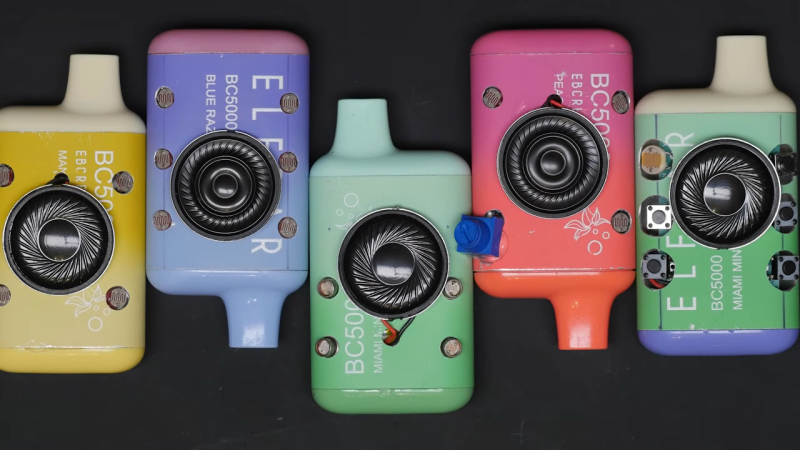
The build started with an ElfBars BC5000 vape. [Becky] notes there may be similar models under different names out there that would work just as well. The vape is effectively gutted for parts, with the LiPo cell, USB charging board, and the low-pressure sensor the main things that remain. These parts are combined with a drop-in 555 synthesizer circuit complete with speaker, which has its pitch controlled by a series of six photoresistors. When the low pressure sensor is triggered by inhalation, the 555 circuit is triggered, and operates at a pitch depending on the resistance of the photoresistor stack.

The output of the vape synth is kind of shrill, and frankly a little bit annoying — which is somehow rather fitting for what it is. If you want to make a better-sounding synth at home, we’ve featured such projects, you’re just unlikely to fit them entirely within the housing of a disposable vape.

Continue reading “Disposable Vape Becomes Breath-Activated Synth”