How TTY Opened Up The Phones For The Hard Of Hearing

The telephone was an invention that revolutionized human communication. No more did you have to physically courier a letter from one place to another, or send a telegram, or have a runner carry the message for you. Instead, you could have a direct conversation with another person a great distance away. All well and good if you can speak and hear, of course, but rather useless if you happen to be deaf.

Those hard of hearing were not left entirely out of the communication revolution, however. Well before IP switched networks and the Internet became a thing, there was already a way for the deaf to communicate over the plain old telephone network—thanks to the teletypewriter!

Over The Wires

The teletypewriter (TTY) has been around for a long time. The first device came into being in 1964, developed by James C. Marsters and Robert Weitbrecht, both deaf. Their idea was to create a method for deaf individuals to communicate over the phone network in a textual manner. To this end, the group sourced teleprinters formerly used by the US Department of Defense, and hooked them up with acoustic couplers that would allow them to mate with the then-ubiquitous AT&T Model 500 telephone. Thus, the TTY was born. A user could dial another TTY machine, and key in a message, which would print out at the other end. The receiving user could then respond in turn in the same manner.

Continue reading “How TTY Opened Up The Phones For The Hard Of Hearing”
Transcribing The Source Of The First DOS For The IBM PC

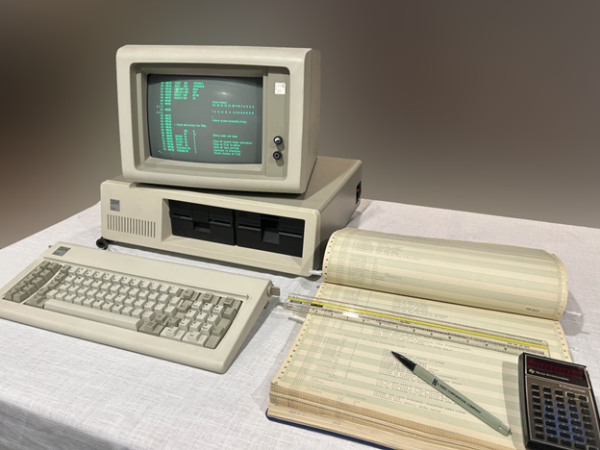
Doing software archaeology can be a harrowing task, as rarely do you find complete snapshots of particular versions of software. Case in point the development of MS-DOS – also known as IBM PC DOS – from 86-DOS, which recently got a lucky break in the form of printed source listings. These printouts come courtesy of [Tim Paterson], the creator of 86-DOS and of MS-DOS during his time working for Microsoft.

These code listings contain the sources of the 86-DOS 1.00 kernel, multiple development snapshots, and also listings for utilities like CHKDSK. These printed listings additionally contain many handwritten notes, making transcribing it into working source code somewhat of a chore. The results can be found on the GitHub project page, with the original scans available on Archive.org.

Of the ten bundles of continuous feed paper prints all but two have been transcribed so far, though with the various DOS kernels and the Seattle Computer Products (SCP) assembler source already ready for compilation. This includes 86-DOS 1.00, MS-DOS 1.25 and PC-DOS 1.00-dev, requiring the same SCP assembler to create a binary.

In the project page README a number of blog posts are also linked that add even more technical detail. Anyone who wants to pitch in with transcribing and/or testing recovered source code is welcome to do so.

Building An X86 Gaming PC Without Intel, NVIDIA Or AMD Parts

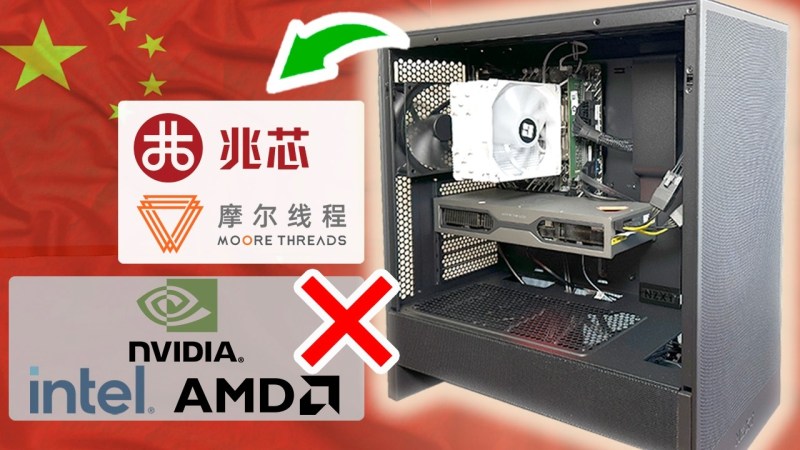
This is an interesting challenge from the “why not?” files — [GPUSpecs] over on YouTube built a gaming PC without using a single component from NVIDIA, Intel, or AMD. That immediately makes us think of the high-power ARM workstations or perhaps even perhaps the new “AI workstations” coming available with RISC V architecture, but the challenge here was specifically “gaming PC,” not workstation. A gaming PC, without a GPU by one of those three? To make it even more interesting, the x86 CPU isn’t Intel or AMD either.

If you’re of a certain vintage, you may remember Cyrix. Cyrix reverse-engineered the x86 ISA and made their own compatible chips in the 90s, before being bought out by National Semiconductor, and then VIA Technologies. VIA partnered with the Government of Shanghai to found Zhaoxin, and it is from Zhaoxin that the KaiXian KX 7000 CPU hails — an x86-64 device, that isn’t Intel or AMD. We’ve actually covered the company before. This particular chip benchmarks like an old i5, so not spectacular, but usable. 

Continue reading “Building An X86 Gaming PC Without Intel, NVIDIA Or AMD Parts”