This Week In Security: AI Generated Reports, More AI Generated Reports, GitHub Chaos, And More Linux Vulnerabilities

Google’s Project Zero demonstrates a new zero-click exploit for the Pixel 10 phones, showing a full escalation from remote to kernel without user interaction. During the investigation Project Zero found unprotected memory access from userspace in the Tensor G5 video processing chip driver, which allows direct write access to kernel memory.

Using previously discovered flaws in media decoding components — in this case CVE-2025-54957 in the Dolby digital audio decoder — Project Zero modified a Pixel 9 attack to work on the Pixel 10, despite newer protections built into the hardware to harden the system against memory corruption.

The author’s takeaway is mixed. Once the bug on Pixel 9 was reported, one could hope that the Android team would look into similar bugs in their newer systems. On the positive side, though, Project Zero reported the vulnerabilities to the Android team in November 2025 and they were patched in February of 2026, 71 days later. That’s 19 days short of the 90-day timeline.

Continue reading “This Week In Security: AI Generated Reports, More AI Generated Reports, GitHub Chaos, And More Linux Vulnerabilities”

Autonomous Submarine Relies On Color Detection

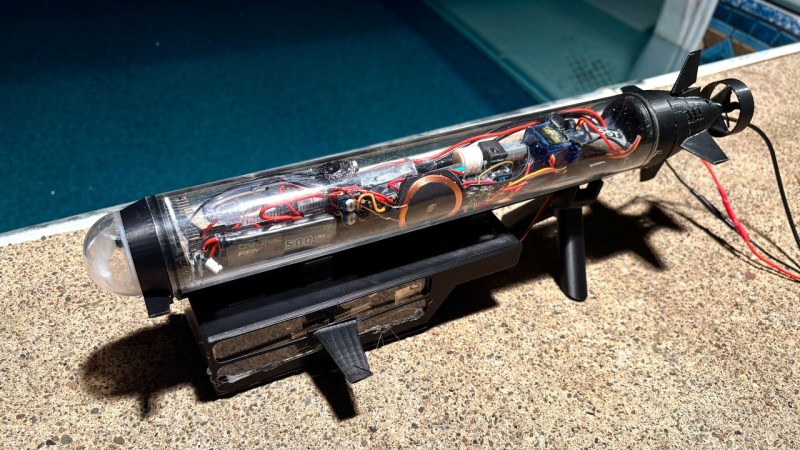
We talk about all kinds of autonomous vehicles here at Hackaday, from aerial drones to rugged rovers. A little less common are the submarine builds, likely due to their technical complexity. That said, though they perhaps benefit most from autonomy given they’re so hard to talk to while underwater. In any case, [Ayman] has built an impressive sub that uses some rudimentary techniques to navigate around while under the surface. 

The build uses typical construction techniques for DIY subs of this size, with a clear acrylic tube serving as the body of the craft. It’s carefully sealed to ensure water ingress doesn’t send it to the bottom, using nifty tricks like a magnetic coupling for the prop. Inside, there’s a Raspberry Pi 4, kitted out with an Arducam IMX708 camera with a wide angle lens. It’s joined by a BNO085 inertial measurement unit, along with two BMP280 pressure sensors for keeping track of motion and the sub’s vital signs, while a DRV8833 motor controller runs the main drive motor.

There’s also an ESP32 which helps out with motor and servo control for steering, and ballast control. Sinking and floating the sub is handled with a pair of two ballast tanks constructed out of 5 mL syringes that are driven in and out with high-torque output gear motors. The build uses an antenna buoy so that communication can be maintained with the sub when it’s within a certain range of the surface.

A neat addition to the sub is its autonomous navigation code. [Ayman] whipped up some simple object avoidance routines, which rely on the Raspberry Pi’s camera. The code uses HSV values to track specific colored objects and avoid them, which proves more reliable than RGB as it allows tracking color in a largely brightness-independent manner.

Although we’ve featured other builds that use similar construction techniques, seeing a transparent submarine gliding through the water will always make us think of the incredible Open Source Underwater Glider that won the 2017 Hackaday Prize.

Continue reading “Autonomous Submarine Relies On Color Detection”

Jacket Turned Cyberpunk Wearable OLED Display

If you’ve played Cyberpunk 2077, you might have seen the rad jacket that has a screen in the collar. Once upon a time, such a thing would be solely the preserve of science fiction—you certainly wouldn’t be achieving that look with cathode ray tubes, that much is for sure. However, technology has advanced to the point where [Zibartas] was able to produce just such a jacket in real life.

The key to the build is the advent of the flexible OLED screen. [Zibartas] was able to source four such panels in a smartphone-like aspect ratio, which came in at the hefty price of $300 each. Two Raspberry Pi 4s were enlisted to drive two screens each. The older model Pi was chosen as it was capable of achieving a neat hack to better play smooth video across two displays. A rudimentary sync system was whipped up using GPIO pins to keep video from both Pis playing together. From there, it was simply a matter of figuring out how to create a structure to hold the screens within the large collar of the scratch built cyberpunk-styled jacket. As it turns out they don’t actually flex much in the final install, as they’re held in a 3D printed structure to keep them safe from damage.

The final result is quite something, very accurately recreating the jacket from the game itself. While technically a simple build, actually pulling it off required some delicate work and smart design decisions to make it practical to wear. We’ve featured some other fun jackets over the years, too.

Continue reading “Jacket Turned Cyberpunk Wearable OLED Display”