Using LineageOS For Phones And DIY Smart TVs Is Pretty Nifty

Although Android is essentially just another Linux distribution, most people only experience it in the form of the rather restrictive and proprietary versions found on smartphones, tablets and smart TVs. While this is probably fine for the average person, there’s also a lot to be said for the more pure Android experience in the form of LineageOS.

With this fully open and community-supported version of Android you’re free to muck about with your hardware to your heart’s content, without annoyances like unremovable bloatware apps and restrictions on e.g. enabling developer mode.

Even more fun is that there are ports of LineageOS to systems such as the Raspberry Pi SBC, including in the Android TV configuration. This means that not only can your ten year old Android phone get a make-over with a recent version of Android, you can also create your own Android TV-based smart TV without all the spying and other nasty things that commercial smart TVs love to do.

Continue reading “Using LineageOS For Phones And DIY Smart TVs Is Pretty Nifty” →
USB-C PD Tamed With This Analyzer

USB-C Power Delivery (PD) has been a boon to anyone working with low-voltage DC power, because at a stroke it replaces a vast array of wall warts, power supplies, and connector standards with one simple and straightforward commoditized system. But with varying capabilities between sources and sinks, it can be difficult to know what’s going on.

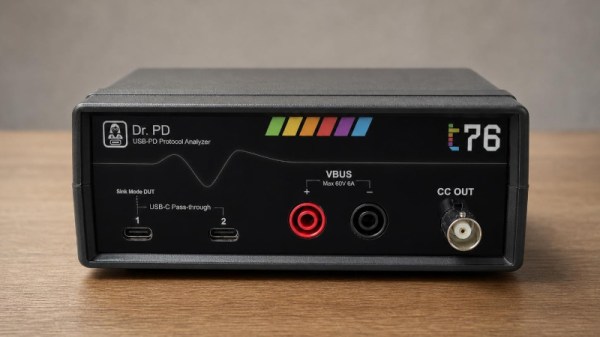
[Marco Tabini] has created Dr. PD, a USB -C PD protocol analyzer. It can sit between USB-C PD source and sink, or emulate a sink in order to characterize a source. It supports an impressive range of USB power protocols, and can work up to the full 48 volt/240 watt limits of the technology. The project is open source and is to be the subject of a crowdfunding campaign should you want one without the extra work.

It’s likely that many of you will have had bad experiences with cheap USB-C PD gear failing to follow standards, being unable to handle the specified current, or just plain supplying the wrong voltage. We have, and while USB-C PD is genuinely a great technology, this regrettable hardware represents its grubby underbelly. This is just the project we need on the bench in our hackerspace.

In the past we’ve written about USB-C PD as a great example of new technology done right.

A New Type Of LLM On The Block: Decision-Making Models

Large language models (LLMs) output language, but they are commonly tasked with making a decision or classification of some kind instead of writing an essay or chat reply. An LLM will be provided with input, and asked to classify that content in some way: with a rating, yes/no answer, a best-fit categorization, and so forth. A recent new type of model by the name of Jev was released only weeks ago and it is extremely fast, ultra-cheap, and laser-focused on that decision-making role. It can’t write even a single sentence, but it can classify and categorize very, very quickly.

Jev works like this: it still accepts text input, but it outputs only floating-point numbers. Those numbers are the “answers” to user-specified yes/no type questions, lists of choices, and scoring-type requests. [Simon Willison] provides a concise summary of what Jev does, and what makes this new category of model so interesting.

To say that the idea has caught on would be a wild understatement. Folks are making their own decision-type models and experiments in a flurry. Kev and Nimble are two examples (Nimble was added as a supported model in Ollama just recently, and is small enough to run locally with relative ease.)

If this type of local AI model was the missing link you needed to get an idea working, don’t keep it to yourself! Tell us all about it on the tips line.