RFIDisk

RFIDisk: When Floppy Drives Go Contactless

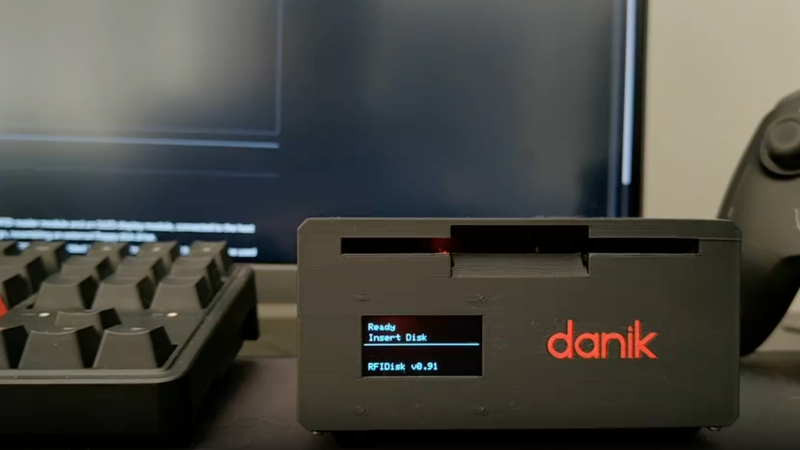
Not too long ago, part of using a computer was often finding the correct disk for the application you wanted to run and inserting it into your machine before you could start. With modern storage, this is largely a thing of the past. However, longing for some of that nostalgia, [ItsDanik] has been developing the RFIDisk, a 3D printed floppy drive that can kick off applications when their disk is inserted.

The desktop enclosure is printed to look like a standalone floppy drive, allowing use with either desktops or laptops. There’s the familiar 3.5 inch slot ready for your floppy disk, and there’s also a 1.3 in. OLED display on the front giving you feedback on the status of the RFIDisk — including telling you what’s currently inserted. Inside the enclosure is an Arduino Uno and an MFRC522 RFID reader. As the name would suggest, the way the RFIDisk enclosure reads its media is via NFC, not the traditional magnetic reader. Due to being RFID-based, the disks printed for the RFIDisk are solid without moving parts, but enclose a 25 mm NTAG213 NFC tag.

On the software side, [ItsDanik] has developed the RFIDisk Manager Python application, which is used to tie specific NFC tag IDs to commands to run when that tag is read. The application includes some nice features, such as being able to adjust the commands for both when the disk is first read and when it’s removed from the RFIDisk. You can also change what shows up on the OLED screen when the cartridge is inserted.

Using NFC to simulate physical media is a clever trick we’ve seen before, but if you’re looking for something with a bit more physical engagement, you could always put your USB devices into 3D printed cartridges.
New Years Circuit Challenge: Make This RFID Circuit

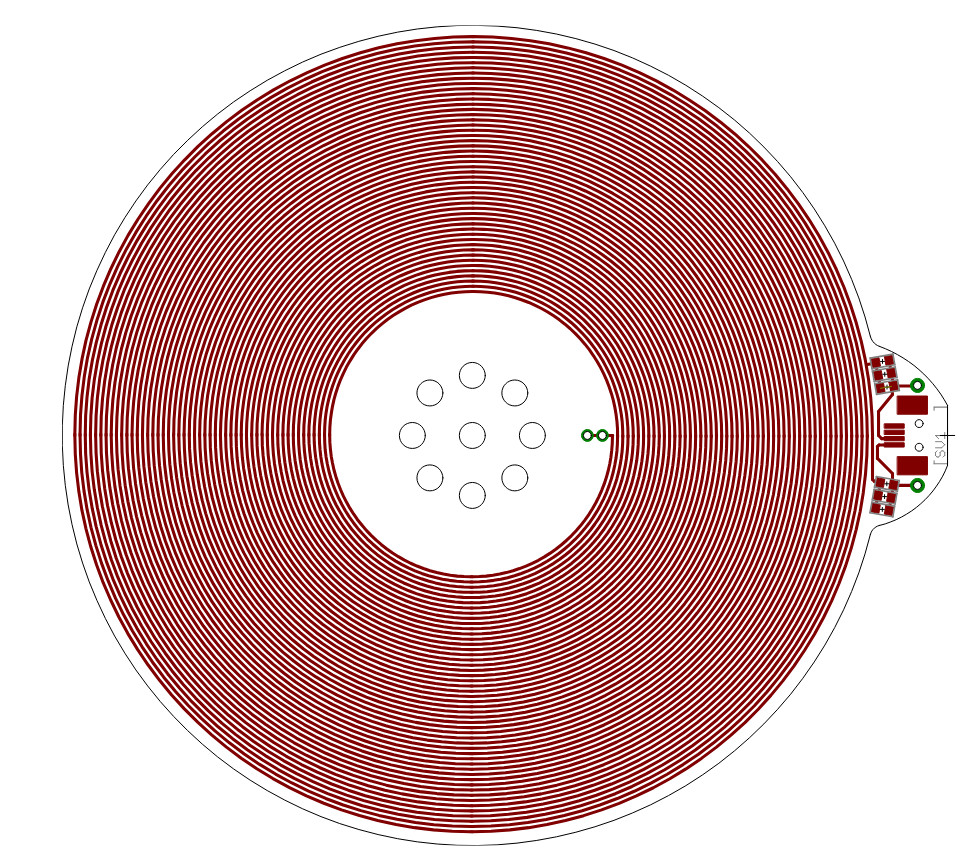
A 125kHz PCB antenna, a spiral pattern on a PCB.
The Proxmark3 PCB 125kHz antenna., GNU GPL version 2, GitHub link.

Picture this: It’s the end of the year, and a few hardy souls gather in a hackerspace to enjoy a bit of seasonal food and hang out. Conversation turns to the Flipper Zero, and aspects of its design, and one of the parts we end up talking about is its built-in 125 kHz RFID reader.

It’s a surprisingly complex circuit with a lot of filter components and a mild mystery surrounding the use of a GPIO to pulse the receive side of its detector through a capacitor. One thing led to another as we figured out how it worked, and as part of the jolity we ended up with one member making a simple RFID reader on the bench.

Just a signal generator making a 125 kHz square wave, coupled to a two transistor buffer pumping a tuned circuit. The tuned circuit is the coil scavenged from an old RFID card, and the capacitor is picked for resonance in roughly the right place. We were rewarded with the serial bitstream overlaying the carrier on our ‘scope, and had we added a filter and a comparator we could have resolved it with a microcontroller. My apologies, probably due to a few festive beers I failed to capture a picture of this momentous event. Continue reading “New Years Circuit Challenge: Make This RFID Circuit”

RFID From First Principles And Saving A Cat

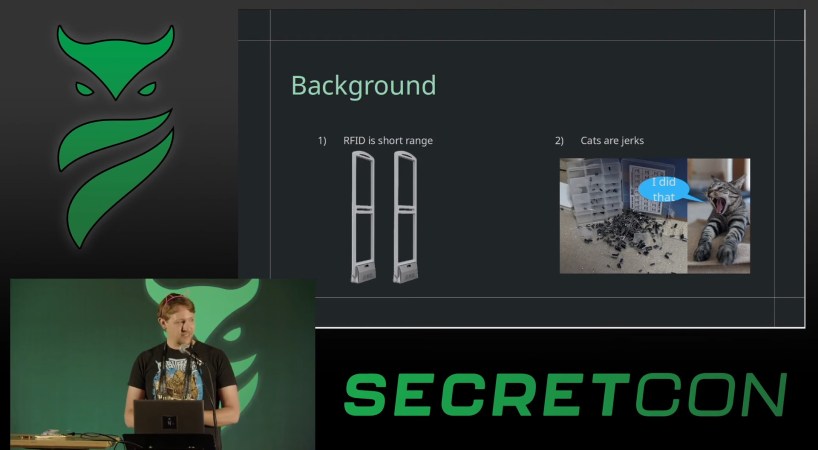
[Dale Cook] has cats, and as he readily admits, cats are jerks. We’d use stronger language than that, but either way it became a significant impediment to making progress with an RFID-based sensor to allow his cats access to their litterbox. Luckily, though, he was able to salvage the project enough to give a great talk on RFID from first principles and learn about a potentially tragic mistake.

If you don’t have 20 minutes to spare for the video below, the quick summary is that [Dale]’s cats are each chipped with an RFID tag using the FDX-B protocol. He figured he’d be able to build a scanner to open the door to their playpen litterbox, but alas, the read range on the chip and the aforementioned attitude problems foiled that plan. He kept plugging away, though, to better understand RFID and the electronics that make it work.

To that end, [Dale] rolled his own RFID reader pretty much from scratch. He used an Arduino to generate the 134.2-kHz clock signal for the FDX-B chips and to parse the returned data. In between, he built a push-pull driver for the antenna coil and an envelope detector to pull the modulated data off the carrier. He also added a low-pass filter and a comparator to clean up the signal into a nice square wave, which was fed into the Arduino to parse the Differential Manchester-encoded data.

Although he was able to read his cats’ chips with this setup, [Dale] admits it was a long road compared to just buying a Flipper Zero or visiting the vet. But it provided him a look under the covers of RFID, which is worth a lot all by itself. But more importantly, he also discovered that one cat had a chip that returned a code different than what was recorded in the national database. That could have resulted in heartache, and avoiding that is certainly worth the effort too.

Continue reading “RFID From First Principles And Saving A Cat”

Paperless RFID Tags Are Carbon-Based

RFID tags are great little pieces of technology, but unfortunately, the combination of paper, metal, and silicon means they are as bad as some modern pregnancy tests — single-use electronic devices that can’t be recycled.

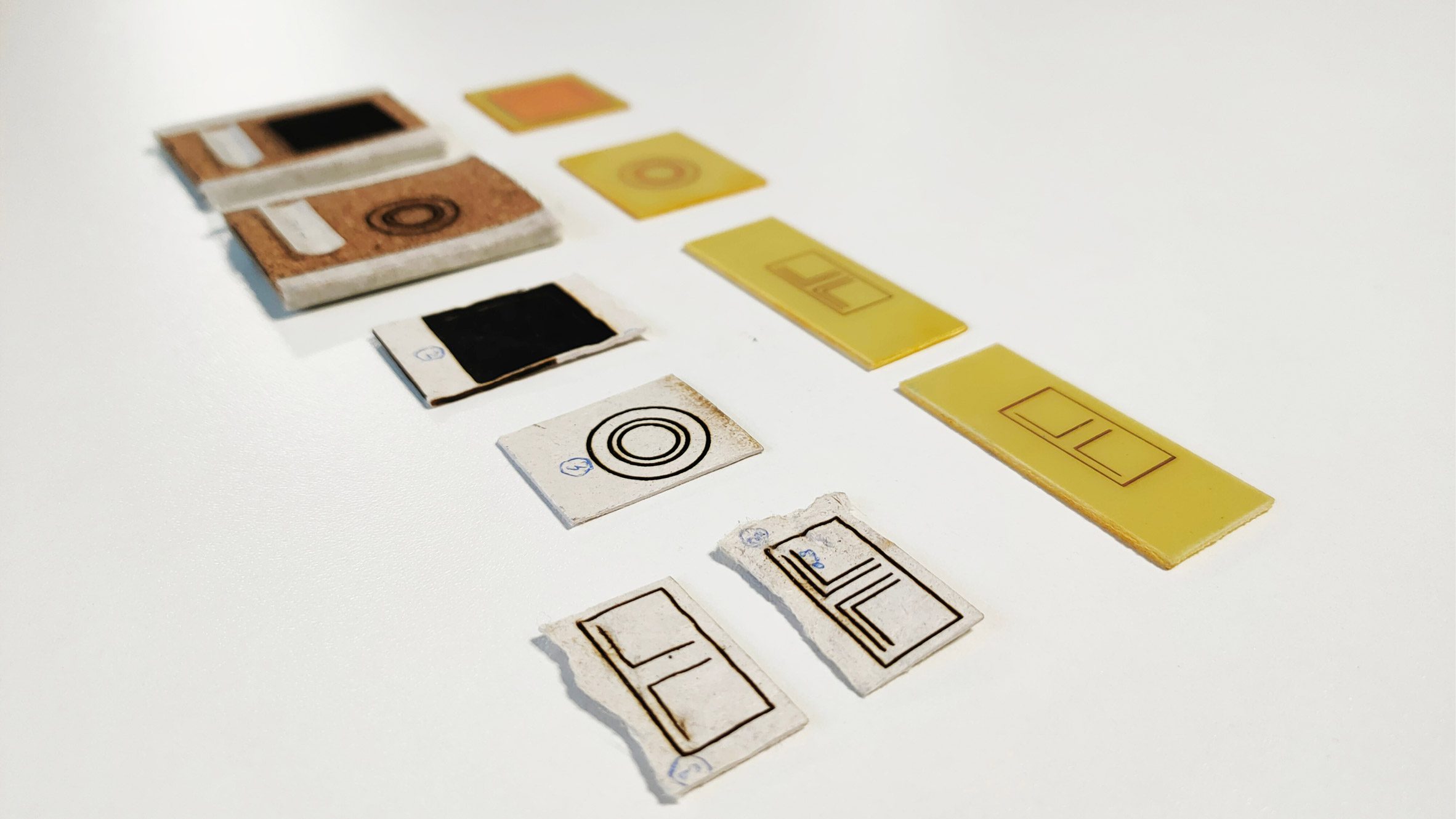
Some prototypes of the RFID tags.

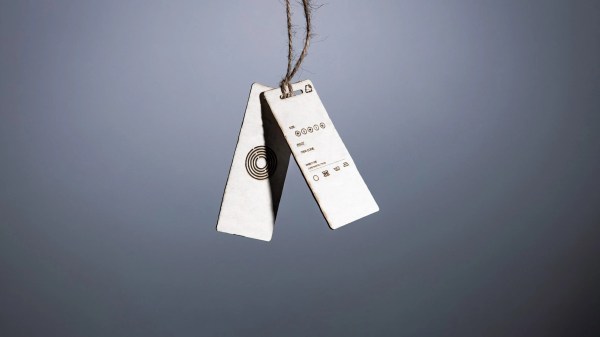
A team of design program graduates from London’s Royal College of Art aim to change that. They’ve devised a mostly-paper RFID tag that’s as safe to recycle as a piece of paper with a pencil doodle on it.

The team’s startup, PulpaTronics have created a design that uses paper as its only material. The circuitry is marked on the paper with a laser set to low power, which doesn’t burn or cut the paper, but instead changes to composition to be conductive.

PulpaTronics were also able to create a chip-less RFID tag much the same way, using a pattern of concentric circles to convey information. The company estimates that these tags will reduce carbon dioxide emissions by 70%, when compared with traditional RFID tags. They’ll also cost about half as much.

RFID is used in many industries, but it’s also great for hacking. Here’s an 8-track player that harnesses the power of RFID tags to play songs off of an SD card.

Thanks for the tip, [gir.st]!

RFID Emulator + E-paper Badge Can Be Programmed With Sound

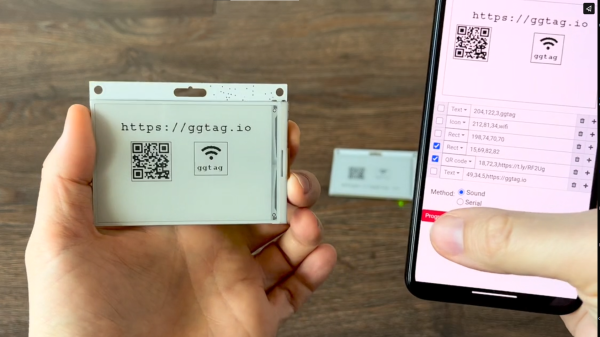
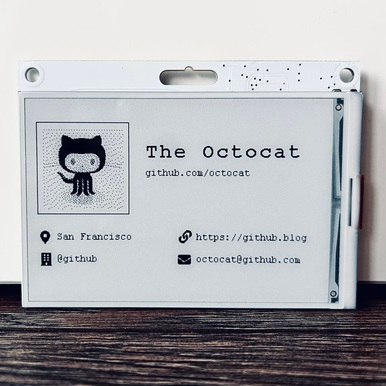
In a way, an e-paper display makes an excellent foundation for a reprogrammable RFID card. The display only needs power during a refresh, and 125 kHz RFID tags are passive in the sense that the power for the RFID transaction comes from the reader itself. [Georgi Gerganov] has put those together in the GGtag, an open-source project for a 3.52″ e-paper badge with a trick or two up its sleeve.

One clever function is that it is programmable with sound, a feature built off another project of [Georgi]’s called ggwave, a data-to-sound (and vice-versa) framework that has been ported to just about every hardware platform one cares to imagine — including mobile phones — and can reliably send data through the air.

Transmitting data over sound is limited in throughput but has a number of advantages, not least of which is the huge range of compatible devices. There’s a web-based tool for programming the GGtag with sound available at ggtag.io that will give you a preview and let you hear how it works. The data encoding method gives transmissions a charming beep-boop quality that’s a bit reminiscent of an analog modem handshake. GGtag can also be programmed over USB serial, a faster (but somewhat less exciting) option.

The project’s GitHub repository contains GGtag’s code and technical details, and the CrowdSupply project is in the works for anyone who would prefer to buy one once they become available.

Cat Feeder Depends On RFID To Keep The Peace At Dinnertime

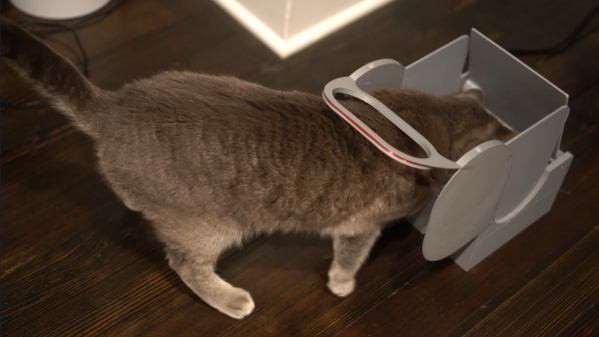
Anyone with more than one cat can tell you that the joy mischief they bring into your life is much more than twice that of a single cat. And if those felines have different dietary needs, you can end up where [Benjamin Krejci] found himself, which resulted in this fancy RFID cat feeder.

For a little backstory, [Ben]’s furry friends [Luna] and [Fermi] have vastly different eating styles, with the former being a grazer and the latter more of a “disordered eater,” to put it politely. [Fermi] tends to eat until she vomits, which is fun, and muscles her pickier sister away from the bowl if there’s anything left in it. [Ben]’s idea was to leverage [Luna]’s existing RFID chip, which he figured would be a breeze. But the vet-inserted chip is designed to be read by a high-power reader directly in contact with the cat’s skin, which made reliably reading the chip a challenge.

Several round of design iteration resulted in the current configuration, with a large antenna coil poised above and behind the food dispenser. [Luna] has no choice but to put the back of her neck and shoulder blades almost directly in contact with the coil, which makes it easier to read the 134.2-kHz chip with a long-distance RFID module. If [Luna]’s chip is found, the lid on the food bowl opens gently and quietly, so as not to spook the mild-mannered cat. The lid stays open as long as [Luna] is in place thanks to some IR sensors, but as soon as she backs out, the lid comes down to keep [Fermi] from gorging herself.

Hats off to [Ben] for working through the problem and coming up with what looks like a fine solution. We suppose he could have tried something easier like weighing the two cats to distinguish between them, but this seems like a cleaner solution to us.

Kids’ Jukebox Based On Arduino With RFID

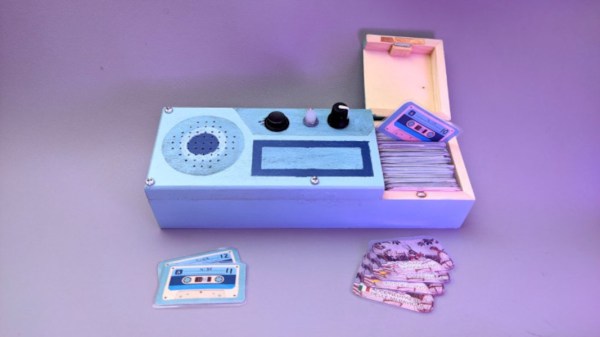
Consumer electronics aimed at young children tend to be quite janky and cheap-looking, and they often have to be to survive the extreme stress-testing normal use in this situation. You could buy a higher quality item intended for normal use, but this carries the risk of burning a hole in the pockets of the parents. To thread the needle on this dilemma for a child’s audiobook player, [Turi] built the Grimmboy for a relative of his.

Taking its name from the Brothers Grimm, the player is able of playing a number of children’s stories and fables in multiple languages, with each physically represented by a small cassette tape likeness with an RFID tag hidden in each one. A tape can be selected and placed in the player, and the Arduino at the center of it will recognize the tag and play the corresponding MP3 file stored locally on an SD card. There are simple controls and all the circuitry to support its lithium battery as well. All of the source code that [Turi] used to build this is available on the project’s GitHub page.

This was also featured at the Arudino blog as well, and we actually featured a similar project a while ago with a slightly different spin. Both are based on ideas from Tonuino, an open source project aimed at turning Arduinos into MP3 players. If you’re looking to build something with a few more features, though, take a look at this custom build based on the RP2040 microcontroller instead.