Hackaday Prize Entry: Sonic Glasses

This year, the Hackaday Prize is going to find the most innovative and interesting assistive technologies. Whether that’s refreshable Braille displays or reliable utensils for the disabled, the finalists for the Assistive Technologies portion of the Prize will be creating some of the most interesting tech out there.

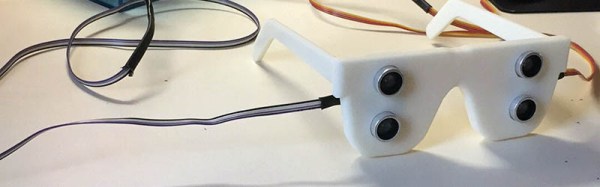
For his entry into the Assistive Technology part of the Prize, [Pawit] is building binaural glasses for the blind. It’s difficult to navigate unknown environments without a sense of sight, and these SonicScape glasses turn cheap distance sensors into head-mounted sonar.

The glasses are built around a pair of ultrasonic distance sensors (the HC-SR-04, if you’re curious), mounted in a convenient 3D-printed enclosure that looks sufficiently like a pair of glasses to not draw too many glares. (Although maybe we’d print them in black to lower the contrast.) Of note in this project is the Bluetooth connectivity to eliminate wires and independent left and right audio channels. That last bit — being able to hear in left and right — is something we haven’t seen before in devices like this and aims to greatly increase the usability of such a device.


Upverter Joins Altium

In a post on the Upverter blog today, [Zak Homuth], founder of the online EDA suite Upverter has announced they have been acquired by Altium.

The largest change in the announcement is the removal of Upverter’s paid professional tier of service. Now, the entirety of Upverter is free. Previously, this paid professional tier included CAM export, 3D preview, BOM management, and unlimited private projects for $1200 per seat per year.

Hackaday has taken a look at Upverter before in an book-length series of posts describing how to build a PCB in every software tool. While Upverter is a web-based PCB design tool that doesn’t respond to a right mouse click, the experience was pleasant overall. There are some interesting features in Upverter that make PCB design work fun — snap-to alignment of pads, a phenomenal number of ways to export your data — and it’s more than capable enough for the electronics hobbyist.

With the Altium announcement, [Zak] says Upverter will continue on its mission to create a system to design a complete product, from schematic to enclosure to firmware to BOM management.

Hackaday Links: August 27, 2017

Hulk Hands! Who remembers Hulk Hands? These were a toy originally released for the 2003 Hulk movie and were basically large foam clenched fists you could wear. Hulk Hands have been consistently been re-released for various Marvel films, but now there’s something better: it’s the stupidest tool ever. Two guys thought it would be fun and not dangerous at all to create cast iron Hulk Hands and use them as demolition and renovation equipment. This is being sold as a tool comparable to a sledgehammer or a wrecking bar.

New Pogs! We’re up to 0x0C. Is your collection complete?

[Peter] is building an airplane out of foam in his basement. He’s also doing it as a five or six-part series on his YouTube channel. Part two is now up. This update covers the tail surfaces, weighing and balancing the fuselage, and a general Q&A with YouTube comments.  Yes, [Peter] still has a GoFundMe up for a parachute, and it’s already about half funded. With any luck, he’ll have the $2600 for a parachute before he builds the rest of the plane. Another option is a ballistic parachute system — a parachute for the whole plane, like a Cirrus. That would be a bit more than $4000, so we’ll see how far the GoFundMe goes.

Hey, remember the Nvidia Jetson TX1? It’s a miniATX motherboard running a fast ARM core with a GPU housing 256 CUDA cores. It’s cool, and the new version — the TX2 — is designed for ‘machine learning at the edge’. They’re on sale now, for only $199.

Primitive Technology has another video out. This time, he’s improving his bow string blower into something that kinda, sorta resembles a modern forge. This time, the experiment was a success when it comes to pottery — he’s now able to fire clay at a much higher temperature, bringing him reasonably close to modern ceramics. At least, as close as you can get starting with the technology of a pointed stick. The experiment was marginally successful when it came to creating iron. He’s using iron-bearing bacteria (!) for his source of ore and was able to smelt millimeter-sized pellets of iron. This guy needs a source of copper or tin. Zinc is also surprisingly possible given his new found capabilities for ceramics.

Casting Metal Directly Into 3D Printed Molds

Casting metal and 3D printing go together like nuts and gum, and there are no shortage techniques that use the two together. Lost PLA casting is common, and sculptors are getting turned on to creating their works in plastic first before sending it off to the foundry. Now the folks at FormLabs have turned the whole ‘casting metal and 3D printer’ thing on its head: they’re printing sacrificial molds to cast pewter.

There are two techniques demonstrated in this tutorial, but the real winner here is printing a complete sacrificial mold for pewter miniatures. While this technique requires a little bit of work including washing, curing, and a bit of post-processing, you would have to do that anyway with anything coming out of a resin printer.

The material of choice for these molds is a high temp resin with a heat deflection temperature of 289 °C. Using a pewter alloy that melts at 260 °C, casting a metal miniature is as simple as pouring molten metal into a mold. Demolding might be a little finicky, but with a small screwdriver used as a chisel, it’s possible to get the cast newly parts out.

We’ve seen pewter casting with PLA, but the quality available from the Form resin printers is truly amazing and produces some great looking miniatures.

Superconference Interview: Alan Yates

In 2015, virtual reality was the future, which means we should all have it right now. One of the most technologically impressive VR sets is the HTC Vive, an amazing piece of kit that’s jam-packed with sensors and has some really cool tech going on inside it.

One of the developers of the HTC Vive and the ever-important ‘Lighthouse’ position sensors is [Alan Yates]. He’s of Valve and gave a talk at last year’s Superconference on Why the Lighthouse Can’t Work. Being able to determine the absolute position of the Valve’s headset is hard, but absolutely necessary for VR. Anything else would be an incomplete VR experience at best, and give you nausea at worst.

We sat down with [Alan] after his talk last year, and now that interview is up. You can check that out below.

Continue reading “Superconference Interview: Alan Yates”

Blinking LEDs On The Internet Of Printers

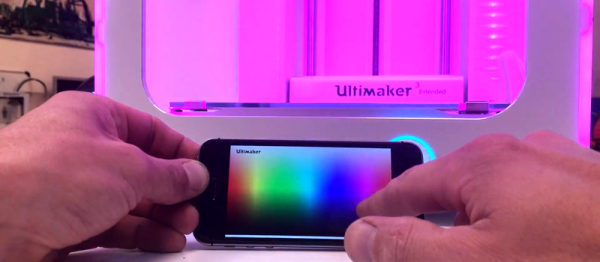
When you ask for recommendations on which 3D printer to buy, damn the cost, the Ultimaker is consistently at the top of the list. There’s a reason for the popularity of this printer — it’s easy to use, extremely high quality, and has an entire freakin’ Linux system running somewhere under the hood. That last bit is opening up a few doors to some interesting hacks, like using a 3D printer as an RGB LED.

The Doodle3D team has been playing around with the Ultimaker API to see if they can make their software work with the Ultimaker printer. The Ultimaker has RGB LEDs, so obviously the simplest proof of concept in futzing around with an API is to blink a few LEDs. The actual code was written in HTML, JavaScript, and Node in just two hours. The author admits it’s ugly, but it works. Can’t go wrong with that.

While this is just a simple test of the Ultimaker API, it’s surprisingly high up on the Google results when you search, ‘Ultimaker API’. That’s a shame, because there’s a lot of power under the hood of this printer. If you have some sort of mod you’d like to throw into the ring, here’s the Hackaday Tip Line.

You can check out the demo video of this hack below.

Continue reading “Blinking LEDs On The Internet Of Printers”

Ask Hackaday: Saving The World With Wacky Waving Inflatable Arm Flailing Tube Men

This is a solution to global warming. This solution will also produce electricity, produce rain in desertified areas, and transform the Sahara into arable land capable of capturing CO2. How is this possible? It’s simple: all we need to do is build a five-kilometer tall, twenty-meter wide chimney. Hot air, warmed by the Earth’s surface, will enter the base of the chimney and flow through turbines, generating electricity. From there, air will rise through the chimney, gradually cooling and transferring energy from the atmosphere at Earth’s surface to five kilometers altitude. This is the idea behind the Super Chimney, It’s an engineering concept comparable to building a dam across the Strait of Gibraltar, a system of gigantic mirrors in Earth’s orbit, or anything built under an Atoms for Peace project. In short, this is fringe engineering.

This is also, ‘saving the world with wacky waving inflatable arm flailing tube men.’

The idea of building tens of thousands of fabric chimneys, placing them all around the globe, and cooling the Earth while sequestering carbon dioxide is fantastic. Ideas are simple, implementation is something else entirely. There are also obvious problems with the physics presented in the Super Chimney presentation, but these problems don’t actually make a Super Chimney impossible. We need more eyes on this, so we’re opening this one up as an Ask Hackaday. What do you think of this audacious scheme, and is it even possible?

Continue reading “Ask Hackaday: Saving The World With Wacky Waving Inflatable Arm Flailing Tube Men”