Industrial GPU Adapted For The Desktop

As technologies change and adapt, we’re often left with seemingly useless junk that has nowhere to go. Certainly anyone still sitting on a pile of floppy disks feels this way sometimes, but odds are anyone who owns a mining ASIC or an NFT can attest to that as well. The trillions of dollars flowing into GPU-based data centers will likely become the next victim of this trend, so if you want to capitalize on the losses of some venture capitalist you’ll want to figure out a way to get GPUs meant for a server into your desktop doing useful work.

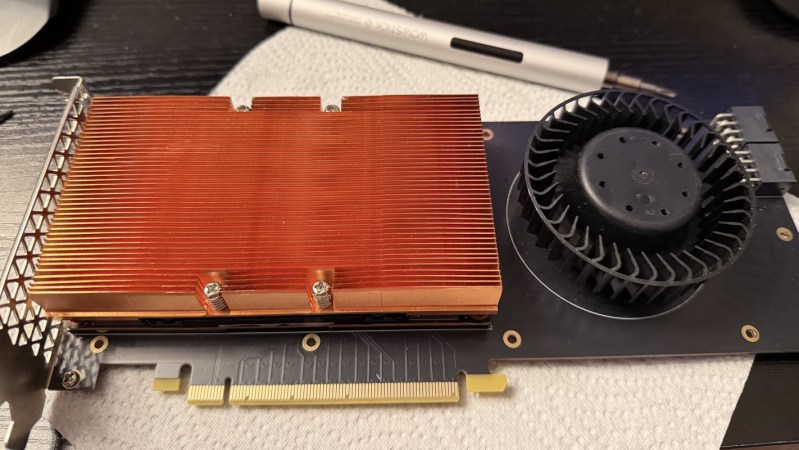
Of course, calling these devices GPUs is a bit of a stretch compared to the Radeon and GeForce cards many of us are used to using for gaming. These don’t even have a PCIe slot or video output, after all. But, as [] notes, the VRAM and GPU cores are very real and can still do useful work. An adapter board is able to mate a Tesla V100 SXM2 16 GB GPU to a standard PCIe slot, which solves the first problem, but the major downside from there is that the cooling fan for this unit was literally deafeningly loud. At 82 dB it was about as loud as a lawnmower, which is fine in a server rack but not great in a bedroom. [Oscar] found a way to tamp down the fan speed, making it usable in a home.

Without video output, the utility of these cards mainly comes from adding VRAM and compute for tasks that benefit from parallel computing. Using tensor splitting, [Oscar] is running a local LLM with this card alongside his RTX 4080, providing 32 GB of VRAM on his NixOS system. With his benchmarking tests, the LLM sports impressive stats for a self-hosted model, ranking somewhere around Claude Sonnet 4.6. What’s even more impressive is that this is all done for around £200, and with the rate the various LLM companies are ratcheting up pricing could pay itself back very quickly. If trading off performance for cost is acceptable, though, it’s possible to run local models on much less powerful hardware as well.
Porting The Nvidia GPU Driver To Haiku For 3D Acceleration

As good as a desktop OS may be, at some point it has to feature accelerated 3D graphics. This has been a bit of a sticking point for Haiku OS, as none of the big names in GPU cards are likely to start putting out drivers for this OS any time soon. Fortunately there is the Linux open source driver code from Nvidia that can be used as a jumping-off point for a port, which is what [X512] and the community over at the Haiku forums did over the course of more than a year.

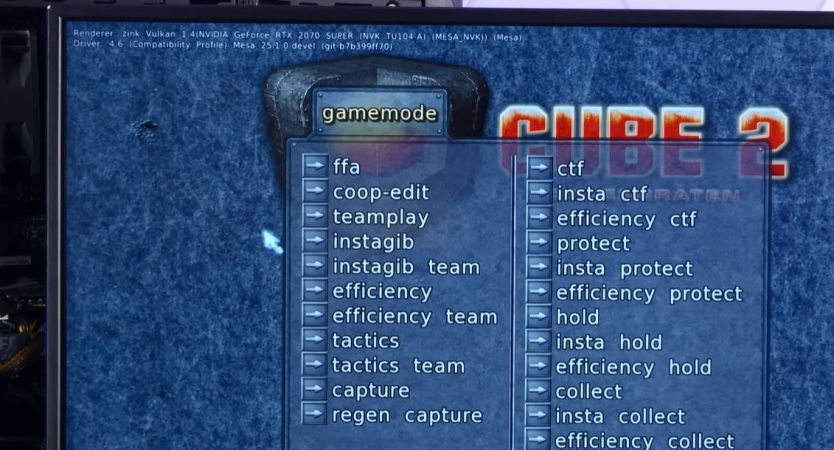
In a recent video [Action Retro] takes a poke at the fruits of these efforts, trying out the driver with an RTX2070 Super GPU. Of note is that this driver requires the GSP (GPU System Processor) controller that got added by Nvidia with the Turing series of GPUs, meaning that you need at least a GTX16 or RTX20 series card.

You can get an installation package from the GitHub repository, such as for the v0.0.2 pre-release that was created in January of 2026. In this pre-release state quite a few things are working, with the ability to play 3D games at a reasonable FPS being the biggest improvement over plain VESA mode. Features like CUDA are not available as they’re not in the open sourced section, of course.

In the [Action Retro] video the whole installation process is demonstrated, starting with a fresh nightly Haiku build. First the gaming performance in software-rendered VESA mode is demonstrated before the GPU driver is installed. This shows a marked improvement in performance, although Minecraft needs to be updated for the newest Mesa library that omits OSMesa, so that couldn’t be tested. Overall it shows that Haiku has made another massive leap forward in becoming a viable daily driver OS.

Meanwhile, over on the ReactOS side of things we just saw a Half-Life 2 playthrough by [Aotori Hibiki], on an Intel Sandy Bridge PC with GeForce 8400GS graphics. Here ReactOS has the advantage of being Windows NT-compatible, including WDDM-style GPU drivers, allowing it to use the same drivers as Windows. Simultaneously, ReactOS is now implementing its first NT6 kernel API calls to make it compatible with modern  (Vista+) Windows.

The upshot here is that for people who want to daily drive an open source OS with all the creature comforts imaginable, things have never seemed more promising. Especially for people who don’t want Yet Another Linux Distro but just an utterly boring desktop-centric, single-user focused OS that Just Works™ these are great tidings.

Continue reading “Porting The Nvidia GPU Driver To Haiku For 3D Acceleration”

Double The VRAM Of An RTX 3070

Modern games are quite often limited by the amount of volatile memory available to the GPU. Games can require many gigabytes of data during the rasterization process. So the obvious solution for better performance would be to buy a faster GPU, right? Well, not for [AssassinWarlord], who decided to find just what happens when you double the VRAM on an RTX 3070. The forum post is in German, but a translator gets the job done rather nicely.

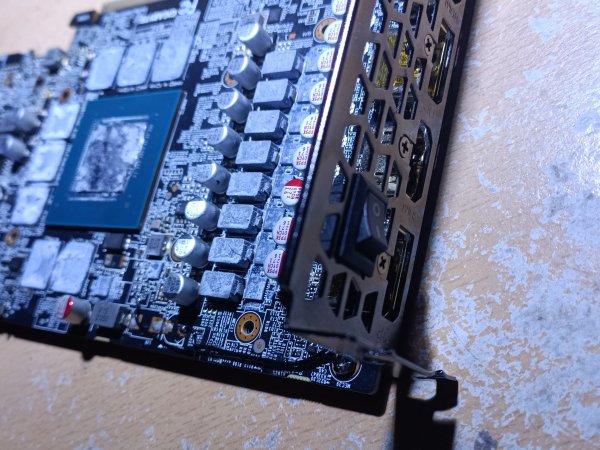
For those of you following along at home, you will need a set of eight Samsung K4ZAF325BM-HC16 GDDR6 memory modules. In this case, the memory modules were salvaged from an AMD RX6900XT with a defective core. Naturally, you will need to re-ball the chips. To help the process, [AssassinWarlord] bought a stencil from AliExpress, with a 3D-printed holder for the memory modules.

Continue reading “Double The VRAM Of An RTX 3070”

Size (and Units) Really Do Matter

We miss the slide rule. It isn’t so much that we liked getting an inexact answer using a physical moving object. But to successfully use a slide rule, you need to be able to roughly estimate the order of magnitude of your result. The slide rule’s computation of 2.2 divided by 8 is the same as it is for 22/8 or 220/0.08. You have to interpret the answer based on your sense of where the true answer lies. If you’ve ever had some kid at a fast food place enter the wrong numbers into a register and then hand you a ridiculous amount of change, you know what we mean.

Recent press reports highlighted a paper from Nvidia that claimed a data center consuming a gigawatt of power could require half a million tons of copper. If you aren’t an expert on datacenter power distribution and copper, you could take that number at face value. But as [Adam Button] reports, you should probably be suspicious of this number. It is almost certainly a typo. We wouldn’t be surprised if you click on the link and find it fixed, but it caused a big news splash before anyone noticed.

Thought Process

Best estimates of the total copper on the entire planet are about 6.3 billion metric tons. We’ve actually only found a fraction of that and mined even less. Of the 700 million metric tons of copper we actually have in circulation, there is a demand for about 28 million tons a year (some of which is met with recycling, so even less new copper is produced annually).

Simple math tells us that a single data center could, in a year, consume 1.7% of the global copper output. While that could be true, it seems suspicious on its face.

Digging further in, you’ll find the paper mentions 200kg per megawatt. So a gigawatt should be 200,000kg, which is, actually, only 200 metric tons. That’s a far cry from 500,000 tons. We suspect they were rounding up from the 440,000 pounds in 200 metric tons to “up to a half a million pounds,” and then flipped pounds to tons.

Continue reading “Size (and Units) Really Do Matter”

NVIDIA Drops Pascal Support On Linux, Causing Chaos On Arch Linux

It’s no surprise that NVIDIA is gradually dropping support for older videocards, with the Pascal (GTX 10xx) GPUs most recently getting axed. What’s more surprising is the terrible way that this is being handled by certain Linux distributions, with Arch Linux currently a prime example.

On these systems, updating the OS with a Pascal, Maxwell or similarly unsupported GPU will result in the new driver failing to load and thus the user getting kicked back to the CLI to try and sort things back out there. This issue is summarized by [Brodie Robertson] in a recent video.

Here the ‘solution’ is to switch to a legacy option that comes from the Arch User Repository (AUR), which feels somewhat sketchy. Worse is that using this legacy option breaks Steam as it relies on official NVIDIA dependencies, which requires an additional series of hacks to hopefully restore this functionality. Fortunately the Arch Wiki provides a starting point on what to do.

It’s also worth noting that this legacy driver on the AUR is being maintained by [ventureo] of the CachyOS project, whose efforts are the sole reason why these older NVIDIA cards are still supported at all on Linux with the official drivers. While there’s also the Nouveau driver, this is effectively a reverse-engineering project with all of the problems that come with such an effort, even if it may be ‘good enough’ for older GPUs.

Continue reading “NVIDIA Drops Pascal Support On Linux, Causing Chaos On Arch Linux”

Kubernetes Cluster Goes Mobile In Pet Carrier

There’s been a bit of a virtualization revolution going on for the last decade or so, where tools like Docker and LXC have made it possible to quickly deploy server applications without worrying much about dependency issues. Of course as these tools got adopted we needed more tools to scale them easily. Enter Kubernetes, a container orchestration platform that normally herds fleets of microservices in sprawling cloud architectures, but it turns out it’s perfectly happy running on a tiny computer stuffed in a cat carrier.

This was a build for the recent Kubecon in Atlanta, and the project’s creator [Justin] wanted it to have an AI angle to it since the core compute in the backpack is an NVIDIA DGX Spark. When someone scans the QR code, the backpack takes a picture and then runs it through a two-node cluster on the Spark running a local AI model that stylizes the picture and sends it back to the user. Only the AI workload runs on the Spark; [Justin] also is using a LattePanda to handle most of everything else rather than host everything on the Spark.

To get power for the mobile cluster [Justin] is using a small power bank, and with that it gets around three hours of use before it needs to be recharged. Originally it was planned to work on the WiFi at the conference as well but this was unreliable and he switched to using a USB tether to his phone. It was a big hit with the conference goers though, with people using it around every ten minutes while he had it on his back. Of course you don’t need a fancy NVIDIA product to run a portable kubernetes cluster. You can always use a few old phones to run one as well.

Continue reading “Kubernetes Cluster Goes Mobile In Pet Carrier”

This Week In Security: Perplexity V Cloudflare, GreedyBear, And HashiCorp

The Internet is fighting over whether robots.txt applies to AI agents. It all started when Cloudflare published a blog post, detailing what the company was seeing from Perplexity crawlers. Of course, automated web crawling is part of how the modern Internet works, and almost immediately after the first web crawler was written, one managed to DoS (Denial of Service) a web site back in 1994. And the robots.txt file was first designed.

Make no mistake, robots.txt on its own is nothing more than a polite request for someone else on the Internet to not index your site. The more aggressive approach is to add rules to a Web Application Firewall (WAF) that detects and blocks a web crawler based on the user-agent string and source IP address. Cloudflare makes the case that Perplexity is not only intentionally ignoring robots.txt, but also actively disguising their webcrawling traffic by using IP addresses outside their normal range for these requests.

This isn’t the first time Perplexity has landed in hot water over their web scraping, AI learning endeavors. But Perplexity has published a blog post, explaining that this is different!

And there’s genuinely an interesting argument to be made,that robots.txt is aimed at indexing and AI training traffic, and that agentic AI requests are a different category. Put simply, perplexity bots ignore robots.txt when a live user asks them to. Is that bad behavior, or what we should expect? This question will have to be settled as AI agents become more common.

Continue reading “This Week In Security: Perplexity V Cloudflare, GreedyBear, And HashiCorp”