VCF: 3D Printing In The 80s

The Vintage Computer Festival East is going down right now, and I’m surrounded by the height of technology from the 1970s and 80s. Oddly enough, Hackaday frequently covers another technology from the 80s, although you wouldn’t think of it as such. 3D printing was invented in the late 1980s, and since patents are only around for 20 years, this means 3D printing first became popular back in the 2000’s.

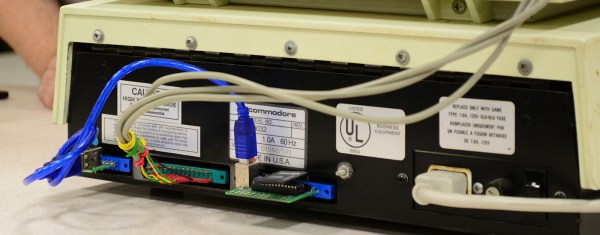
In the 1970s, the first personal computers came out of garages. In the early 2000s, the first 3D printers came out of workshops and hackerspaces. These parallels pose an interesting question – is it possible to build a 1980s-era 3D printer controlled by a contemporary computer? That was the focus of a talk from [Ethan Dicks] of the Columbus Idea Foundry this weekend at the Vintage Computer Festival.

Continue reading “VCF: 3D Printing In The 80s”

Ask Hackaday: Which Balaclava Is Best For Hacking?

At Hackaday, we’re tapped into Hacker Culture. This goes far beyond a choice of operating system (Arch Linux, or more correctly, ‘Arch GNU/Linux’, or as I’ve recently taken to calling it, ‘Arch GNU plus Linux’).  This culture infects every fiber of our soul, from music (DEF CON’s station on Soma FM), our choice in outerwear (black hoodies, duh), and our choice in laptops (covered in stickers). We all wear uniforms, although a gaggle of computer science and electronics nerds all wearing black t-shirts won’t tell you that. We all conform, whether we’re aware of it or not.

Despite a standardized uniform for this subculture, one small detail of this Hacker Uniform has remained unresolved for decades. Are one-hole or three-hole balaclavas best for hacking? Which balaclava is best for stealing bank accounts and hacking into NASA computers? What offers the best protection from precipitating ones and zeros in a real-life Matrix screensaver?

Continue reading “Ask Hackaday: Which Balaclava Is Best For Hacking?”

The Midwest RepRap Festival Spectacular

Every year, nestled between a swine auction and beef auction at the fairgrounds in Goshen, Indiana, the world’s greatest 3D-printing meetup happens. The Midwest RepRap Festival draws the greatest minds in 3D printing from around the world, with teams flying in from Prague, Oxford, and Hong Kong. This year was bigger than any other year. Over 1,000 people ventured forth into the sticks to attend this awesome festival dedicated to DIY printers.

What did we see this year? The PartDaddy, SeeMeCNC’s 18-foot-tall delta printer made an appearance. We saw a new extruder from E3D, and an announcement that Open Source filaments will soon be a reality. True color printing with a five filament CMYKW system is weird and cool. DIY resin printers using laser diodes and galvos are now a thing. An Easy Break Oven isn’t broken. Printers with an infinite build volume now exist, and it skirts around a MakerBot patent, too.

There was more to see at MRRF than a single weekend would allow. [Jason Kridner] from BeagleBone was there talking about the latest in fancy single-chip Linux computers. Hackerspaces were there talking about their coolest builds and doing the calculations necessary to strap model rocket engines to 3D printed rockets. A few local colleges sent teams out to talk about their efforts to bring additive manufacturing to their programs. YouTube personalities were there. Check out the rest of the goodies we saw below.

Continue reading “The Midwest RepRap Festival Spectacular”

Next Weekend: The Vintage Computer Festival East

Next weekend is the Vintage Computer Festival East in Wall, New Jersey. We’re going, and you should be there too.

The VCF East is the largest gathering of retrocomputing aficionados on the east coast. It’s three days of talks, exhibits, a flea market, and a pow-wow of the greatest minds buried under obsolete technology. No VCF is complete without a few talks, and this year is shaping up to be great. Keynotes will include [Bjarne Stroustrup], designer / implementor / inventor of C++. Computer historian [Bill Degnan] will give a review of 40 years of ‘appliance computers’, and [Tom Perera], Ph.D. will be giving a talk on the Enigma machine.

The exhibits at VCF are always the star of the show, and this year is no different. Highlights include mechanical computers, the finest from Silicon Graphics, and a version of Unix published by Microsoft. The individual exhibits are always great; last year the world’s first digital camera made an appearance. If you’re in the area, this isn’t an event to miss. VCF is going down at InfoAge, a science center at the former Camp Evans — a military installation that is best described as, ‘DARPA before World War II’.

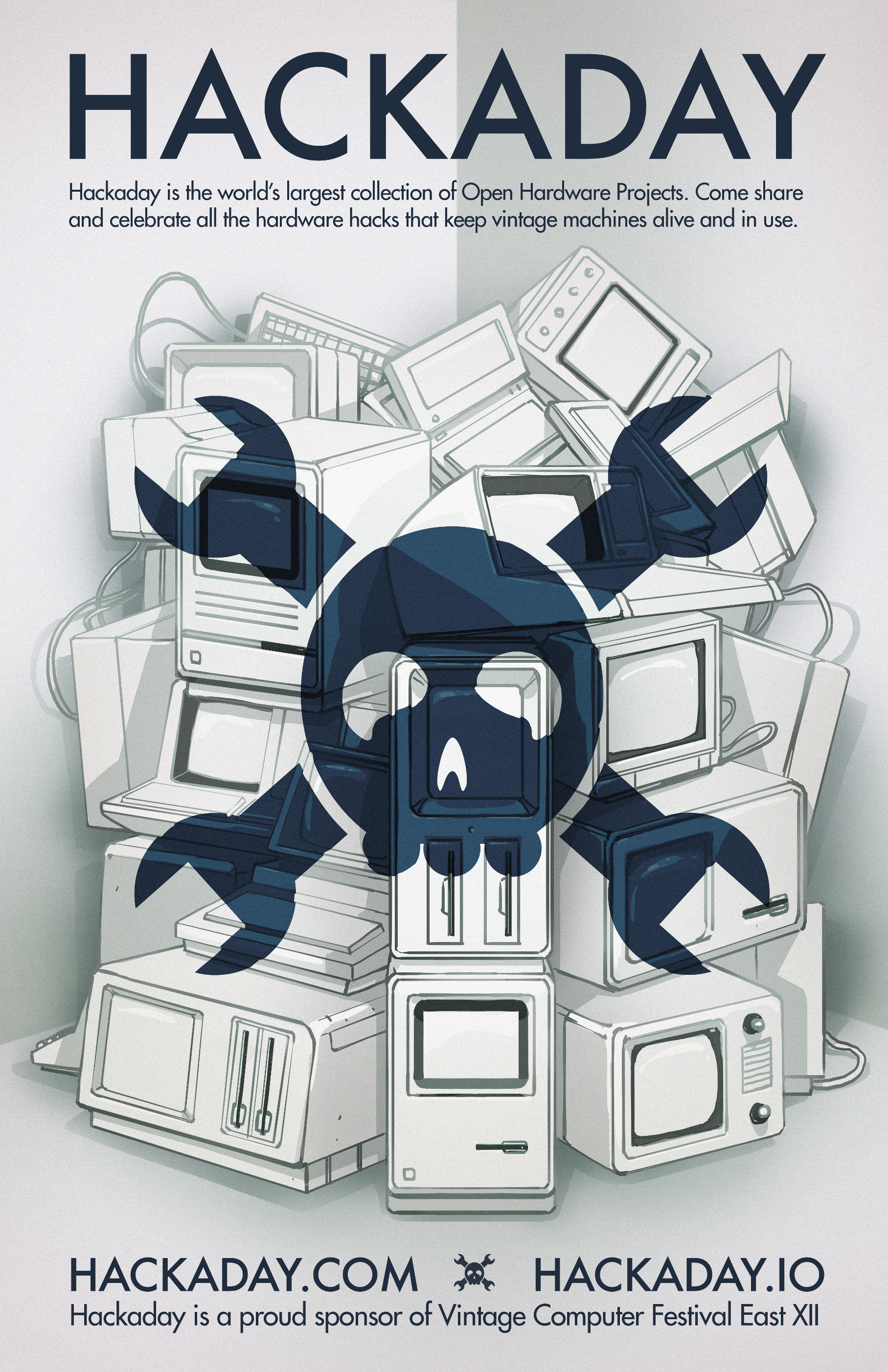
Hackaday is proud to once again sponsor VCF East. This has been going on for a couple of years now and our Art Director, [Joe Kim] has created some incredible art as part of the sponsorship. Click on the thumbnail of this year’s art to embiggen. The VCF West art from last year is a stunning take on the Macintosh and last year’s VCF East art reflected the retro hackathon we sponsored.

MRRF 17: A Working MakerBot Cupcake

The Midwest RepRap Festival is the best place to go if you want to see the latest in desktop 3D printing. This weekend, we saw full-color 3D printers, a printer with an infinite build volume, new extruders, a fantastic development in the pursuit of Open Source filament, and a whole bunch of D-bots. If you want the bleeding edge in 3D printing, you’re going to Goshen, Indiana.

Of course, it wasn’t always like this. In 2009, MakerBot released the Cupcake, a tiny printer that ushered in the era of democratized 3D printing. The Cupcake was a primitive machine, but it existed, it was open source, and it was cheap – under $500 if you bought it at the right time. This was the printer that brought customized plastic parts to the masses, and even today no hackerspace is complete without an unused Cupcake or Thing-O-Matic sitting in the corner.

The MakerBot Cupcake has not aged well. This should be expected for a technology that is advancing as quickly as 3D printing, but today it’s rare to see a working first generation MakerBot. Not only was the Cupcake limited by the technology available to hackers in 2009, there are some pretty poor design choices in these printers. There’s a reason that old plywood MakerBot in your hackerspace isn’t used anymore – it’s probably broken.

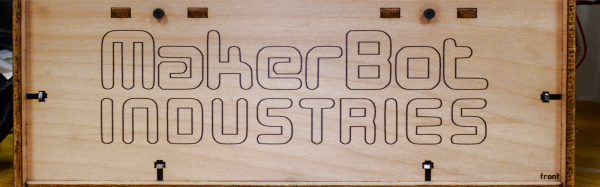
This year at MRRF, [Ryan Branch] of River City Labs brought out his space’s MakerBot Cupcake, serial number 1515 of 2,625 total Cupcakes ever made. He got his Cupcake to print a test cube. If you’re at all familiar with the Cupcake, yes, this is a hack. It’s a miracle these things ever worked in the first place.

Continue reading “MRRF 17: A Working MakerBot Cupcake”

MRRF 17: Laser Resin Printers

The Midwest RepRap Festival is the best 3D printer con on the planet. In the middle of Indiana, you’ll find the latest advances for CNC hot glue guns and the processes that make squirting filament machines better, more accurate, and more efficient. There’s more to 3D printing than just filament-based machines, though, and for the last few MRRFs we’ve been taking a look at resin-based machines.

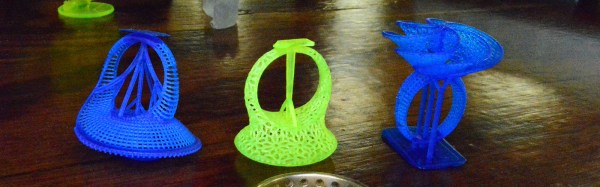
While most of the current crop of resin printers use either DLP projectors or LCDs and a big, bright backlight [Mark Peng]’s Moai printer uses a 150 mW laser diode and galvos. This is somewhat rare in the world of desktop 3D printers, thanks in no small part to the ugliness between Formlabs and 3D Systems. Still, it’s a printer that looks fantastic and produces prints that are far beyond what’s possible with a filament-based machine.

Continue reading “MRRF 17: Laser Resin Printers”

Hackaday Links: March 26, 2017

PoC||GTFO 14 is now out. It’s a 40 MB PDF that’s also a Nintendo Entertainment System ROM, and a Zip archive. Pastor Laphroaig Screams High Five To The Heavens As The Whole World Goes Under. Download this, but don’t link – host it yourself. Bitrot will be the end of us all.

[Photonicinduction] is back. The guy best known for not starting an electrical fire in his attic has been working through some stuff recently. He got married, went to India, and he’s going to try to blow a five thousand amp fuse. Good on him.

There’s a certain segment of the Internet that believes the Raspberry Pi Zero doesn’t exist. The logic goes something like this: because I can’t buy a Ferrari right now, Ferraris don’t exist. Now there’s a new and improved website that checks if the Pi Zero and Pi Zero W are in stock: thepilocator.com. It checks a dozen or so online stores for the Pi Zero and Pi Zero W. Guess what? They’re mostly in stock.

[bxcounter] built a PC case and holy crap this thing is incredible. This case is made out of Paulownia wood, and is made up out of fifty pieces held together with magnets. This thing is hand-carved and looks fantastic. Inside is a Mini-ITX motherboard, an i3, a Gigabyte ITX-sized 1060, and an SSD. It’s no powerhouse, but then again it’s not overkill, either. This is a fantastic addition to any battlestation.

As most hackerspaces do, the Omaha Maker Group had a storage problem. Previously, members used plastic totes someone picked up as surplus, but these totes were in short supply. Banker’s Boxes are a better idea, but how to store them? A box case. This ‘bookcase for boxes’ holds 21 standard Banker’s Boxes and only uses two full sheets of MDF in its construction.