Hackaday Prize Entry: You Have No Free Will

The concept of free will is the perfect example of human arrogance ever conceived. If a gas molecule collides with another gas molecule, simple physics can determine the momentum of the first gas molecule, the kinetic energy imparted to the second gas molecule, and the resulting trajectories of both molecule. Chemical reactions are likewise easy to calculate. Scale a system up to something the size of a human brain, and you have a perfectly predictable system. It’s complex, yes, but predetermined since the beginning of time. You are without moral agency, or any independent thought of your own. You are merely a passive observer in a vast, cold, uncaring universe. You are cursed with the awareness of this fact.

For his Hackaday Prize project, [Patrick Glover] is proving we don’t have free will. Will he win the Hackaday Prize? That’s up for the cold machinations of fate to decide.

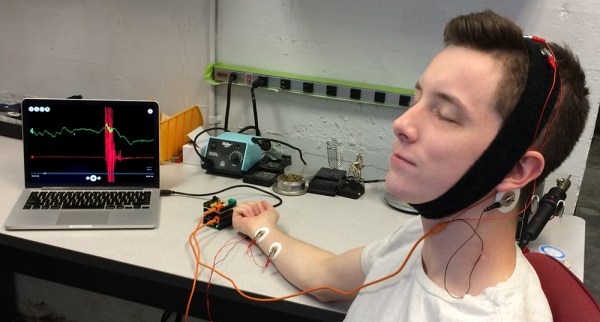
In the 1980s, psychologist [Benjamin Libet] performed an experiment. He connected an EEG to a subject’s arm and head, and asked them to flex their wrist whenever they felt like it. It turns out, an area of your brain generates an EEG potential a significant time before the subject is aware of deciding to flex their wrist. This is a foundational study in the physiology of consciousness, and direct evidence an IRB is okay with giving subjects an existential crisis.

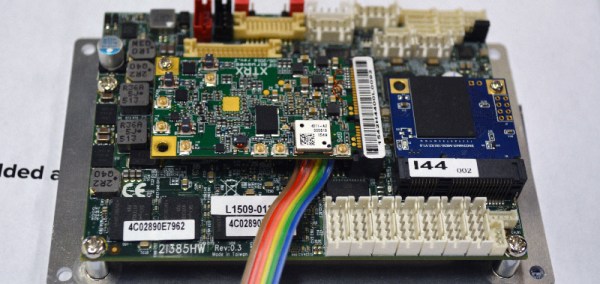
[Patrick] is in the process of replicating the [Libet] study. Unlike the 1980s experiment, [Patrick] has access to handy Arduino shields and MATLAB, making the experimental setup very easy. The results, of course, will be the subject of philosophical debates continuing until the heat death of the universe, but we already knew that, didn’t we?

Check out the comments below for objectors predictably saying they do, in fact, have free will.

Hackaday Prize Entry: Reflectance Transformation Imaging

Reflectance transformation imaging (RTI), or polynomial texture mapping, is a very interesting imaging technique that allows you to capture all the detail of an object. It’s used to take finely detailed pictures of scrawlings on cave walls in archeology, capture every detail of a coin for coin collectors, and to measure the very slight changes in a work of art.

RTI does this by shining light over an object at very particular angles and then using image processing to produce the best image. Despite being only a few LEDs and a bit of software, RTI systems are outrageously expensive. For his Hackaday Prize entry, [leszekmp] is building his own RTI system. It’ll cost about $600, making this the best way for Citizen Scientists to capture the best image possible.

RTI is simply shining light onto an object and taking synchronized pictures of the object from directly above. As you can imagine, putting LEDs in a dome is the obvious solution to this problem, and already [leszekmp] has made three systems that works well on domes up to a meter in diameter. The electronics are as simple as an Arduino shield and a few MOSFETS, and the dome itself is an off the shelf component. It’s a great project that enables better photography, and one of the simplest and best entries we’ve seen for The Hackaday Prize.

The Problem With Software Defined Radio

There’s a problem with software defined radio. It’s not that everyone needs to re-learn what TEMPEST shielding is, and it’s not that Bluetooth is horribly broken. SDR’s biggest problem is one of bandwidth and processing. With a simple USB TV Tuner, you can listen in on aircraft, grab Landsat images from hundreds of miles up, or sniff the low-power radios used in Internet of Things things. What you can’t do is make your own WiFi adapter, and you can’t create your own LTE wireless network. This is simply a problem of getting bits from the air to a computer for processing.

At HOPE last weekend, the folks behind the very capable LimeSDR and a new company working with Lime’s hardware laid out the possibilities of what software defined radio can do if you make a link to a computer very fast, and add some processing on the SDR itself.

Continue reading “The Problem With Software Defined Radio”

Hackaday Prize Entry: Profiling Underwater Light

The goal for the Citizen Science portion of the Hackaday Prize is to empower people to create their own devices to perform their own analyses For [Adam]’s project, he’s designing a device that measures the health of waterways simply by looking at the light availability through the water column. It’s called PULSE, the Profiling Underwater Light SEnsor, and is able to monitor changes that are caused by algal blooms, suspended sediments, or sewer runoff.

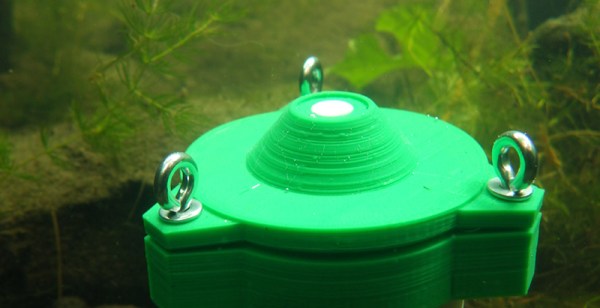
The design of PULSE is a small electronic depth charge that can be lowered into a water column from anything between a research vessel to a kayak. On the top of this sinkable tube is a sensor to measure photosynthetically active radiation (PAR). This sensor provides data on light irradiance through the water column and gives a great insight into the health of photosynthesis, marine plant life, and ultimately the health of any aquatic environment.

Measuring the light available for photosynthesis through a water column is great, but PULSE isn’t a one trick pony. On the bottom of the aquatic probe are three sensors designed to measure photosynthesis, dissolved organic matter, and turbidity. These sensors are really just a few LEDs and photodiodes, proving just how much science you can do with simple tools.

The goal of the Citizen Science portion of the Hackaday Prize is to put scientific discovery in the hands of everyone. PULSE is a great example of this: it’s a relatively simple device that can be thrown over the side of a boat, lowered to the bottom or a lake, and hoisted back up again. It’s inexpensive to build, but still provides great data. That’s remarkable, and an excellent example of what we’re looking for in the Hackaday Prize.

New Chip Alert: RTL8710, A Cheaper ESP8266 Competitor

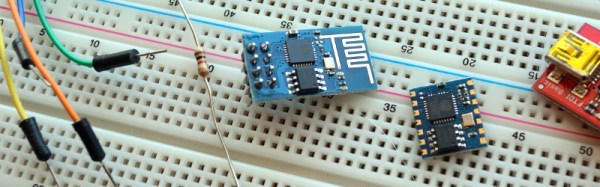
Almost exactly two years ago, shocking news thundered across the electronics blogosphere. There was a new WiFi module on the block. It was called the ESP8266, a simple serial device capable of taking care of an 802.11 network and a WiFi stack, giving any project with a microcontroller access to the Internet. Earlier modules to connect microcontrollers were sufficient for the task, but nothing could beat the ESP8266 on price.

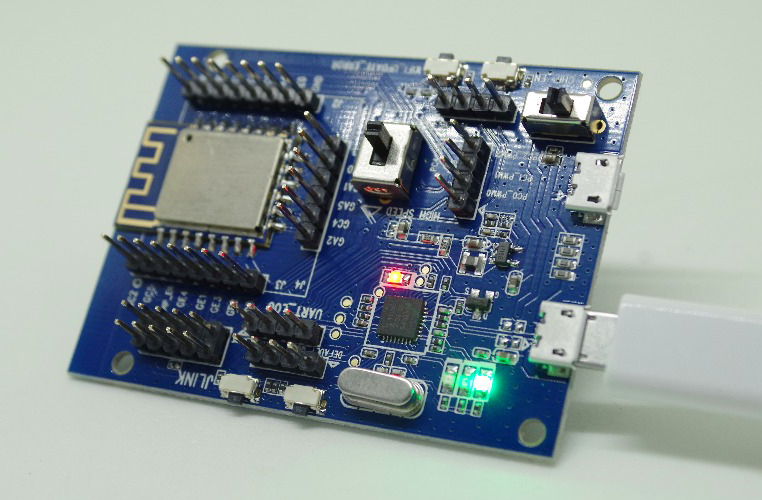
The RTL8710 dev kit
The RTL8710 dev kit

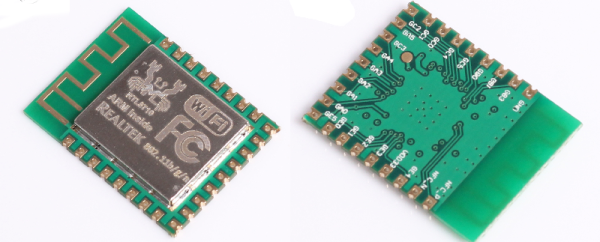
Now, there’s a new module that’s even cheaper and more powerful than the ESP8266, and just like all of our favorite parts from China, it inexplicably shows up on eBay and AliExpress before anywhere else. It’s the Realtek RTL8710, available on eBay, on AliExpress, and elsewhere around the web for about $1.50 per device. There’s also a dev kit for the device featuring breakouts, an additional microcontroller, and a few switches and buttons for about $15.

As you would expect, there is zero English-language data available about the RTL8710, everything is in Chinese. There is a forum of sorts going over this new chip, and the Google Translatrix is good enough to glean a little bit of info about the new chip.

The RTL8710 features an ARM processor clocked at 166MHz. Stock, this module is running FreeRTOS. There’s 1MB of Flash, 48k of RAM available to the user, up to 21 GPIOs, 3 I2C, 4 PWM pins, and 2 PCM. This module also comes with an FCC logo, but I can’t find anything on the FCC website about this module.

If anything, the Realtek RTL8710 isn’t meant to be a competitor to the ESP8266. While extremely popular and still very useful, the ‘next gen’ ESP32 is due to be released in a month or so, and with the exception of Bluetooth on the ESP32, this Realtek module should match its capabilities quite well. Whether anyone can get an English datasheet is another matter, but if history is any indication a few English language RTL8710 forums will pop up a few hours after this is posted.

Thanks [sabas] for sending this in

DEF CON Meetup At The Grave Of James T. Kirk

DEF CON is just around the corner, and that means in just a few days thousands of hardware hackers will be wandering around the casinos in Vegas. Yes, in a mere handful of hours, the tech literati will be accosted by the dead, disaffected eyes of dealers and the crass commercialization of every culture in humanity’s recorded history. The light of god does not penetrate mirrored ceilings. Vegas is terrible, it’ll be 120ºF outside, but at least there’s cool stuff happening Thursday through Sunday.

Hackaday is going to be there, but we really don’t want to spend the entire weekend walking around casinos. That’s why we’re hosting a meetup at the most unlikely place possible: Veridian III, the site of the battle between the Duras sisters and the Enterprise, the crash site of NCC-1701-D, and the final resting place of Admiral James Tiberius Kirk.

We’ll be visiting Veridian III at the Valley of Fire State Park on Wednesday, August 3rd, starting at 1pm. It’s about an hour north of Vegas. As you would expect, hats, sunscreen, good shoes, and a supply of water that could be categorized as “survivalist” are a good idea. Hackaday will be at the visitor center at 1PM, and after a half hour or so, the entire meetup will drive a few miles north to cooler looking rocks.

If you want an FAQ, here you go:

  • What’s this all about, then?
    • Drive out to the desert because cool rocks.
  • No, really, what’s up?
    • Watch Star Trek: Generations. We’re going to the filming location of Soren’s launch site on Veridian III. This is where Kirk died (on a bridge), and where he was buried by Picard.
  • Where and when?
    • Valley of Fire State Park. Here’s the Google Map. 1PM, August 3rd. It’s about an hour north of Vegas. We’re going to meet at the visitor center around 1pm. Around 1:30, we’re going a few miles north to the White Dome trailhead. Look for the Hackaday Flag. It’ll be flying on a PVC pipe taped to a car.
  • Why are you going to the desert, in August, in the middle of the day, with no plan whatsoever?
    • Because Benchoff.
  • Why would extinguishing a star alter its gravity? The mass of the star would still be there, which means the Nexus ribbon wouldn’t be deflected at all. Is this crazy? What’s going on here?
    • Because Rick Berman.
  • Why weren’t there two Picards after Picard and Kirk returned from the Nexus?
    • Rick Berman.
  • Is this really the grave site of James T. Kirk?
    • No, because Kirk was resurrected by the Borg and his katra restored by Romulans.

This meetup will be a continuation of a series of Hackaday meetups in the middle of nowhere. Earlier, we had a gathering at the childhood home of the worst president of the United States of America. That meetup was a roaring success, with people travelling from surprisingly far away. If you’re unlucky enough to be in Vegas for DEF CON a day early, this is one of the weirdest meetups you could possibly attend.

By the way, if enough people attend, it will serve as proof we can do a meetup anywhere. I have my eyes on Spillville, Iowa, Oregon’s House of Mystery, and one of the remaining Blockbuster stores in El Paso. If you support this idea, come on out.

Ask Hackaday: Is The ESP8266 5V Tolerant?

The ESP8266 is the reigning WiFi wonderchip, quickly securing its reputation as the go-to platform for an entire ecosystem of wireless devices. There’s nothing that beats the ESP8266 on a capability vs. price comparison, and this tiny chip is even finding its way into commercial products. It’s also a fantastic device for the hardware tinkerer, leading to thousands of homebrew projects revolving around this tiny magical device.

In every technical document, summary, and description of the ESP8266, the ESP8266 is said to be a 3.3V part. While we’re well into the age of 3.3V logic, there are still an incredible number of boards and hardware that still operate using 5V logic. Over on the Hackaday.io stack, [Radomir] is questioning this basic assumption. He’s wondering if the ESP8266 is 5V tolerant after all. If it is, great. We don’t need level converters, and interfacing the ESP to USB TTL serial adapters becomes much easier. Yes, you’ll still need to use a regulator if the rest of your project is running at 5V, but if the pins are 5V tolerant, interfacing the ESP8266 with a variety of hardware becomes very easy.

[Radomir]’s evidence for the possibility of 5V tolerant inputs comes from a slight difference in the official datasheet from Espressif, and the datasheet translated by the community before Espressif realized how many of these chips they were going to sell.

The best evidence of 5V tolerant pins might come from real-world experience — if you can drive a pin with 5V for months on end without it failing, there might be something to this claim. It’s not definitive, though; just because a device will work with 5V input pins for a few months doesn’t mean it won’t fail in the future. So far a few people have spoken up and presented ESPs directly connected to the 5V pin of an Arduino that still work after months of service. If this is evidence of 5V tolerant design or simply luck is another matter entirely.

While the official datasheet from Espressif lists a maximum VIH of 3.3V, maximum specs rarely are true maximums — you can always push a part harder without things flying apart at the seams. Unfortunately, unless we hear something from the engineers at Espressif, we won’t know if the ESP8266 was designed to be 5V tolerant, if it can handle 5V signals reliably, or if 5V signals are a really good way to kill a chip eventually.

Lucky for us — and this brings us to the entire point of an Ask Hackaday column — a few Espressif engineers read Hackaday. They’re welcome to pseudonymously chime in below along with the rest of the peanut gallery. Failing that, the ESP8266 has been decapped; are there any die inspection wizards who can back up a claim of 5V tolerance for the GPIO? We’d also be interested in hearing any ideas for stress testing pin tolerance.