Broadcasting Bluetooth Beacons With Bubbles

Bluetooth beacons have only been around for a few years, but the draw is incredible. With Bluetooth beacons, your phone is location aware, even with location services are turned off. They’re seen in fast food joints, big box retailers, and anywhere else there’s a dollar to be made. [Nemik] has been working on a home automation project, and came up with a use for Bluetooth beacons that might actually be useful. It’s a WiFi-based Bluetooth beacon notifier that scans the area for beacons and forwards them to an MQTT server.

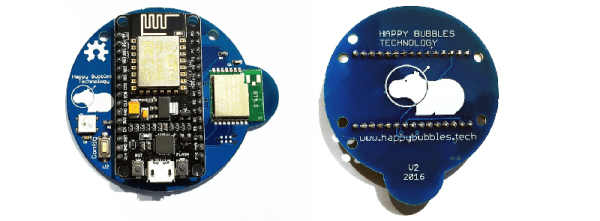
[Nemik]’s ‘Presence Detector’ for Bluetooth advertisements is actually a surprisingly simple build, leveraging the unbelievably cheap wireless modules available to us today. The WiFi side of the equation is a NodeMCU v2 ESP8266 dev board that provides all the smarts for the device via Lua scripting. The Bluetooth side of the board is a PTR5518 module that has a nRF51822 tucked inside. With the right configuration, this small board will listen for BLE advertisements and forward them to an MQTT server where they can be seen by anyone on the network.

[Nemik] is selling these beacon to WiFi bridges, but in the spirit of Open Hardware, he’s also giving away the designs and firmware so you can make your own. If you ever have an abundance of Bluetooth beacons sitting around and want to make a beacons of Things thing, this is the build for it.

3D Printering: Makerbot’s Class Action Suit Dismissed

This time last year, Stratasys, parent company of Makerbot, was implicated in a class action suit. Investors claimed Stratasys violated securities laws, and overstated both the performance of the 5th generation of Makerbot printers and the performance of the company itself. Court docs received by Adafruit have revealed this case has been dismissed with prejudice. Makerbot won this one.

The case presented by Stratasys investors relied on two obvious facts. First, the price of Stratasys shares fell far beyond expectations. Second, the extruder for the 5th generation of Makerbot printers – the ‘Smart Extruder’ – was terrible. No one can reasonably dispute these claims; shares of SYSS fell from $120 in September of 2014 to $30 in September of 2015. With many returns to handle, Makerbot quickly redesigned the Smart Extruder.

Both of these indisputable facts are in stark contrast to statements made by Stratasys and Makerbot at the time. In a press release for the 4th quarter 2013 financial results, Stratasys’ expected sales to grow at least 25% over 2013 and stated it was experiencing “strong sales” of its desktop 3D printer. Concerning the Smart Extruder, Makerbot stated this new feature of the 5th generation Makerbots would make them easy to use, and “define the new standard for quality and reliability.”

The facts of this case are not in dispute – Stratasys did not see the growth they expected in late 2013. The Smart Extruder certainly did not make printers more reliable. These facts, however, are not sufficient to violate securities law.  In a wonderful legal turn of phrase, the judge deciding this case called the statements about the quality of the 5th generation Makerbots consisted of, “non-actionable puffery,” and a ‘statement so vague and such obvious hyperbole than no reasonable investor would rely on them.’

Statements made by Stratasys on their financial performance were also found not to be sufficient to violate securities laws. Stratasys did make several statements about negative performance in late 2014 and 2015, and positive statements made earlier did not have an intent to deceive investors.

This is good news for Makerbot. The claims brought by investors in this case had little merit. The case cannot be appealed, and Stratasys is no longer facing a class action suit. Does this news actually matter? Not really; Makerbot is a dead man walking, and 2016 sales will be at levels not seen since 2010 or 2011.

The consumer 3D printing industry is booming, despite the Makerbot bellwether though.

A Jailbreak For Every Kindle

[Geekmaster] wrote in to tell us about a new hack for the Amazon Kindle. It’s a jailbreak. Universal jailbreak for almost every eInk Kindle eReader eOut eThere.

This jailbreak is a pure software jailbreak for the Kindle Paperwhite 2, the Kindle Paperwhite 3, Kindle Touch, Kindle Voyage, and Kindle Oasis. If you’re keeping track, that’s any 6th, 7th, or 8th generation device, running any firmware version. Already the jailbreak has been tested by over one thousand people, after the cloud served up half a Terabyte of jailbreak image downloads. That’s extraordinarily popular for a device that hasn’t seen much action of late.

Several years ago, [Geekmaster] made a name for himself – and for [NiLuJe], [KNC1], and other developers over at the Mobileread forums – for jailbreaking the Kindle Paperwhite. This jailbreak was, and is extremely simple; just upload a file to the root directory, restart, and the Kindle is jailbroken. The latest development extends this to nearly all Kindle models, while still being as easy to deploy as the original hack from four years ago.

If you’re looking for something to do with a neat jailbroken device with an eInk screen, they make a great serial consolethermostat, and wallpaper.

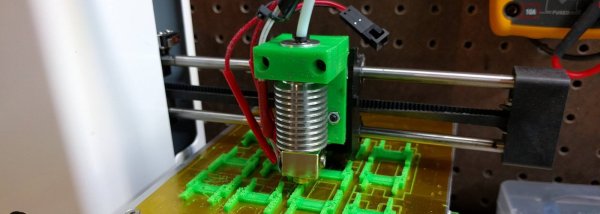
Modding The Monoprice MP Mini Printer

Two weeks after my review of the MP Select Mini 3D printer, Monoprice’s own website has said this printer has been out of stock, in stock, and out of stock again several times. This almost unimaginably cheap 3D printer is proving to be exceptionally popular, and is in my opinion, a game-changing machine for the entire world of 3D printing.

With the popularity of this cheap printer that’s more than halfway decent, there are bound to be improvements. Those of us who have any experience with 3D printers aren’t going to be satisfied with a machine with any shortcomings, especially if it means we can print enhancements and mods for our printers.

Below are the best mods currently available for this exceptional printer. Obvious problems with the printer are corrected, and it’s made a little more robust. There are mods to add a glass build plate, and a few people are even messing around with the firmware on this machine. Consider this volume one of the MP Mini hacks; with a cheap printer that’s actually good, there are bound to be more improvements.

Continue reading “Modding The Monoprice MP Mini Printer”

Using The Vive’s Lighthouse With DIY Electronics

The HTC Vive is the clear winner of the oncoming VR war, and is ready to enter the hallowed halls of beloved consumer electronics behind the Apple Watch, Smart Home devices, the 3Com Audrey, and Microsoft’s MSN TV. This means there’s going to be a lot of Vives on the secondhand market very soon, opening the doors to some interesting repurposing of some very cool hardware.

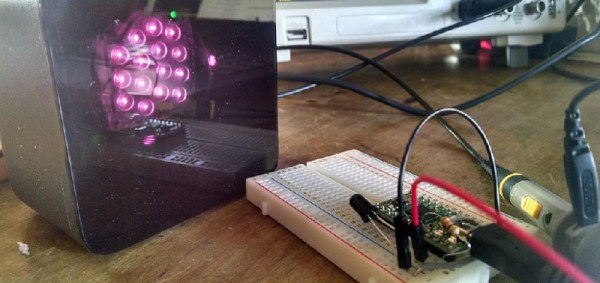
[Trammell Hudson] has been messing around with the Vive’s Lighthouse – the IR emitting cube that gives the Vive its sense of direction. There’s nothing really special about this simple box, and it can indeed be used to give any microcontroller project an orientation sensor.

The Vive’s Lighthouse is an exceptionally cool piece of tech that uses multiple scanning IR laser diodes and a bank of LEDs that allows the Vive to sense its own orientation. It does this by alternately blinking and scanning lasers from left to right and top to bottom. The relevant measurements that can be determined from two Lighthouses are the horizontal angle from the first lighthouse, the vertical angle from the first lighthouse, and the horizontal angle from the second lighthouse. That’s all you need to orient the Vive in 3D space.

To get a simple microcontroller to do the same trick, [Trammell] is using a fast phototransistor with a 120° field of view. This setup only works out to about a meter away from the Lighthouses, but that’s enough for testing.

[Trammell] is working on a Lighthouse library for the Arduino and ESP8266, and so far, everything works. He’s able to get the angle of a breadboard to a Lighthouse with just a little bit of code. This is a great enabling build that is going to allow a lot of people to build some very cool stuff, and we can’t wait to see what happens next.

The Future Of Eagle CAD

Last week, Autodesk announced their purchase of CadSoft Eagle, one of the most popular software packages for electronic design automation and PCB layout.

Eagle has been around for nearly thirty years, and has evolved to become the standard PCB design package for electronic hobbyists, students, and engineering firms lead by someone who learned PCB design with Eagle. The reason for this is simple: it’s good enough for most simple designs, and there is a free version of Eagle. The only comparable Open Source alternative is KiCad, which doesn’t have nearly as many dedicated followers as Eagle.  Eagle, for better or worse, is a standard, and Open Source companies from  Sparkfun to Adafruit use it religiously and have created high-quality libraries of parts and multiple tutorials

I had the chance to talk with [Matt Berggren], former Hackaday overlord who is currently serving as the Director of Autodesk Circuits. He is the person ultimately responsible for all of Autodesk’s electronic design products, from Tinkercad, 123D, Ecad.io, and project Wire, the engine behind Voxel8, Autodesk’s 3D printer that also prints electronics. [Matt] is now the master of Eagle, and ultimately will decide what will change, what stays the same, and the development path for Eagle.

Continue reading “The Future Of Eagle CAD”

Data Exfiltration With Broadcast Radio And CD-ROM Drives

The first music played on personal computers didn’t come out of fancy audio cards, or even a DAC. the first audio system in a personal computer was simply holding an AM radio up to the case and blinking address pins furiously. This worked wonderfully for homebrew computers where EMC compliance hadn’t even become an afterthought, but the technique still works today. [Chris] is playing music on the radio by sending bits over the system bus without using any wires at all.

[Chris]’ code is based on the earlier work of [fulldecent], and works pretty much the same. To play a sound over the radio, the code simply writes to a location in memory when the waveform should be high, and doesn’t when the waveform is low.

Of course the ability to exfiltrate information over an airgap has a few more nefarious purposes, but [Chris] also has another way of doing just that which is undefeatable by a TEMPEST shielded computer. He can send one bit at a time by opening and closing a CD-ROM drive, capturing these bits with a webcam. Is it useful? It’s hard to imagine how this setup could ever capture any valuable data, but it is a proof of concept.